

Путеводитель по линиям продольной резки: Прецизионная обработка металла для производителей
Three months ago, a Wisconsin automotive parts supplier called us about a quality problem. Their decade-old slitting line couldn’t maintain consistent strip widths on mixed-gauge galvanized steel, causing 8% rejection rates downstream. Worse, they were trimming 4.2% of coil width as waste—which at 15,000 tons annual volume meant $1.6 million literally going into scrap bins.
After upgrading to servo-controlled slitting with integrated tension management, their edge trim dropped to 1.8% and rejections fell below 2%. The equipment paid for itself in 18 months, but here’s what matters more: they’re now accepting orders they previously had to decline because they couldn’t guarantee the tolerances.
That’s what precision slitting equipment actually does—it transforms what your facility can manufacture, not just how efficiently you process material. MaxDoMachine has spent two decades helping manufacturers understand this difference, and this guide explains the engineering principles that separate productive slitting lines from expensive machinery that underperforms.
What Actually Happens Inside a Slitting Line
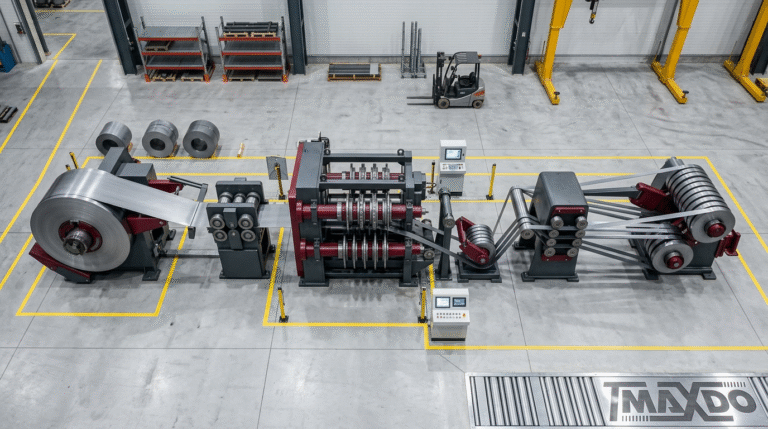
Strip a slitting line down to fundamentals and you’re looking at controlled longitudinal cutting of coiled metal. A 20-ton master coil enters one end as a single wide strip and exits as multiple narrower coils with dimensional accuracy that determines whether your customers accept or reject the material.
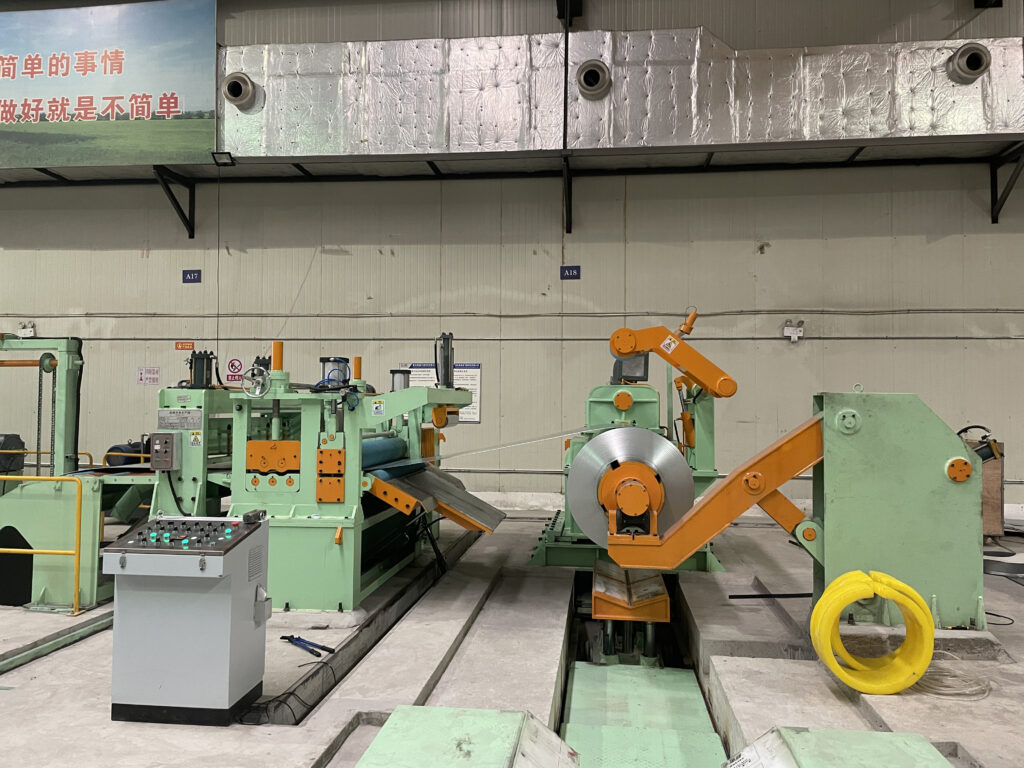
The physics sounds straightforward until you consider what happens at 150 meters per minute with material thickness varying 0.05mm within a single coil. Rotary knives must maintain precise clearances while compensating for coil diameter changes, material property variations, and thermal expansion from friction heating. Tension control systems apply 5-20 tons of force that must adjust within milliseconds or you’ll see camber defects that render strips unusable for precision applications.
Modern slitting lines handle this complexity through servo-driven systems that make thousands of micro-adjustments per second. The MD-850 precision slitting machine maintains ±0.1mm accuracy across 300-820mm widths by monitoring blade position, material thickness, processing speed, and tension zones continuously. When thickness increases mid-coil, servo motors adjust blade penetration automatically to maintain consistent edge quality—something mechanical systems simply can’t do.
Material enters through mandrel-based uncoilers that expand hydraulically to grip 508mm or 610mm inner diameters. Bridle rolls and loop accumulators eliminate slack while applying the entry tension that prevents telescoping during unwinding. This initial tension zone matters more than most operators realize—improper tension here propagates through the entire line, causing downstream quality problems that seem unrelated to the entry section.
Where Slitting Lines Actually Make Money
Construction markets consume massive volumes of slit galvanized steel for HVAC ductwork and roofing profiles. These applications don’t demand aerospace tolerances, but they absolutely require consistency—when a fabricator sets up equipment for 305mm strips, receiving material that varies between 304.5mm and 305.5mm causes fitting problems during installation.
Automotive suppliers face tighter constraints. Chassis reinforcements and structural components require width tolerances within ±0.1mm because subsequent stamping operations depend on precise material positioning. A major parts manufacturer processing 15,000 tons annually achieved 12% yield improvement specifically by tightening width control—the dimensional precision eliminated secondary trimming operations that were consuming both material and production time.
Electronics manufacturing pushes slitting capabilities to their limits with ultra-thin aluminum for circuit boards and specialty copper alloys for connector strips. These applications process materials down to 0.1mm thickness at widths under 50mm, where surface finish and edge quality directly affect electrical performance. Traditional mechanical slitting systems leave micro-burrs that cause short circuits; precision slitting with optimized blade geometry produces burr-free edges ready for immediate use.
The packaging industry represents volume opportunities—can stock production consumes enormous quantities of precisely slit aluminum and tin-plated steel. While individual tolerances may be less demanding than automotive applications, the combination of thin gauges (0.15-0.3mm), high speeds (200+ meters/minute), and zero defect requirements creates its own challenges.
Solar panel manufacturing demands copper strips with specific width tolerances and surface conditions for interconnect wiring. A renewable energy supplier processing photovoltaic materials found that optimizing their slitting parameters improved downstream welding success rates by 18%—the better edge quality from precision slitting reduced joint failures during panel assembly.
Engineering Principles That Determine Performance
Blade geometry sounds like a detail until you understand its impact on yield. Contemporary slitting operations use circular knives with servo-driven positioning that maintains clearances throughout production runs measured in hundreds of tons. Research from metallurgical institutes shows optimal blade penetration of 8-12% of material thickness, with side clearances at 5-8% of thickness.
These aren’t arbitrary numbers. Insufficient penetration produces ragged edges requiring secondary deburring operations. Excessive penetration accelerates blade wear while creating work-hardening zones along cut edges that cause problems during subsequent forming operations. The optimal range depends on material type, thickness, and hardness—which is why advanced systems monitor cutting forces in real-time and adjust blade position automatically.
Multi-zone tension management prevents the camber defects that waste 10-20% of processed strips in facilities using conventional pneumatic control. Servo-driven dancer roll systems respond within milliseconds to material property variations, coil diameter changes, and speed adjustments. This eliminates the tension spikes that cause dimensional inconsistencies and edge damage inherent to slower pneumatic systems.
A regional steel service center discovered this principle after analyzing their quality data. Camber-related rejections consumed 8% of production using their legacy pneumatic tension control. After upgrading to servo-driven multi-zone management, rejections dropped below 2%—the $200,000 annual savings in reduced scrap justified their equipment investment in under 24 months.
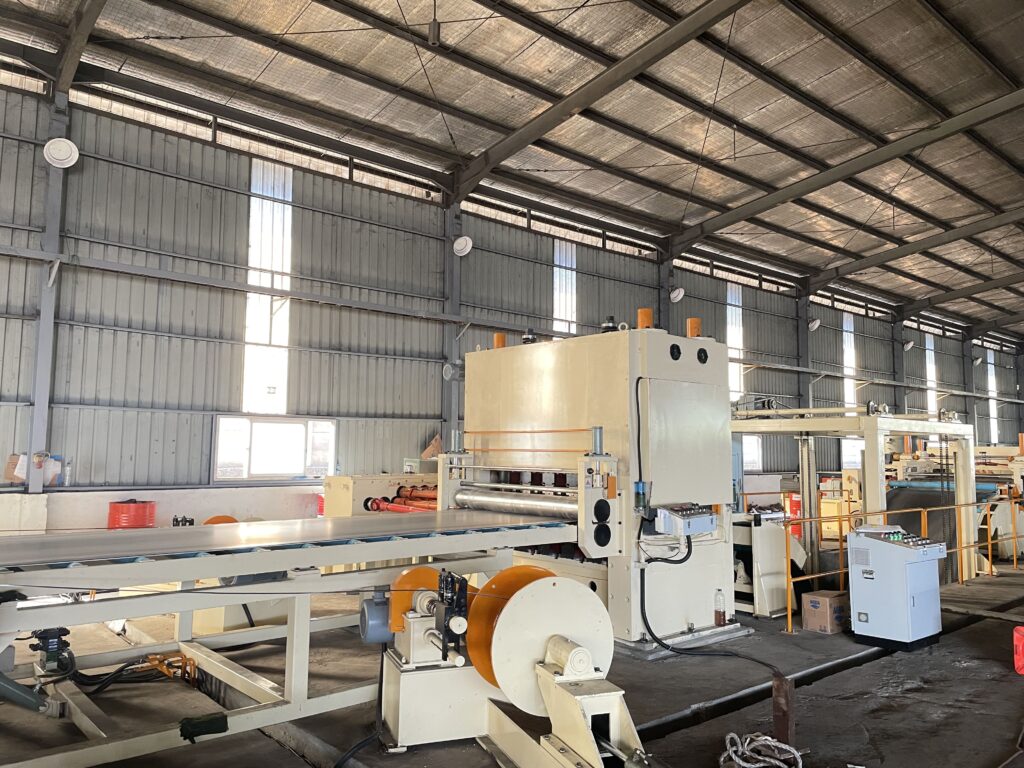
Integration architecture matters more than individual component specifications. Contemporary lines coordinate decoiling, leveling, slitting, and recoiling through centralized servo control that optimizes material flow throughout the process. This eliminates handoff points where material damage and dimensional variations typically occur in segmented systems running independent controls.
Сайт MD-1650 slitting system demonstrates this integrated approach by processing materials up to 1,600mm width while maintaining identical ±0.1mm precision standards across the working range. Customizable configurations from 10-35 ton capacity allow optimization for specific material types—heavier frames for thick steel processing, lighter configurations for aluminum applications where excessive mass would increase energy consumption unnecessarily.
Why Standard and Precision Lines Serve Different Markets
Standard slitting lines prioritize robustness and throughput for bulk processing applications. These workhorses excel at converting hot-rolled carbon steel up to 12mm thickness into construction-grade strips where tolerances of ±0.3mm meet customer requirements. Variable speed drives adjust from 50-150 meters/minute depending on material thickness and width patterns.
Simple arbor designs enable quick blade changes—experienced operators complete changeovers in under an hour using standardized tooling. Robust frames handle 30-ton coils without deflection issues that would affect cutting accuracy. For fabricators serving construction and general industrial markets, these systems deliver the reliability and cost-effectiveness that makes economic sense.
Precision lines target aerospace, electronics, and medical device manufacturing where sub-millimeter tolerances and burr-free edges aren’t preferences—they’re requirements. These systems use laser-aligned knives and non-contact measurement for accuracy within ±0.05mm on materials as thin as 0.1mm. Cryogenic cooling prevents thermal expansion during extended production runs that would cause dimensional drift in conventional equipment.
Processing speeds moderate to 50-100 meters/minute, but the superior surface finish eliminates secondary deburring operations entirely. An electronics manufacturer calculated that precision slitting equipment costing 40% more than standard lines delivered positive ROI within 18 months by eliminating manual edge conditioning that was consuming 12 labor-hours per shift.
Material-specific optimization determines whether equipment delivers promised performance in your actual production environment. Stainless steel’s work-hardening characteristics demand specialized blade configurations and tension parameters completely different from what works for aluminum or cold-rolled carbon steel.
Austenitic stainless grades require 15-20% higher cutting forces than carbon steel equivalents, necessitating more robust blade mounting and enhanced vibration damping. Proper blade geometry selection reduces edge work-hardening by 40-60%, improving subsequent forming operations and reducing customer complaints about material properties near cut edges.
Aluminum presents unique challenges related to material adhesion and edge quality. Aluminum’s tendency to build up on cutting edges requires specialized blade coatings and more frequent cleaning cycles—something many facilities discover only after processing issues emerge. However, aluminum’s excellent ductility enables tighter cutting tolerances, potentially reducing edge trim by an additional 0.5-1.0% compared to steel processing when equipment is properly configured.
How Slitting Lines Compare to Other Coil Processing
Many manufacturers struggle to understand when slitting lines versus CTL (cut-to-length) systems make better business sense. Slitting creates continuous longitudinal strips for recoiling—ideal for tube manufacturing, roll forming, and any application requiring coiled strip input. CTL lines shear material crosswise into flat sheets for stamping, laser cutting, and applications where flat blanks are required.
These aren’t competing technologies—they’re complementary processes serving different manufacturing needs. A steel service center analyzed their order patterns and discovered 65% could be processed more efficiently through optimized slitting rather than CTL operations. They reduced inventory by 25% while improving order fulfillment by 35% simply by matching process to product requirements.
Blanking lines punch discrete shapes crosswise from coiled material, suiting stamped automotive panels and appliance components where the final part geometry gets created during the blanking operation. Many sophisticated facilities run integrated lines where slit strips feed into blanking or CTL systems for secondary operations—the width reduction from slitting enables more efficient downstream processing.
Selecting Equipment That Matches Your Production Reality
Choosing slitting equipment starts with honest assessment of what you actually manufacture. Maximum coil width determines whether compact systems like the MD-850 handling 820mm widths suffice, or if you need 1,650mm+ capacity for wide coil processing. Processing speed requirements depend on volume—facilities running single-shift operations have different needs than 24/7 production environments.
Material thickness range and types matter enormously. Equipment optimized for thin-gauge aluminum (0.3-1.5mm) won’t perform well on 8-12mm carbon steel—the structural requirements and blade systems differ substantially. If your product mix includes both thin and thick materials, you’ll need versatile equipment or dedicated lines for different gauge ranges.
Tolerance requirements determine whether standard or precision equipment makes economic sense. Construction-grade applications accepting ±0.3mm tolerances don’t justify precision systems costing 40% more for ±0.05mm capability you don’t need. Conversely, trying to serve aerospace customers with standard equipment guarantees rejection rates that destroy profitability.
Automation levels scale with production volume and available labor. Entry-level lines suit smaller operations where skilled operators handle setup and monitoring. Fully integrated systems with PLC control, automated width measurement, and real-time quality monitoring make sense for high-volume facilities where labor costs and consistency requirements justify the investment.
Don’t underestimate facility requirements. Electrical capacity for servo drives, floor space for material handling, and compressed air for pneumatic components all impact implementation costs and timelines. A Texas fabricator spent an unexpected $180,000 on power system upgrades because their existing electrical infrastructure couldn’t support regenerative servo drives on their new CTL line.
Making Slitting Lines Actually Perform
Equipment specifications promise capabilities that real-world production may or may not achieve. The difference comes down to implementation quality, operator training, and disciplined maintenance protocols.
Site preparation beyond equipment installation includes electrical upgrades for stable power delivery, proper foundations for dynamic loads from high-speed processing, and climate control for precision applications where temperature variations affect dimensional accuracy. A Midwest service center discovered their precision slitting couldn’t maintain spec because 15°C temperature swings between day and night shifts caused thermal expansion that exceeded their ±0.1mm tolerance budget.
Training extends far beyond equipment operation. Maintenance personnel need to understand tension system calibration, blade wear patterns, and statistical process control principles. Operators should recognize when material property variations require parameter adjustments versus when equipment issues need attention. The Wisconsin automotive supplier mentioned earlier invested 80 hours in comprehensive training—their production manager credits that training as equally important as the equipment upgrade for achieving their quality improvements.
Preventive maintenance determines whether equipment delivers promised performance or gradually degrades until quality problems force expensive emergency repairs. Blade inspection intervals depend on material processed and production volume—some operations inspect every 250 tons, others run longer cycles with materials that cause less wear.
Tension system calibration deserves regular attention because small drift in tension control causes camber problems that seem unrelated to tension settings. A fabrication shop spent weeks troubleshooting mysterious camber issues before discovering their dancer roll position sensors had drifted out of calibration—a 30-minute adjustment eliminated problems that were costing them $15,000 weekly in rejected strips.
What the Numbers Actually Show
Yield improvements from precision slitting translate directly to bottom-line impact. At $1,000/ton material cost processing 15,000 tons annually, every 1% yield improvement represents $150,000 annual savings. The automotive supplier who reduced edge trim from 4.2% to 1.8% gained $360,000 yearly just from that single improvement—their camber reduction added another $1.2 million in annual value.
Energy efficiency matters more than equipment brochures suggest. Modern servo drives with regenerative braking recover energy during deceleration that older systems waste as heat. A regional service center calculated 18% energy reduction after upgrading from conventional drives to servo systems—worth $65,000 annually at their production volumes.
Quality consistency affects customer relationships and market positioning. When an electronics manufacturer improved edge quality through optimized slitting parameters, their downstream welding success rate increased by 18%. Fewer joint failures during panel assembly meant lower warranty costs and stronger customer relationships—value that’s harder to quantify but equally important to financial improvements.
Equipment reliability determines whether promised productivity translates to actual output. The Indonesian facility mentioned earlier maintains 83% equipment availability with basic preventive maintenance. That sounds modest until you compare it to operations running legacy equipment at 60-65% availability where unplanned downtime consumes productivity gains from higher processing speeds.
MaxDoMachine’s MD Series delivers these results through engineering focused on metal processing realities rather than chasing technological sophistication for its own sake. Our systems incorporate proven Siemens control hardware combined with process software developed through 20+ years of slitting experience—we’ve seen what actually matters in production environments versus what looks impressive in specifications.
Contact MaxDoMachine’s engineering team to discuss how precision slitting solutions address your specific production challenges. We’ll analyze your material requirements, volume targets, and facility constraints to recommend configurations delivering measurable ROI for your operations.