

Metal Processing Glossary: 100+ Terms Explained
Comprehensive glossary of metal processing terms: slitting, CTL, blanking, leveling, coil handling & more. Quick-reference definitions for buyers & engineers.
This glossary covers the core terminology used across metal coil processing, including slitting, cut-to-length (CTL), blanking, leveling, and related equipment. Definitions follow industry-standard usage per SME (Society of Manufacturing Engineers) y AISI (American Iron and Steel Institute) conventions. Use the alphabet navigation below to jump to specific terms.
A
Alloy Steel
Steel containing significant amounts of alloying elements (chromium, nickel, molybdenum, vanadium, etc.) beyond carbon and manganese. Common alloy grades used in coil processing include 4130 and 4340. Requires harder blade materials and adjusted clearances during slitting.
Annealing
A heat treatment process that softens metal by heating it to a specific temperature and slowly cooling it. Annealed coils are easier to process (lower hardness) but more prone to surface scratching during handling.
Arbor
The shaft in a slitting head on which circular slitting blades and spacers are mounted. Arbor diameter affects rigidity — larger arbors (200–300 mm) resist deflection better, producing more consistent slit widths. See also: Slitting Head.
AHSS (Advanced High-Strength Steel)
Steel grades with tensile strengths exceeding 550 MPa, including Dual Phase (DP), TRIP, and martensitic grades. Requires heavy-duty slitting equipment with reinforced arbors and higher-torque recoilers.
B
Blade Clearance
The horizontal gap between the upper and lower circular blades in a slitting head, expressed as a percentage of material thickness per side. Typical range: 5–12%. Too tight → premature blade wear and increased cutting force. Too loose → excessive burr and edge rollover. See our Slitting Lines Guide for setup recommendations.
Blanking
A metal cutting process that produces flat, shaped parts (blanks) from strip or sheet material. Unlike slitting (longitudinal) or CTL (transverse straight cuts), blanking uses a die to produce parts with specific contours.
Burr
A raised edge or small piece of metal remaining on a workpiece after cutting. In slitting, burr forms on the exit side of the cut. Burr height is controlled by blade clearance, blade sharpness, and material hardness. Maximum acceptable burr height is typically 5–10% of material thickness.
Bow (Crossbow)
A curvature across the width of a metal strip or sheet, where the strip arcs like a shallow bowl. Caused by uneven stress distribution during coiling. Corrected by a leveler with adjustable backup rolls.
C
Camber
A lateral curvature of a slit strip — the strip curves left or right like a banana when laid flat. Caused by uneven blade clearance between the left and right cutting edges. Maximum acceptable camber is typically 3 mm per 3 meters of strip length.
Coil
A roll of flat-rolled metal wound around a central mandrel. Master coils from steel mills typically weigh 10–30 tons, with widths from 600 to 2,200 mm.
Coil Break
Coil break refers to visible lines or creases on the strip surface, appearing perpendicular to the rolling direction. Caused by localized yielding at the uncoiler as the coil’s outer wraps straighten. More prominent in high-strength and thick-gauge materials. A leveler with sufficient penetration eliminates coil break by plastically deforming the affected area.
Coil Car
A powered cart (hydraulic or motorized) used to transport coils from storage to the uncoiler. Includes a V-saddle for coil centering and hydraulic lifting for height adjustment.
Coil ID (Inner Diameter)
The inside diameter of a wound coil, determined by the mandrel or drum it was wound on. Common IDs: 508 mm (20″) and 610 mm (24″). Uncoiler mandrels must match the coil ID.
Coil OD (Outer Diameter)
The outside diameter of a wound coil. Affects coil weight and the required capacity of the decoiler and coil car.
Coil Set
A lengthwise curvature in a strip caused by the coil’s memory of being wound. The strip curves in the same direction it was coiled. Removed by a leveler through reverse bending. More pronounced in thicker gauges and tighter coil IDs.
Cold-Rolled (CR)
Steel that has been rolled at room temperature after hot rolling. Cold-rolled steel has tighter thickness tolerances, smoother surfaces, and higher hardness compared to hot-rolled. Gauge range: typically 0.15–3.0 mm.
Crown
The intentional or unintentional thickness variation across the width of a strip, where the center is thicker than the edges. Mill crown can cause edge wave during leveling.
CTL (Cut-to-Length)
A metal processing method that converts coiled strip into flat sheets of specified length. See our CTL Lines Guide for complete details.
D
Decoiler
See Uncoiler.
Drag Pad
See Friction Pad.
Ductility
The ability of a metal to deform plastically without fracturing. Measured by elongation percentage in a tensile test. Higher ductility = easier to slit and level. Aluminum and mild steel are highly ductile; martensitic steel is not.
E
Deburring
Deburring is the process of removing burrs (raised edges) from slit or sheared metal. Methods include grinding wheels, belt sanders, roller deburring machines, and chemical deburring (for precision parts). Many service centers offer deburring as a value-added service on slit coils.
Edge Condition
The quality of the cut edge after slitting, categorized as:
- #1 Edge (mill edge): As-received from the rolling mill, untrimmed
- #3 Edge (slit edge): Standard slit, may have slight burr
- #5 Edge (trimmed/deburred): Slit and deburred, suitable for exposed applications
Edge Trim
The narrow strips of material removed from the edges of a coil during slitting. Edge trim is typically wound onto a scrap winder for recycling.
Edge Wave
A flatness defect where the edges of a strip are wavy or buckled while the center remains flat. Caused by the strip edges being longer than the center (from mill rolling or thermal effects). Corrected by adjusting the work-roll bending on the leveler.
Encoder Wheel
A measuring wheel that rides on the strip surface in a CTL line, counting rotations to measure strip length. Accuracy depends on wheel diameter and encoder resolution. Typical accuracy: ±0.5 mm.
F
Flatness
The deviation of a sheet or strip from a perfectly flat plane, measured in mm per meter of length (mm/m) or as an I-unit. A flatness of ±1 mm/m means the sheet deviates no more than 1 mm from flat over any 1-meter span.
Flying Shear
A shearing mechanism that cuts the strip while it is in motion, eliminating the need to stop the strip for each cut. Used in high-speed CTL lines (light gauge). Types include rotary flying shears and crank-type flying shears. See Shear.
Friction Pad
An adjustable brake pad in a tension stand that applies friction to individual slit strips to maintain tension during recoiling. Used in light-gauge slitting lines. Also called a “drag pad.”
G
Galvanized Steel
Steel coated with zinc for corrosion resistance. Available in hot-dip galvanized (HDG) and electro-galvanized (EG). Requires non-marking guides during processing to avoid damaging the zinc coating.
Gauge
A traditional numbering system for indicating the thickness of sheet metal. Lower gauge numbers = thicker material. Example: 16 gauge = 1.52 mm (steel). See our Gauge Thickness Chart for complete conversion tables.
Guillotine Shear
A shearing mechanism where a moving upper blade descends against a stationary lower blade to make a straight cut across the full width of the strip. Used in CTL lines for medium-to-heavy gauge materials. See Shear.
H
Hardness
Resistance of a material to indentation or deformation. Measured on Rockwell (HRC/HRB), Brinell (HB), or Vickers (HV) scales. Harder materials require harder blades and tighter blade clearance during slitting.
Heat Number
A unique identifier assigned by the steel mill to a specific batch (heat) of metal. Used for traceability in quality-critical applications (automotive, pressure vessels).
Hold-Down Arm
A pivoting arm on the uncoiler that presses against the top of the coil to prevent the outer wrap from springing open (clock-springing) during loading and initial pay-off.
Hot-Rolled (HR)
Steel rolled at temperatures above its recrystallization point. Hot-rolled coils have mill scale on the surface, wider thickness tolerances, and lower hardness. Gauge range: typically 1.5–25 mm.
I
I-Unit
A non-dimensional measurement of strip flatness used in precision applications. 1 I-unit represents a very small deviation. Typical acceptable ranges: 5 I-units (standard), 2 I-units (precision).
J
Jog
To move a machine at slow speed in small increments, typically during setup, threading, or troubleshooting. “Jog the line forward” means to advance the strip a short distance.
K
Kerf
The width of material removed by the cutting process. In slitting, kerf is determined by the blade overlap and clearance. Typical kerf in slitting: 0.1–0.5 mm. Minimizing kerf improves material yield.
Knife
See Slitting Blade.
L
Leveler
A machine with multiple work rolls arranged in a staggered upper-lower pattern that reverse-bends the strip to remove coil set, crossbow, and waviness. Central to Líneas CTL. Roll counts range from 5 (basic) to 23 (precision temper-pass).
Looping Pit
A pit in the floor between the slitting head and the recoiler that allows slit strips to form gentle loops, absorbing speed differences between the two sections. Required for heavy-gauge slitting (>6 mm) where tension control alone is insufficient.
M
Mandrel
A shaft or drum around which coil or slit strips are wound. Expandable mandrels use hydraulic or mechanical segments to grip the coil ID. Collapsible mandrels allow easy coil removal after winding.
Master Coil
The original wide coil as received from the steel mill, before any slitting or processing. Typical master coil widths: 600–2,200 mm; weights: 5–30 tons.
Mill Edge
The as-rolled edge of a coil from the steel mill, without any slitting or trimming. Mill edges may have slight irregularities and are not suitable for tight-tolerance applications.
N
Nesting
Arranging sheet metal parts in a pattern that maximizes material utilization and minimizes scrap. Important downstream process after CTL cutting.
O
OD
See Coil OD.
Oscillate Winding
A winding method where the strip traverses back and forth across the mandrel, creating a wider coil package. Used for narrow slit strips to prevent the coil from becoming too tall and unstable.
P
Passivation
Passivation is a chemical treatment (typically nitric or citric acid) applied to stainless steel after processing to restore the chromium oxide layer and improve corrosion resistance. Important after slitting or shearing stainless steel, as the cutting process disrupts the protective layer at the cut edge.
PLC (Programmable Logic Controller)
The industrial computer that controls a slitting or CTL line’s automated functions: speed, tension, blade positioning, shear timing, and safety interlocks. Modern lines use touchscreen HMI (Human-Machine Interface) connected to the PLC.
Niveladora de precisión
A leveler with 11–23 work rolls designed specifically for achieving tight flatness tolerances (±1 mm/m or better). Distinguished from a standard roller leveler (5–9 rolls) by its greater number of bending cycles per pass.
Q
QC (Quality Control)
In-process and final inspection of slit or CTL output. Key QC checks include: width/length measurement, burr height, flatness, surface condition, and edge quality.
R
Recoiler (Rewinder)
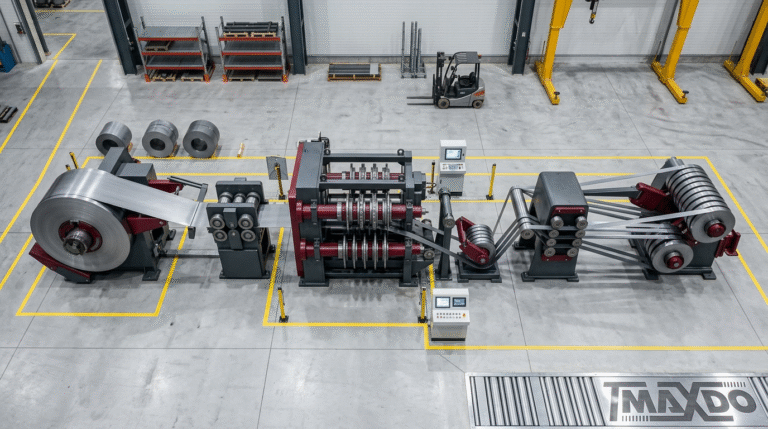
The section of a slitting line that winds slit strips onto individual mandrels or a common drum. Proper recoiler tension is critical to producing tight, uniform coils.
Recoiling
Recoiling is the process of unwinding a coil and rewinding it with proper tension, alignment, and packaging. Used to re-tension loose coils, inspect for defects, or apply edge conditioning. Often performed as a standalone operation before shipping or further processing.
Rockwell Hardness
A scale for measuring material hardness. HRB (Ball) is used for softer metals (aluminum, mild steel); HRC (Cone) is for harder metals (tool steel, AHSS). Blade material hardness is typically 58–62 HRC.
Roll Forming
A downstream process where slit coils are fed through a series of forming rolls to create profiles (C-channels, Z-purlins, tubes). Slit width accuracy directly affects roll-formed part quality.
Rollover
The rounded portion of a sheared edge where material deforms plastically before shearing begins. Some rollover is normal; excessive rollover indicates blade clearance is too wide.
S
Scrap Rate
The percentage of material lost as edge trim, kerf, and defective product during processing. Typical slitting scrap rates: 2–5%. Target: <3% for well-optimized lines.
Scrap Winder
A motorized reel that coils edge trim scrap into tight bundles for easy handling and recycling. Essential safety equipment — loose scrap on the factory floor is a tripping and injury hazard.
Servo Feed
A precision strip feeding system using servo motors to control strip advance with high accuracy (±0.25 mm). Used in CTL lines for precision length cutting.
Shear
A cutting mechanism that separates metal by applying opposing forces. In CTL lines, two types are used: Guillotine Shear (stop-and-cut) and Flying Shear (cut while moving).
Corte
The process of cutting a wide coil longitudinally (along its length) into narrower strips using circular rotary knives. See our Metal Slitting Lines Guide.
Slitting Blade
A hardened circular knife (D2 tool steel or carbide) mounted on the slitting head arbor. Upper and lower blades overlap with a controlled clearance to shear the strip. Blade diameter: 150–300 mm typically.
Slitting Head
The core assembly in a slitting line containing upper and lower arbors with mounted blades and spacers. The slitting head determines maximum cut count, width accuracy, and edge quality.
Spacer
A precision-ground ring mounted on the arbor between slitting blades to set the distance (and therefore the slit width) between adjacent cuts. Spacer accuracy directly determines slit-width consistency.
Stacker
See the CTL stacking types in our CTL Lines Guide.
Strip
A narrow piece of metal produced by slitting a wider coil. Strip widths can range from as narrow as 10 mm to the full coil width minus trim.
T
Telescoping
A coil defect where one or more wraps shift sideways during winding, creating a stepped or cone-shaped coil profile. Caused by uneven tension during recoiling. Telscoped coils are difficult to process downstream and may jam in uncoilers.
Temper Pass
Temper pass (also called skin pass) is a light cold-rolling operation (typically 0.5–2% reduction) applied to steel strip to improve surface finish, eliminate yield point elongation (which causes Lüders lines), and set mechanical properties. Some CTL lines include an inline temper pass mill for premium flatness.
Tensile Strength
The maximum stress a material can withstand before fracturing, measured in MPa or psi. Higher tensile strength = more cutting force required, harder blade materials needed.
Tension Stand
A section between the slitting head and recoiler that controls individual strip tension to prevent telescoping and ensure uniform coil winding. Types: friction pad (light gauge) and roller tension (medium-heavy gauge).
Threading
The process of feeding the leading edge of a coil through the line during initial setup. Manual threading involves operators guiding the strip through each section; semi-auto and auto threading use pilot mechanisms to reduce setup time.
TIR (Total Indicated Runout)
A measure of rotational accuracy for an arbor or roll, indicating how much the surface deviates from a perfect circle during rotation. Acceptable TIR for slitting arbors: ≤0.02 mm.
Tolerancia
The allowable deviation from a specified dimension. In slitting: width tolerance (±0.1 to ±0.5 mm). In CTL: length tolerance (±0.25 to ±1.0 mm).
U
UHSS (Ultra High-Strength Steel)
Steel grades with tensile strengths exceeding 780 MPa. Used in automotive structural components. Requires specialized slitting equipment with reinforced frames and high-torque drives.
Uncoiler
The first section of a slitting or CTL line that holds the master coil on an expandable mandrel and pays off strip into the line under controlled speed and tension. Also called a “decoiler.”
V
V-Saddle
A V-shaped support cradle on a coil car that centers the coil by gravity. The V-angle (typically 45–60°) must match the range of coil outer diameters being processed.
W
Tolerancia de anchura
The allowable deviation in the finished width of a slit strip, measured in mm. Standard: ±0.5 mm. Precision: ±0.2 mm. High precision: ±0.1 mm.
Work Roll
The rolls in a leveler that directly contact the strip surface, performing the reverse-bending action that removes flatness defects. Work roll diameter and spacing determine the leveler’s capability on different gauges.
Y
Yield (Material)
The percentage of input material that becomes usable finished product. A slitting line with 96% yield means 4% of the input coil becomes scrap (edge trim + kerf + defects). Higher yield = lower cost per finished ton.
Yield Strength
The stress at which a material begins to deform permanently (plastically). Measured in MPa or psi. Important for leveler setup — the leveler must bend the strip beyond its yield strength to achieve permanent flatness correction.
Explore MaxDo Equipment
See how these terms apply to real equipment. MaxDo manufactures the full range of coil processing machinery:
- Slitting Lines (MD Series) — Precision coil-to-strip processing
- CTL Lines (CT Series) — Coil-to-sheet with precision leveling
- Request a quote — Tell us your application