

Complete Guide to Cut-to-Length Lines: Equipment, Process & ROI Analysis
¿Está listo para mejorar su procesamiento de metales? Póngase en contacto con MaxDo Machine para obtener asesoramiento personalizado sobre soluciones de corte a medida que impulsen su producción.
Cut-to-length lines transform metal coil processing by delivering precision-cut sheets at speeds up to 80 meters per minute while eliminating waste that traditional shearing methods accept as inevitable. A CTL line (Cut-to-Length Line, also called a CTL machine or cut to length production line) takes raw coil stock weighing up to 35 tons and produces flat sheets cut to exact length specifications, ready for fabrication without secondary processing.
Modern cut-to-length equipment handles materials from 0.2 mm aluminum foil to 25 mm structural plate with length tolerances under ±1.5 mm—precision that matters when downstream press brakes, laser cutters, or stamping dies expect material that feeds without jamming or dimensional correction. Industry-leading systems like MaxDo’s MD series achieve even tighter tolerances of ±0.1 mm while maintaining 96%+ material yield across 500+ installations in 30+ countries, backed by ISO 9001 certification and 20 years of R&D expertise in metal coil processing equipment.
This guide covers everything you need to evaluate, select, and optimize CTL line performance: the step-by-step cutting process, critical equipment components, material-specific configurations, industry applications, ROI analysis, and operator best practices. Whether you’re replacing manual shearing operations or scaling production capacity, understanding these systems ensures you match equipment capabilities to your actual processing requirements and growth trajectory.
What Is a Cut-to-Length Line? (CTL Full Form & Definition)
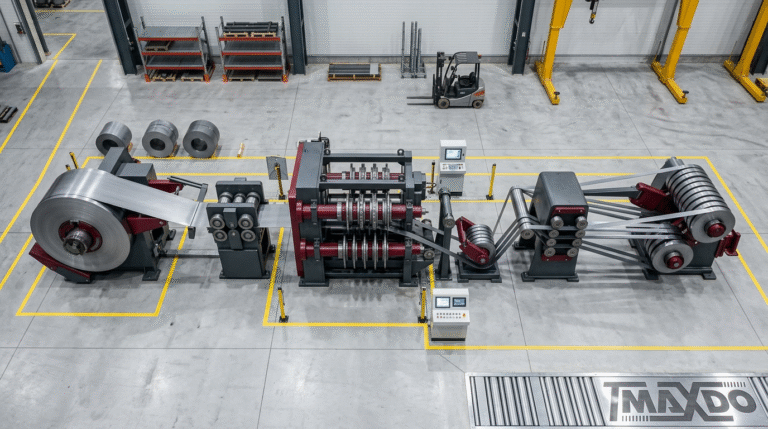
CTL stands for Cut-to-Length, referring to automated production systems that convert metal coils into flat sheets cut to precise dimensions. A cut to length line integrates multiple processing stages—decoiling, leveling, measuring, cutting, and stacking—into a continuous workflow that produces thousands of dimensionally accurate sheets per shift with minimal operator intervention.
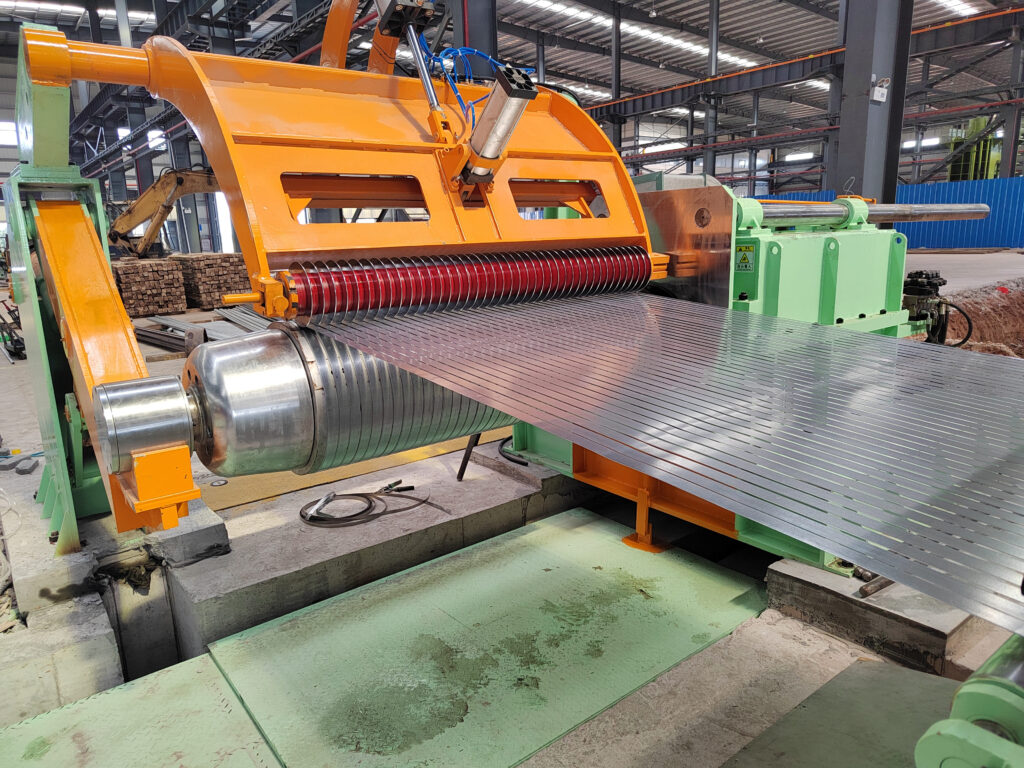
The core function addresses a fundamental metal fabrication challenge: coil stock arrives from mills in massive rolls that must be transformed into manageable, flat sheets before fabricators can stamp, bend, weld, or machine them. CTL machines automate this transformation with servo-controlled precision that manual operations cannot match consistently.
Key technical parameters define CTL line capability:
- Thickness range: 0.2 mm to 25 mm (light gauge to structural plate)
- Processing speed: 15-80 meters per minute depending on material thickness and shear type
- Length tolerance: ±1.5 mm industry standard, ±0.1 mm on premium systems
- Width capacity: 1,000 mm to 2,438 mm (standard configurations)
- Coil weight: Up to 35 tons on heavy-duty decoilers
Industries relying on cut-to-length metal processing include automotive parts manufacturing, appliance production, HVAC systems, construction materials, shipbuilding, and electronics enclosures. Any operation that fabricates metal components from coil stock benefits from the precision, speed, and waste reduction that CTL lines deliver compared to traditional shearing methods.
CTL vs. Traditional Shearing: Key Differences
The efficiency gap between automated CTL systems and manual shearing becomes clear when comparing operational metrics:
| Parámetro | Cizallado manual | Línea CTL | Performance Gain |
|---|---|---|---|
| Velocidad de procesamiento | 5-10 m/min | 15-80 m/min | 3-8x faster |
| Length Tolerance | ±5-10 mm | ±1.5 mm (±0.1 mm MaxDo) | 5-10x more accurate |
| Scrap Rate | 5-15% | <1% | 80-95% waste reduction |
| Labor Required | 4-6 operators | 2-3 operators | 40-60% lower headcount |
| Tiempo de preparación | 15-30 min | 5-10 min (automated) | 50-70% faster |
For a detailed breakdown of how the cut-to-length process optimizes each production stage, see our dedicated process guide. The automation advantages compound across shifts, with a single CTL line producing 4-8 times the output of manual operations while delivering superior dimensional accuracy and lower defect rates.
How Cut-to-Length Lines Work: Step-by-Step Process
Cut-to-length lines execute five integrated processing stages that transform coiled metal into precision-cut sheets without stopping material flow (in rotary shear configurations) or with minimal interruption (guillotine systems).
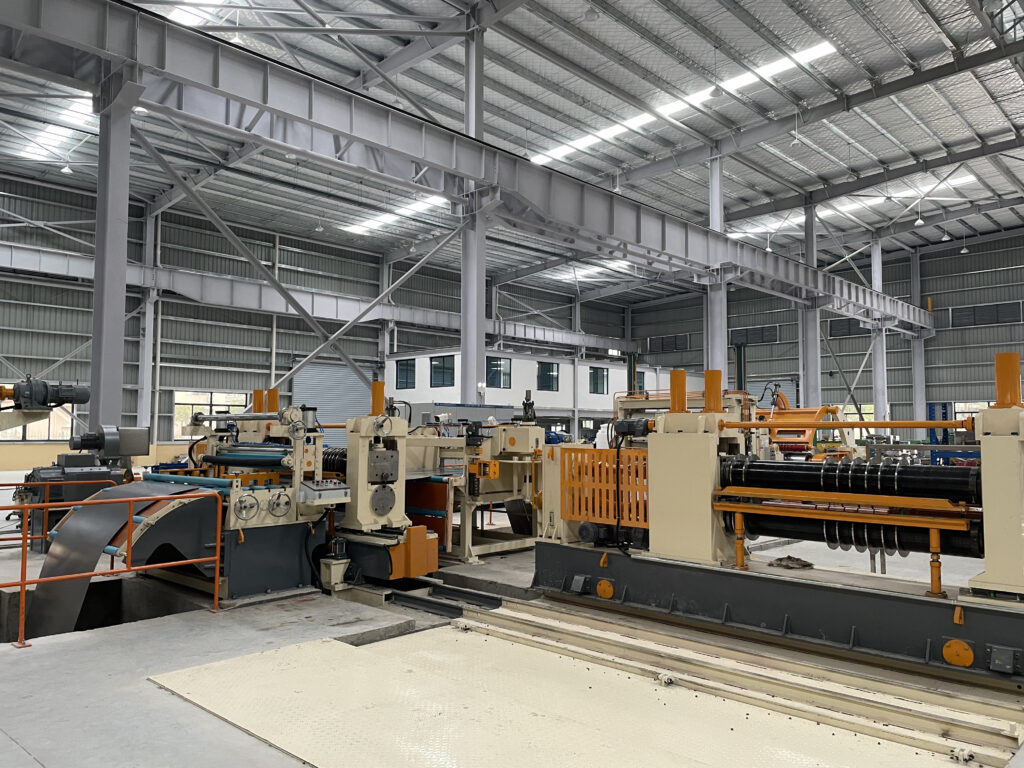
Step 1: Hydraulic Decoiler & Coil Loading
Hydraulic decoilers initiate the CTL process by gripping coils up to 35 tons and unwinding them under controlled tension to prevent edge wave or surface marking. The entry coil car positions incoming coils onto expanding mandrels that grip the coil’s inner diameter and rotate smoothly to maintain constant tension as material feeds downstream. Tension control systems adjust unwinding speed to match downstream processing rates, preventing slack that causes threading issues or excessive tension that stretches material beyond specification.
Step 2: Pre-Leveling & Main Leveling Units
Leveling units eliminate coil set—the natural curl that remains in sheet metal after unwinding—and internal stress that causes dimensional instability during fabrication. Pre-levelers knock down gross coil curvature through aggressive roller pressure, while the main leveling unit applies precisely controlled pressure across multiple work rolls to achieve flatness within 1.5 mm per meter. The number of leveling rollers (typically 7-13 working rolls) and their diameter determine how effectively the system eliminates residual stress without over-working the material.
Step 3: Servo-Driven Feed Systems
Servo-driven feed systems eliminate measuring errors by tracking length with rotary encoders that detect 0.1 mm deviations before they become scrap. Unlike mechanical feed systems that accumulate positioning errors, servo systems execute closed-loop control where actual material position continuously corrects against programmed dimensions. High-resolution encoders paired with industrial PLCs ensure length accuracy regardless of material thickness variations or line speed changes.
Step 4: Shear Stations (Guillotine or Rotary)
The strip reaches the shear station where either a guillotine or rotary shear executes the cut with dramatically different performance characteristics. Guillotine shears move vertically through the material, producing burr-free edges with ±0.5 mm cutting accuracy, but they stop material flow for each cut, limiting line speed to 25 meters per minute. Rotary shears use synchronized circular blades that never stop material movement, enabling continuous operation up to 80 meters per minute for high-volume thin gauge production, though edge quality suffers slightly compared to guillotine cutting.
Step 5: Automated Stacking Systems
After cutting, sheets move across roller tables to automated stackers that use pneumatic arms or magnetic lifters to bundle finished material without manual handling. Automated stackers handle widths from 1,000 to 2,438 mm and adjust grip force based on material thickness and surface coating, preventing damage to pre-painted or polished sheets. Modern stacking systems integrate weighing scales that trigger bundle transfers when programmed weight limits are reached, enabling lights-out operation during night shifts.
Decoiler Technology: Hydraulic vs. Motorized Systems
Hydraulic decoilers dominate heavy-gauge applications because they deliver the clamping force needed to prevent 30-ton coils from slipping during acceleration or deceleration. The expanding mandrel design uses hydraulic cylinders to radially expand segmented fingers that grip the coil’s inner diameter, distributing clamping pressure evenly to prevent localized deformation. Motorized decoilers serve lighter applications where air-actuated expansion provides sufficient grip force at lower equipment cost.
Leveling Unit Performance Factors
Material properties dictate leveling requirements more than thickness alone. Stainless steel and aluminum alloys require more aggressive leveling pressure than mild steel to achieve equivalent flatness because of their different yield characteristics and work hardening behavior. Pre-painted coils demand gentler roller contact to avoid coating damage, requiring larger diameter rollers that distribute pressure over a wider contact area. Side guides and loop systems maintain lateral alignment throughout the leveling zone, absorbing speed variations between processing stations to prevent edge damage during threading.
Critical Components: What Determines CTL Line Performance
Five subsystems determine whether a CTL line delivers advertised accuracy and throughput or underperforms due to component limitations that only surface under production conditions.
Decoiler Mandrel Design
Expanding mandrels prevent coil slippage through segmented finger designs that distribute clamping force across the coil’s inner diameter without causing ovality or surface marking. Hydraulic expansion systems maintain constant grip pressure regardless of coil diameter variations between orders, while pneumatic systems work for lighter materials where lower clamping force suffices. The mandrel surface finish matters—rough surfaces grip better but risk marking pre-painted material, while polished surfaces protect coatings but require higher clamping force.
Leveling Roller Configuration
The number, diameter, and material hardness of leveling rollers determines flatness capability across different gauges and material types. More working rolls (11-13 vs. 7-9) enable finer flatness control but increase equipment cost and maintenance complexity. Roller diameter affects the bending radius applied to material—larger diameters produce gentler forming that prevents work hardening in aluminum alloys, while smaller diameters deliver more aggressive leveling needed for high-strength steels. Roller surface hardness (typically 60-65 HRC) resists wear from abrasive materials like galvanized steel while maintaining the smooth finish needed to prevent surface marking.
Shear Blade Material & Maintenance
Blade material selection balances edge life against cutting quality. High-speed steel blades (M2, M42) handle most applications with sharpening intervals of 50,000-100,000 cuts, while tungsten carbide blades extend life to 500,000+ cuts for high-volume operations processing abrasive materials. Blade geometry—rake angle, clearance, and edge bevel—must match material thickness and hardness to produce clean cuts without excessive burr formation. Sharpening frequency directly impacts edge quality; waiting until visible burrs appear allows blade damage that requires more aggressive grinding to restore proper geometry.
Servo Control Systems
Length accuracy depends on encoder resolution and PLC scan rates more than mechanical precision. High-resolution encoders (10,000+ pulses per revolution) detect position changes below 0.1 mm, while fast PLC scan times (≤10 ms) ensure the control system responds to deviations before they accumulate into out-of-tolerance cuts. Feed roller diameter and encoder mounting position introduce mechanical variables—encoders mounted directly on feed rolls eliminate gearbox backlash that degrades accuracy on encoder-to-motor mounting configurations.
Safety Sensors & Interlocks
Modern CTL lines integrate photoelectric sensors, laser curtains, and pressure-sensitive mats that halt operation before material jams cause equipment damage or operators contact moving components. Jam detection sensors monitor material position at multiple points along the line, triggering immediate stops if sheets buckle or mis-feed. Emergency stop circuits must meet Category 3 or 4 safety requirements per ISO 13849, ensuring redundant stopping paths that function even if a single component fails.
Guillotine Shear vs. Rotary Shear: Technical Comparison
Shear type selection drives fundamental performance tradeoffs between cutting quality and line speed:
| Característica | Guillotine Shear | Rotary Shear |
|---|---|---|
| Cut Quality | Burr-free, straight edges | Minor burr, slight distortion |
| Edge Accuracy | ±0.5 mm (±0.1 mm MaxDo) | ±1.0-1.5 mm |
| Velocidad de línea | 15-25 m/min | 40-80 m/min |
| Thick Gauge Capability | Excellent (up to 25 mm) | Limited (typically 6 mm max) |
| Maintenance Frequency | Blade sharpening every 50K-100K cuts | Blade replacement every 200K+ cuts |
| Equipment Cost | Higher initial investment | Lower capital cost |
Guillotine shears excel when processing thick gauge material above 8 mm where edge quality requirements rule out any burr or distortion. Their vertical blade motion through stationary material produces straight, square edges with dimensional accuracy that rotary systems cannot match. MaxDo’s MD series guillotine configurations achieve ±0.1 mm cutting tolerance compared to the ±1.5 mm industry standard, critical for automotive stampings and precision enclosures where dimensional stacking tolerances leave no margin for cutting errors.
Rotary shears sacrifice some edge quality for continuous operation that never stops material flow, ideal for thin to medium gauge production where throughput matters more than perfect edges. The circular blade motion introduces slight edge distortion and burr formation, acceptable for applications like HVAC ductwork or construction panels where edges will be hemmed or overlapped during assembly.
For applications requiring both precision width tolerance in slitting machines and length control, integrated slitting-CTL systems deliver complete dimensional accuracy.
Automated Stacking Systems: Pneumatic vs. Magnetic Lifters
Stacking technology must match material characteristics and production volume. Pneumatic arm stackers grip sheet edges through vacuum cups or mechanical fingers, suitable for coated materials where magnetic attraction would damage surface finishes. Magnetic lift systems use electromagnets to lift ferrous materials, enabling faster cycle times but incompatible with aluminum, stainless steel (non-magnetic grades), or pre-painted products where magnetic contact mars surfaces.
High-volume operations justify dual-station stackers that build one bundle while the line continues feeding material to a second stacking position, eliminating downtime for bundle removal. Lower-volume job shops accept single-station stackers that pause production briefly while operators swap full bundles for empty pallets.
Material-Specific CTL Solutions
Different materials demand specialized equipment configurations that generic CTL lines cannot accommodate without performance compromises or premature component wear.
Aluminum Cut-to-Length Line Setup
Aluminum cut to length lines face unique challenges from the material’s low density, high thermal conductivity, and tendency to gall (cold weld) against steel tooling. Leveling rollers require larger diameters (150-200 mm vs. 100-130 mm for steel) to achieve equivalent strain without work hardening that makes material brittle. Roller surfaces need hard chrome plating or ceramic coating to prevent aluminum pickup that scores subsequent sheets.
Feed speed optimization becomes critical—aluminum’s lower strength means higher speeds cause edge wave at the same tension settings used for steel. MaxDo’s aluminum-specific configurations incorporate tension sensors that automatically adjust decoiler brake pressure to maintain optimal material stress throughout the speed range. Anti-oxidation treatments (oil misting or dry film application) prevent surface staining during multi-shift storage between cutting and fabrication operations.
Heavy Gauge CTL Lines for Structural Plate
Heavy gauge CTL equipment processing 5-25 mm thick material requires hydraulic systems with 2-3x the tonnage of standard configurations. Guillotine shears become mandatory above 8 mm thickness because rotary shears lack the cutting force needed to penetrate structural plate without excessive blade wear or edge distortion. Blade material shifts from high-speed steel to carbide-tipped or solid carbide inserts that maintain edge geometry through thousands of cuts in abrasive high-strength steels.
Shipbuilding and heavy equipment manufacturing rely on heavy gauge CTL lines to process structural plate where cutting accuracy directly impacts fit-up quality during welding operations. MaxDo’s heavy-gauge systems maintain ±0.5 mm length tolerance even at maximum 25 mm thickness, eliminating the grinding and fitting operations that manual shearing requires to achieve acceptable dimensional control.
Leveling capacity must scale proportionally—heavy plate requires 11-13 working rolls with diameters of 200-250 mm to generate the bending force needed to eliminate coil set in thick, high-strength materials. Hydraulic pressure systems deliver 3,000-5,000 kN of leveling force compared to 1,000-2,000 kN for light gauge lines.
Stainless Steel Processing
Stainless steel’s high tensile strength and work hardening characteristics accelerate blade wear compared to mild steel. Cutting forces increase 40-60% for 304/316 stainless versus equivalent thickness carbon steel, requiring more frequent blade sharpening to maintain edge quality. Leveling roller materials shift to higher hardness grades (62-65 HRC vs. 58-60 HRC) to resist deformation under the higher pressures needed to achieve flatness in stainless alloys.
Pre-Painted Coil Handling
Pre-painted materials demand gentle handling throughout the CTL process to protect coating integrity. Leveling rollers require rubber or polyurethane covers that distribute pressure without scoring painted surfaces. Feed rollers use similar soft coverings, with adjustable pressure settings that prevent coating damage while maintaining grip sufficient to control material position. Stacking systems must avoid scratching through non-contact magnetic lifters or foam-padded pneumatic grips.
High-Strength Steel (AHSS/UHSS)
Advanced high-strength steels and ultra-high-strength steels in automotive applications present processing challenges from their high yield strength (600-1,500 MPa) and spring-back characteristics. Shear forces increase proportionally with tensile strength, accelerating blade wear and requiring more powerful hydraulic systems. Leveling becomes more critical because AHSS retains more residual stress after unwinding, yet over-leveling causes work hardening that makes material brittle. MaxDo’s adaptive leveling systems adjust roller pressure based on material grade input, optimizing flatness without degrading formability.
Industry Applications & Use Cases
Cut-to-length lines serve diverse industries where dimensional accuracy, surface quality, and production efficiency determine competitive advantage.
Automotive Industry
Automotive parts manufacturers process high-strength steel for body panels, chassis components, and structural reinforcements where consistent flatness prevents die damage during stamping operations. Length tolerance directly impacts blank nesting efficiency—tighter dimensional control allows closer part spacing during laser cutting or stamping, reducing material waste per vehicle. MaxDo CTL systems processing AHSS for automotive applications maintain ±0.1 mm tolerance across production runs, enabling fabricators to achieve 96%+ material utilization rates that reduce per-part costs by 15-20% compared to manual shearing’s ±5 mm variance.
Fabricación de electrodomésticos
White goods manufacturers cut pre-painted steel for refrigerator cabinets, washing machine panels, and dishwasher components where surface protection matters as much as dimensional accuracy. Coating damage during cutting or stacking creates rework costs that exceed material waste—a single deep scratch requires panel replacement at 5-10x the material cost. Appliance-grade CTL lines use polyurethane-covered rollers and non-contact stacking systems to maintain coating integrity while producing thousands of panels per shift with tight length tolerance that ensures panels align during assembly without trimming.
Construction & Architecture
Construction material suppliers process roofing panels, wall cladding, and structural components where large sheet lengths (up to 25 meters on specialized configurations) serve architectural applications. Pre-painted galvanized coil for metal roofing requires surface protection throughout cutting, while tight dimensional control ensures panels interlock properly during installation without on-site trimming. Heavy gauge structural plate for building frames demands the cutting accuracy that only guillotine shears deliver, with ±0.5 mm tolerance preventing fit-up issues during welding.
Shipbuilding
Ship fabricators process 6-25 mm structural plate for hull sections, deck panels, and bulkheads where cutting accuracy impacts welding quality and construction timelines. Manual shearing’s ±10 mm tolerance requires grinding and fitting operations that add days to hull assembly schedules. Heavy gauge CTL lines eliminate this secondary processing by delivering plate sections that fit together without modification, cutting labor costs by 30-40% while reducing quality defects from dimensional mismatch.
HVAC & Ductwork
HVAC manufacturers process thin gauge galvanized steel (0.5-1.5 mm) for duct components where high-speed production and cost control drive equipment selection. Rotary shear CTL lines running at 60-80 meters per minute produce thousands of duct blanks per shift, with edge quality sufficient for spot welding or mechanical seaming. The scrap rate reduction from <1% on CTL lines versus 8-12% on manual shearing translates directly to margin improvement in price-competitive ductwork markets.
Electronics Enclosures
Electronics manufacturers cut aluminum alloy sheet for computer housings, telecom equipment enclosures, and control panels where tight tolerance prevents assembly issues. Length accuracy of ±0.5 mm enables automated assembly operations where robotic systems install components into precisely dimensioned enclosures without human adjustment. Surface quality requirements demand non-contact handling and burr-free cutting that only guillotine shears deliver consistently.
For operations requiring flexible material handling across multiple gauges and widths, multi-blanking lines offer material flexibility beyond standard CTL configurations.
Case Study: Automotive Parts Manufacturer Reduces Scrap by 87%
A tier-1 automotive supplier processing 2,500 tons of high-strength steel monthly replaced three manual shearing lines with a single MaxDo MD-2200 CTL system, achieving measurable operational improvements:
- Scrap reduction: 12.3% to 1.6% (87% improvement)
- Production throughput: 180% increase from 25 m/min automated vs. 9 m/min manual
- Labor cost: 55% reduction from 6 operators to 3 per shift
- Dimensional accuracy: Length variance reduced from ±8 mm to ±0.1 mm
- ROI timeline: 2.7 years including installation and training costs
The dimensional accuracy improvement proved most valuable—tighter blank tolerance enabled the fabricator to reduce laser cutting margins from 15 mm to 3 mm per part, increasing material utilization from 78% to 94%. At 2,500 tons monthly throughput, the 16% yield improvement delivered $420,000 annual material savings that accelerated ROI beyond initial labor cost reduction projections.
CTL vs. Slitting Lines: When to Choose Each
Cut-to-length lines and slitting lines serve complementary roles in metal coil processing, with functional differences determining which equipment matches your production requirements.
Functional Differences
CTL lines cut coils across their width to produce sheets of specified length while maintaining full coil width (or trimming edges). Slitting lines cut coils longitudinally to produce narrow strips of specific width while maintaining coil form (rewound onto smaller diameter cores). The processing directions are perpendicular—CTL creates sheets, slitting creates coils.
Equipment Configuration Comparison
Both systems share decoiling and leveling stages, but cutting and handling differ fundamentally. CTL lines use guillotine or rotary shears that cut perpendicular to material flow, followed by stacking systems that bundle flat sheets. Slitting lines use circular knives that cut parallel to material flow, followed by recoiling systems that wind narrow strips onto individual cores. Our detailed comparison between slitting and CTL lines explores configuration differences comprehensively.
Application Selection Criteria
Choose CTL lines when downstream fabrication requires flat sheets—laser cutting, press brake forming, stamping, welding operations all demand flat stock that feeds through equipment without the curl inherent in slit coils. Choose slitting lines when fabrication uses coiled material—roll forming, tube mills, progressive stamping from coil feeders all work directly from narrow slit coils without intermediate flattening.
Cost & Efficiency Considerations
CTL lines deliver better material utilization for applications requiring multiple widths from the same coil—one CTL line produces sheets at any length within its capacity range without tooling changes. Slitting lines optimize throughput for applications requiring consistent width—once tooling is set, slitting processes coils at 100-200 m/min versus CTL’s 15-80 m/min maximum. For comprehensive strategies to minimize downtime, see our guide on slitting line setup time reduction.
Integrated Slitting-CTL Systems
High-volume operations processing diverse order mixes justify integrated systems that slit wide coils into multiple widths, then cut resulting strips to length in a continuous operation. This configuration combines slitting’s high-speed width reduction with CTL’s length precision, ideal for service centers serving customers with varied dimensional requirements.
Why CTL Lines Outperform Manual Shearing
The operational gap between automated cut-to-length lines and manual shearing widens as production volume increases and labor costs rise.
Speed Comparison
Manual shearing operations run at 5-10 meters per minute accounting for material handling, measurement, cutting, and bundle building. Operators must stop between cuts to verify length, adjust back gauges, and clear finished sheets before processing the next piece. Cut-to-length lines maintain 15-25 meters per minute for medium gauge material on guillotine configurations, with rotary shear systems reaching 80 meters per minute on thin stock. The speed advantage compounds hourly—a CTL line at 20 m/min produces 9,600 meters per 8-hour shift versus 2,880 meters from manual operations at 6 m/min.
Precision Comparison
Manual length tolerance drifts between ±5 mm and ±10 mm depending on operator skill, back gauge accuracy, and equipment maintenance condition. Worn back gauge slides, blade deflection, and human measurement error accumulate into dimensional variance that causes fabrication issues downstream. CTL lines maintain ±1.5 mm tolerance through servo control and automated measurement that eliminates human error. Premium systems like MaxDo’s MD series achieve ±0.1 mm accuracy by integrating high-resolution encoders with rigid mechanical systems that prevent deflection under cutting loads.
Scrap Rate Comparison
Manual shearing generates 5-15% scrap from measurement errors, incorrect cuts, and edge trim waste that operators cannot optimize in real-time. Each mis-cut consumes raw material at full cost while producing no saleable product. Cut-to-length lines reduce scrap below 1% because servo systems don’t make measuring mistakes and optimized cutting sequences minimize edge trim. Software calculates nesting patterns that maximize usable sheets per coil, automatically adjusting cut lengths to reduce remnant drops.
Labor Requirements
Manual operations require 4-6 operators per shift to handle coil loading, material feeding, measurement, cutting control, quality inspection, and bundle building. Personnel costs accumulate across shifts and years, subject to wage inflation that compounds operational expense. CTL lines operate with 2-3 personnel who load coils, monitor automated systems, and handle finished bundles. The 40-60% labor reduction generates ongoing cost savings that typically recover equipment investment within 3-4 years.
Eficiencia energética
Automated systems reduce energy consumption per sheet because they don’t idle between cuts like manual operations do. Servo motors only consume power during material movement, while hydraulic systems maintain pressure only during cutting cycles. Manual shearing equipment runs continuously regardless of cutting activity, wasting energy during measurement, adjustment, and material handling pauses.
Long-Term Cost Trends
Equipment costs stabilize after initial investment—a properly maintained CTL line delivers consistent output for 15-20 years with predictable maintenance expenses. Labor costs trend upward 2-5% annually as wages rise with inflation and labor market competition. The cost divergence favors automation increasingly over equipment lifespan.
ROI Calculation Example: 3-Shift Operation
Consider a fabricator processing 1,000 tons monthly of mixed gauge steel, evaluating a $1.2 million fully automated CTL line against their existing manual shearing operation:
Annual Cost Comparison
| Category | Cizallado manual | Línea CTL | Annual Savings |
|---|---|---|---|
| Labor (18 operators @ $45K) | $810,000 | $270,000 (6 operators) | $540,000 |
| Material Waste (8% vs. 0.8%) | $192,000 | $19,200 | $172,800 |
| Energy | $48,000 | $28,800 | $19,200 |
| Rework & Scrap | $84,000 | $12,000 | $72,000 |
| Total Annual Operating Cost | $1,134,000 | $330,000 | $804,000 |
Investment Recovery Timeline
- Equipment cost: $1,200,000
- Installation & training: $180,000
- Total investment: $1,380,000
- Annual savings: $804,000
- Simple payback: 1.7 years
Accounting for time value of money at 8% discount rate, net present value over 10 years reaches $4.2 million, validating the investment even before considering throughput increases that enable revenue growth without proportional cost increases.
Industry 4.0 & Smart Manufacturing Integration
The cut-to-length market has shifted decisively toward fully automated systems integrating IoT sensors, predictive maintenance algorithms, and real-time process monitoring. Premium CTL lines now function as intelligent production nodes that optimize performance autonomously while feeding operational data to enterprise systems.
IoT Sensors for Real-Time Monitoring
Modern CTL lines integrate distributed sensor networks monitoring blade wear, hydraulic pressure stability, leveling roller condition, and material position accuracy. Blade wear sensors detect cutting force increases that signal dulling before edge quality degrades visibly, triggering maintenance alerts with sufficient lead time to schedule sharpening during planned downtime rather than emergency stoppages. Hydraulic pressure monitoring detects seal leaks or pump degradation weeks before failures occur, preventing unplanned downtime that costs $5,000-15,000 per hour in lost production and emergency repair premiums.
Predictive Maintenance
Industry 4.0 integration transforms maintenance from reactive (fix failures after they occur) or time-based (service on fixed schedules regardless of condition) to predictive (service based on actual component condition). Bearing vibration analysis detects wear patterns 2-4 weeks before failures, extending bearing life by eliminating premature replacements while preventing catastrophic failures that damage adjacent components. Predictive maintenance extends equipment uptime by 20% compared to time-based schedules by eliminating unnecessary service while catching developing issues early.
MES Integration
Cut-to-length lines feed production data to Manufacturing Execution Systems that track OEE (Overall Equipment Effectiveness), material utilization rates, quality metrics, and energy consumption across shifts and production runs. Real-time visibility enables production managers to identify bottlenecks, quantify setup time waste, and measure actual capacity against theoretical throughput. Integrated scheduling systems optimize job sequencing to minimize material waste—grouping orders by width reduces edge trim, while batching similar thicknesses minimizes leveling adjustments between runs.
Adaptive Cutting Algorithms
Smart CTL systems adjust cutting parameters automatically based on material characteristics detected by inline sensors. Thickness sensors measure gauge variations along coil length, triggering shear force adjustments that maintain consistent edge quality despite material inconsistencies. Material hardness variations that would cause edge burr on fixed-parameter systems trigger automatic blade speed or pressure compensation on adaptive configurations.
Diagnóstico a distancia
MaxDo’s Industry 4.0 implementation includes secure remote connectivity enabling engineering teams to diagnose operational issues without site visits. When operators report unusual behavior, MaxDo technicians access equipment controller logs, sensor data histories, and current operating parameters to identify root causes within hours rather than days required for travel and on-site investigation. Remote diagnostics reduce mean time to repair by 40-60% while minimizing travel costs and downtime.
Data-Driven Continuous Improvement
Historical production data drives continuous improvement initiatives by quantifying performance trends and identifying improvement opportunities. Analyzing setup time across hundreds of changeovers reveals best practices that reduce average changeover duration by 20-30% when systematically documented and trained. Material utilization analysis across different operators or shifts identifies training gaps or procedural inconsistencies that corrective action resolves.
MaxDo’s Industry 4.0 Implementation
MaxDo’s MD series integrates comprehensive smart manufacturing capabilities through the company’s proprietary monitoring platform:
- Predictive maintenance algorithms analyze vibration, temperature, and force data to forecast component service requirements 2-4 weeks in advance
- Real-time quality monitoring tracks dimensional accuracy across every cut, alerting operators to trending deviations before production runs out of tolerance
- Cloud platform dashboard aggregates performance data across equipment fleets, enabling multi-site manufacturers to benchmark facility performance and share best practices
- Mobile app alerts notify maintenance teams of developing issues regardless of location, ensuring rapid response even during off-shifts
The platform integrates with existing enterprise systems through standard protocols (OPC-UA, MQTT), avoiding proprietary lock-in while enabling data flow to MES, ERP, and CMMS systems that manufacturers already use.
CTL Line Selection Guide: Matching Equipment to Your Needs
Selecting the optimal cut-to-length configuration requires matching six critical parameters to your actual processing requirements and growth projections.
Shear Type Selection: Guillotine vs. Rotary
Material thickness and edge quality requirements drive shear selection. Choose guillotine shears when:
- Processing thick gauge material above 8 mm where rotary shears lack cutting force
- Edge quality requirements demand burr-free cuts with ±0.5 mm accuracy
- Material applications involve welding where edge squareness affects fit-up quality
- Processing stainless steel or high-strength alloys where rotary blades wear rapidly
Choose rotary shears when:
- Processing thin to medium gauge material (0.5-6 mm) where edge quality requirements allow minor burr
- Throughput demands exceed 30 m/min where guillotine cycle time becomes limiting
- Applications like HVAC ductwork or construction panels where edges will be hemmed or overlapped
- High-volume operations justify rotary blade replacement costs against productivity gains
Material Compatibility Assessment
Different materials demand specialized configurations beyond basic thickness capacity:
- Stainless steel: Requires higher shear force, harder leveling rollers, more frequent blade maintenance
- Aluminum alloys: Needs larger diameter leveling rollers, anti-galling roller coatings, tension optimization
- Pre-painted coil: Demands soft roller covers, non-contact stacking, gentle material handling
- High-strength steel: Requires adaptive leveling, carbide blades, higher hydraulic capacity
MaxDo’s material compatibility assessment evaluates your product mix to identify configuration requirements before equipment specification.
Análisis del volumen de producción
Daily throughput and order mix patterns determine optimal automation level:
- High-volume, limited SKU mix (>500 tons/month, <20 regular products): Fully automated configuration with robotic coil loading, inline quality inspection, autonomous stacking maximizes lights-out operation
- Medium-volume, moderate mix (200-500 tons/month, 20-100 products): Semi-automatic configuration balances automation benefits against setup flexibility for order variations
- Job shop, high mix (<200 tons/month, 100+ products): Manual loading with automated cutting and stacking provides efficiency gains while maintaining changeover flexibility
Budget Planning
CTL line investment scales with capability and automation level:
- $500,000-700,000: Basic uncoil-level-cut-stack system suitable for thin gauge (0.5-3 mm), moderate speeds (15-20 m/min), manual coil loading, single-station stacking
- $800,000-1,200,000: Mid-range configuration handling medium gauge (0.5-6 mm), automated coil loading, guillotine or rotary shear options, dual-station stacking, basic Industry 4.0 integration
- $1,400,000-2,000,000: Fully automated heavy gauge line (0.5-25 mm), robotic handling, advanced leveling, integrated edge trimming, comprehensive quality monitoring, predictive maintenance systems
Total cost of ownership exceeds purchase price—factor in installation ($50K-150K), operator training ($15K-30K), and first-year spare parts inventory ($25K-50K).
Manufacturer Evaluation: MaxDo vs. Competitors
Selecting a coil processing equipment manufacturer involves evaluating more than specifications:
| Evaluation Criteria | MaxDo | Typical Competitor |
|---|---|---|
| ISO Certification | ISO 9001 certified | Varies |
| Global Installations | 500+ in 30+ countries | 100-300 installations |
| R&D Experience | 20+ years | 10-15 years |
| Length Tolerance | ±0.1 mm (MD series) | ±1.5 mm |
| Material Yield | 96%+ | 92-94% |
| Warranty | 10 years core components | 1-3 years |
| Remote Support | 24/7 global coverage | Business hours regional |
| Spare Parts Delivery | 48-72 hours global | 1-2 weeks |
MaxDo’s 96%+ material yield advantage translates to $15,000-40,000 annual material savings per line depending on throughput, effectively subsidizing the equipment investment through operational efficiency.
Warranty & Support Considerations
After-sales support determines whether maintenance issues get resolved in hours versus days that idle expensive equipment:
- Warranty coverage: 10-year warranties on core components (frames, hydraulic systems, decoilers) versus 1-3 years industry standard
- Response time commitments: Contractual 4-hour response for critical failures versus best-effort support
- Spare parts inventory: Regional distribution centers ensure 48-72 hour delivery versus 1-2 week international shipping
- Training programs: Comprehensive operator and maintenance certification versus basic equipment delivery
- Remote diagnostics: Secure connectivity enables real-time troubleshooting versus on-site visit requirements
Support quality impacts total cost of ownership more than purchase price—a $1.2M line idled for 3 days costs $40K-90K in lost production that poor support turns into recurring expense.
MaxDo MD Series: Technical Specifications
MaxDo’s flagship MD series delivers industry-leading performance across critical parameters:
| Modelo | Gama de espesores | Anchura | Velocidad | Length Tolerance | Material Yield |
|---|---|---|---|---|---|
| MD-1600 | 0.3-6 mm | 1,000-1,600 mm | 40-80 m/min | ±0,1 mm | 96%+ |
| MD-2000 | 0.5-12 mm | 1,250-2,000 mm | 25-60 m/min | ±0,1 mm | 96%+ |
| MD-2200 | 0.8-16 mm | 1,500-2,200 mm | 20-50 m/min | ±0,1 mm | 96%+ |
| MD-2400H | 3-25 mm | 1,600-2,400 mm | 15-30 m/min | ±0.15 mm | 95%+ |
All MD series configurations include Industry 4.0 integration, predictive maintenance monitoring, and remote diagnostics as standard features. For detailed specifications on our precision systems, explore the MaxDo MD-2200 precision CTL system.
Total Cost of Ownership (TCO) Analysis
Ten-year TCO encompasses more than purchase price:
Capital Costs (Years 0-1)
- Equipment: $1,200,000
- Installation & commissioning: $120,000
- Training & startup: $30,000
- Initial spare parts: $40,000
- Total capital: $1,390,000
Operating Costs (Annual, Years 1-10)
- Labor (3 operators @ $45K): $135,000
- Energy: $28,800
- Preventive maintenance: $45,000
- Blade sharpening & replacement: $18,000
- Spare parts & repairs: $22,000
- Annual operating: $248,800
10-Year TCO: $3,878,000
Compare against manual shearing 10-year TCO of $11,340,000 (labor-intensive operations scale poorly), validating $7.46 million net savings over equipment life even before accounting for throughput advantages enabling revenue growth.
CTL Operator Training & Best Practices
Equipment capability only matters when operators possess the knowledge to run systems consistently at rated capacity while maintaining quality standards.
Operator Training Curriculum
Comprehensive CTL operator training covers four competency areas:
- Equipment startup & shutdown procedures: Proper hydraulic pressure initialization, system diagnostics interpretation, emergency stop protocols
- Parameter setting & adjustment: Material thickness input, length programming, shear selection, leveling pressure optimization
- Quality inspection procedures: First-piece verification, in-process dimensional checks, edge quality assessment, flatness measurement
- Troubleshooting fundamentals: Common fault diagnosis, corrective actions within operator authority, escalation procedures for maintenance issues
Structured training programs require 40-60 hours combining classroom instruction, supervised operation, and competency testing before operators run production independently.
Setup Procedures
Standardized setup procedures minimize changeover time while ensuring consistent quality:
- Coil loading: Position coil on entry car, verify ID diameter matches mandrel range, thread leading edge through leveling unit
- Material parameters: Input thickness, width, material grade, and target length into controller
- Leveling adjustment: Set pre-leveler and main leveler pressure based on material thickness and type
- Feed system calibration: Verify encoder zero position, set acceleration/deceleration profiles
- Shear setup: Adjust blade gap for material thickness, verify cutting sequence programming
- First-piece inspection: Cut sample sheets, measure length accuracy and edge quality, adjust parameters if needed
Well-trained operators complete setup in 5-10 minutes versus 20-30 minutes for personnel lacking systematic procedures.
Quality Control Checkpoints
Continuous quality monitoring prevents production of out-of-specification material:
- First-piece inspection: Measure length (±tolerance), check edge squareness, verify flatness before releasing production
- In-process sampling: Random length checks every 30-60 minutes, edge quality inspection every 2 hours
- Dimensional measurement: Calibrated steel tapes (±0.5 mm accuracy minimum) or laser measurement systems (±0.1 mm)
- Flatness assessment: Straightedge verification or coordinate measuring machine for critical applications
- Documentation: Record inspection results in SPC charts that trend performance and trigger corrective action before drift causes rejections
Safety Protocols
CTL line operation involves pinch points, shear hazards, and material handling risks requiring comprehensive safety procedures:
- Lockout/tagout: Multi-point energy isolation before maintenance, verified zero energy state
- Emergency stop access: E-stop buttons within 3 meters of all operator positions, unobstructed access maintained
- Personal protective equipment: Safety glasses, steel-toed boots, hearing protection in shear zones
- Material handling: Proper lifting techniques, team lifts for bundles >25 kg, forklift certification for bundle movement
- Guarding compliance: All rotating and shear points protected per OSHA 1910.212 or equivalent regional standards
Troubleshooting Common Issues
Systematic troubleshooting methodologies accelerate issue resolution:
- Edge wave/curl: Increase leveling pressure, verify roller parallelism, check for worn bearing assemblies
- Length deviation: Calibrate encoder zero position, verify feed roller traction, check for material slippage
- Shear burr: Inspect blade condition (sharpen if needed), adjust blade gap, verify material is within thickness specification
- Surface marking: Reduce leveling pressure, inspect roller surface for damage, verify roller parallelism
- Feed jamming: Check for material edge damage, verify side guide alignment, confirm proper coil threading
Scheduled Maintenance Tasks
Preventive maintenance prevents unplanned downtime:
- Daily: Visual inspection of hydraulic hoses, lubrication point service, blade edge examination
- Weekly: Leveling roller cleaning, encoder connection verification, safety interlock testing
- Monthly: Blade sharpening (or per cut count), hydraulic oil sampling, precision alignment verification
- Quarterly: Bearing lubrication replacement, servo motor encoder calibration, PLC battery replacement
- Annual: Complete hydraulic system service, structural frame alignment verification, electrical connection torque verification
MaxDo Training & Certification Program
MaxDo provides structured training that accelerates operator proficiency while establishing competency verification:
- On-site training: 5-day program during equipment commissioning covering operation, basic maintenance, troubleshooting
- Advanced training: 3-day specialized courses for maintenance personnel covering hydraulic systems, servo controls, predictive maintenance interpretation
- Online learning resources: Video tutorials, troubleshooting guides, and best practice documentation accessible 24/7
- Certification testing: Competency verification ensuring operators meet performance standards before running production independently
- Refresher programs: Annual update training covering software enhancements and process optimization techniques
Certified operators achieve 15-25% higher OEE than uncertified personnel through systematic application of best practices and faster issue resolution.
Operating Efficiency & Long-Term ROI Optimization
Long-term return on investment depends on matching equipment configuration to product mix while executing consistent maintenance and continuous improvement practices.
Equipment-to-Product Mix Matching
Oversized equipment wastes capital through idle capacity, while undersized systems constrain growth:
- Capacity analysis: Calculate required throughput accounting for 85% utilization (allowing maintenance downtime and order fluctuation buffers)
- Material range assessment: Specify thickness and width ranges covering 90% of current orders plus anticipated expansions
- Speed requirements: Match line speed to downstream fabrication capacity—faster cutting than downstream processing creates inventory buildup
- Automation level: Justify automated coil loading only when labor costs and throughput demands support 18-36 month payback
Professional capacity planning prevents both over-investment and growth constraints from undersized equipment.
Preventive Maintenance Execution
Consistent maintenance prevents catastrophic failures and maintains dimensional accuracy:
- Hydraulic system service: Oil analysis every 6 months detects contamination before pumps or valves fail, filter changes per manufacturer schedules prevent pressure loss
- Blade maintenance: Sharpening at programmed cut intervals maintains edge geometry, waiting for visible burr allows blade damage requiring complete replacement
- Leveling roller alignment: Monthly precision alignment verification prevents uneven pressure distribution causing localized surface marking
- Encoder calibration: Quarterly verification maintains length accuracy as mechanical wear accumulates
Scheduled maintenance costs 30-40% less than reactive repairs while delivering 95%+ uptime versus 75-85% for run-to-failure operations.
Real-Time Monitoring Value
Industry 4.0 integration surfaces problems early when corrective action is simple and inexpensive:
- Bearing vibration detection: Identifies wear 2-4 weeks before failure, enabling scheduled replacement during planned downtime versus emergency repairs during production shifts
- Blade wear tracking: Monitors cutting force trends that signal dulling before edge quality degrades, optimizing sharpening schedules based on actual condition versus arbitrary cut counts
- Dimensional drift alerts: Detects encoder calibration drift or mechanical wear before length tolerance exceeds specification, preventing production of out-of-spec material
Early detection reduces maintenance costs by 25-35% through planned intervention before failures cause collateral damage.
Continuous Improvement Methodology
Data-driven improvement initiatives systematically reduce waste and increase throughput:
- Bottleneck identification: Production data reveals which process stage limits throughput, focusing improvement efforts where they deliver maximum impact
- Setup time optimization: Analyzing changeover across operators identifies best practices that reduce average setup time 20-30%
- OEE tracking: Overall Equipment Effectiveness measurement (Availability × Performance × Quality) quantifies improvement opportunities and validates corrective actions
- Material yield analysis: Nesting optimization and edge trim reduction initiatives increase usable material per coil by 2-4 percentage points
Manufacturers implementing structured continuous improvement achieve 12-18% OEE gains within 12 months through systematic waste elimination.
Energy Efficiency Optimization
Operating cost reduction extends beyond labor:
- Idle time minimization: Production scheduling that batches similar orders reduces leveling adjustments and blade changes that consume energy without producing output
- Load balancing: Distributing processing across shifts avoids peak demand charges while utilizing lower off-peak electric rates
- Variable frequency drives: Servo systems consume power proportional to load, reducing energy waste during light-load operation compared to fixed-speed motors
Energy optimization delivers 15-25% consumption reduction worth $5,000-15,000 annually on typical installations.
Professional Site Assessment
MaxDo provides complimentary production line assessments evaluating current capacity, identifying bottlenecks, and quantifying improvement opportunities. Site assessment includes:
- Current throughput measurement and capacity utilization analysis
- Material waste quantification and yield improvement potential
- Labor cost benchmarking against automated alternatives
- Equipment condition assessment and replacement timing recommendations
- ROI projections for specific upgrade or replacement scenarios
Contact our engineering team to schedule your assessment and receive data-driven recommendations for optimizing your metal coil processing operations.
Frequently Asked Questions (FAQ)
What does CTL stand for in manufacturing?
CTL stands for Cut-to-Length, referring to automated production equipment that converts metal coils into flat sheets cut to precise length specifications. CTL machines (also called cut to length lines or cut to length production lines) integrate decoiling, leveling, measuring, cutting, and stacking operations into automated systems that process materials from 0.2 mm aluminum foil to 25 mm structural plate with minimal operator intervention.
How much does a CTL line cost?
Cut-to-length line prices range from $500,000 to $2,000,000 depending on thickness capacity, width range, automation level, and component specifications. Basic systems handling thin gauge material (0.5-3 mm) with manual coil loading and single-station stacking start around $500K-700K. Mid-range configurations processing medium gauge (0.5-6 mm) with automated loading and dual-station stacking cost $800K-1.2M. Fully automated heavy gauge lines (up to 25 mm) with robotic handling, advanced leveling, and Industry 4.0 integration reach $1.4M-2M. Installation, training, and initial spare parts add 15-20% to equipment cost.
What is the difference between CTL and slitting lines?
CTL lines cut coils perpendicular to material flow, producing flat sheets of specified length while maintaining full coil width. Slitting lines cut coils parallel to material flow, producing narrow strips of specific width that remain in coil form. CTL serves fabrication requiring flat stock (laser cutting, press braking, stamping), while slitting serves processes using coiled material (roll forming, tube mills, progressive dies). For comprehensive comparison, see our detailed analysis of slitting vs CTL lines.
¿Qué materiales pueden procesar las líneas CTL?
Cut-to-length lines process ferrous and non-ferrous metals including cold-rolled steel, galvanized iron, pre-painted steel, stainless steel (304, 316, 430 grades), aluminum alloys (1xxx-7xxx series), copper, brass, and high-strength steels (AHSS/UHSS). Material compatibility depends on thickness range (0.2-25 mm), tensile strength, and surface coating requirements. Stainless steel and aluminum require specialized leveling roller configurations, while pre-painted materials demand soft roller covers and non-contact handling to protect surface finishes.
How fast do CTL lines operate?
Processing speeds range from 15 to 80 meters per minute depending on material thickness, shear type, and automation level. Guillotine shear systems run 15-25 m/min because vertical blade motion stops material flow for each cut. Rotary shear configurations reach 40-80 m/min through continuous circular blade motion that never halts material movement. Thick gauge material (above 10 mm) processes slower due to longer cutting cycles and leveling requirements, while thin gauge stock (below 2 mm) achieves maximum speeds.
What is the typical tolerance of a CTL line?
Industry standard length tolerance is ±1.5 mm for automated CTL systems using servo-driven feed control and encoder-based measurement. Premium configurations like MaxDo’s MD series achieve ±0.1 mm accuracy through high-resolution encoders (10,000+ pulses/revolution), rigid mechanical systems preventing deflection, and advanced servo algorithms compensating for material variations. Manual shearing operations typically deliver ±5-10 mm tolerance depending on operator skill and equipment condition.
How many operators are needed to run a CTL line?
Automated CTL lines require 2-3 operators per shift: one managing coil loading and material threading, one monitoring system operation and quality, and one (on higher-volume lines) handling finished bundle removal and logistics. Fully automated configurations with robotic coil loading and autonomous stacking can operate with 2 personnel. Manual shearing operations require 4-6 operators handling material movement, measurement, cutting control, and stacking. The 40-60% labor reduction from automation typically recovers equipment investment within 3-4 years.
What is the ROI timeline for a CTL line investment?
Return on investment timelines range from 2 to 4 years depending on production volume, material waste reduction, labor cost savings, and throughput gains. High-volume operations (>500 tons monthly) processing expensive materials achieve payback under 2 years through material waste reduction (from 8-12% to <1%) and labor savings. Medium-volume operations (200-500 tons monthly) see 3-4 year payback. Job shops with lower volumes (<200 tons monthly) justify investment through quality improvements and capacity constraints rather than pure cost reduction.
Do CTL lines require special foundation or installation?
CTL lines require reinforced concrete foundations (minimum 200 mm thickness) to support equipment weight (15-50 tons depending on configuration) and absorb cutting vibration. Floor loading capacity must exceed 5-8 tons per square meter for heavy gauge systems. Electrical requirements range from 150-400 kVA three-phase power depending on line capacity. Installation takes 2-4 weeks including equipment positioning, leveling, electrical/hydraulic connections, and commissioning. Ceiling height must accommodate coil loading equipment (typically 5-7 meters minimum).
What after-sales support does MaxDo provide?
MaxDo delivers comprehensive support throughout equipment life: 10-year warranty on core components (frames, hydraulic systems, decoilers) versus 1-3 years industry standard; 24/7 remote diagnostics enabling real-time troubleshooting without site visits; 48-72 hour spare parts delivery through global distribution centers; structured training programs including operator certification and maintenance technician courses; annual preventive maintenance inspections; and software updates incorporating process improvements and Industry 4.0 enhancements. Support quality determines whether equipment issues get resolved in hours versus days that idle expensive production capacity.
For more information about our complete CTL line portfolio and to explore our precision metal processing solutions, contact MaxDo today.
Conclusión
Cut-to-length lines eliminate the dimensional inconsistency, material waste, and labor inefficiency that manual shearing methods impose on metal fabrication operations. Automated systems deliver 3-8x faster processing speeds, 5-10x better length accuracy, and 80-95% scrap reduction while cutting labor requirements by 40-60%—advantages that compound into substantial competitive benefits for manufacturers competing on cost, quality, and delivery performance.
MaxDo’s MD series represents two decades of engineering refinement focused on the performance parameters that matter most: 96%+ material yield through optimized nesting algorithms, ±0.1 mm length tolerance from high-resolution servo control, and 500+ global installations proving reliability across demanding production environments. ISO 9001 certification, 10-year core component warranties, and 24/7 remote support infrastructure ensure equipment delivers rated performance throughout its 15-20 year service life.
The decision to invest in CTL technology ultimately depends on matching equipment capabilities to your actual processing requirements—material range, production volume, quality standards, and growth trajectory. Oversized systems waste capital through idle capacity, while undersized configurations constrain growth and force overtime or outsourcing that erodes margin.
MaxDo’s engineering team provides complimentary production assessments that quantify current capacity utilization, identify bottlenecks, measure material waste, and project ROI timelines for specific equipment configurations matched to your order mix and expansion plans. The assessment delivers data-driven recommendations that support confident investment decisions backed by actual operational analysis rather than generic capability claims.
Contact our engineering team to schedule your free production line assessment and receive customized recommendations for optimizing your metal coil processing operations. Our experts will evaluate your current processes, identify improvement opportunities, and provide detailed ROI projections for equipment configurations that match your manufacturing requirements and growth objectives.