

Metal Slitting vs Cut-to-Length Lines: ROI-Focused Equipment Selection Guide 2026
Сравните рентабельность инвестиций в линии продольной резки и раскроя металла с помощью экспертного анализа. Технические характеристики, руководство по внедрению и стратегии оптимизации для руководителей производства и инженеров по обработке металла.
Metal coil processors choosing between slitting and cut‑to‑length (CTL) lines in 2026 are really choosing where they want to capture margin: in multi‑width strip yield or in flat‑sheet quality and downstream efficiency. A well‑specified slitting line can lift usable yield to 96–98% and cut width‑related scrap by 10–15%, while a CTL line tuned for your core sheet sizes can reduce flatness‑related rework by 20%+ and stabilize length accuracy at ±0.10–0.15mm.
Metal slitting lines are the higher‑ROI choice wherever narrow strips (typically 10–300mm wide) dominate your tonnage and downstream processes stay coil‑fed—tube mills, roll forming, and high‑speed press lines. CTL lines win when standardized sheets drive revenue in construction, appliance, and general fabrication, and when eliminating coil set and improving flatness has a measurable impact on welding, bending, or laser‑cutting performance.
Понимание основных задач обработки данных
Анализ объемов производства и ассортимента продукции
The first step in equipment selection is a hard, data‑driven look at your current and projected throughput by product type. Slitting lines usually deliver superior economics when narrow strip products represent more than 60–65% of monthly tonnage, because multiple strips are produced from a single master coil in one pass, maximizing both throughput and yield.
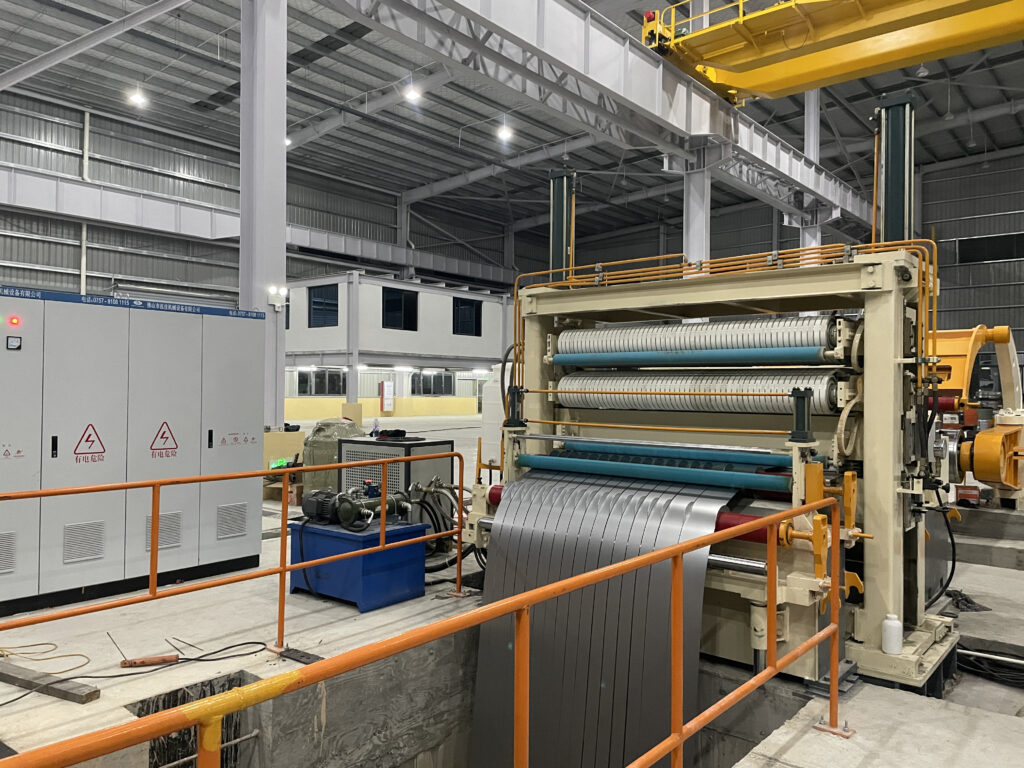
Key indicators that favor a slitting line:
- Strip width requirements concentrated in the 10–300mm range across multiple SKUs
- Frequent multi‑strip production from a single coil setup to feed tube mills or roll‑forming lines
- Coil‑to‑coil processing that supports continuous downstream operations
- High variability in required strip widths driven by diverse customer specifications
CTL line economics, by contrast, become compelling when standardized flat sheet dimensions dominate your order book. When flat sheets account for 70–75%+ of tonnage, a CTL line that uncoils, levels, cuts, and stacks to finished sheet sizes can consolidate multiple steps and lower overall handling cost.
CTL becomes the preferred choice when:
- Standard sheet dimensions form the core of your product portfolio
- Flat sheet demand consistently exceeds 75% of monthly volume
- Dimensional accuracy and flatness are critical quality parameters for downstream fabrication
- Integration with automated stacking systems reduces manual handling and storage labor
Контроль качества и требования к точности
As tolerances tighten across automotive, appliance, and construction markets, coil processors must align equipment choices with specific dimensional and surface quality targets. Slitting operations typically achieve width tolerances from ±0.1mm to ±0.3mm, depending on material thickness, knife metallurgy, and line configuration, with edge quality and burr control directly impacting downstream forming and welding.
Critical slitting line quality factors:
- Edge quality and burr minimization through correct knife selection and clearance
- Strip width consistency across the full coil length and at full line speed
- Coil telescoping prevention via multi‑zone tension control and synchronized recoiling
- Surface finish preservation through optimized threading, tension, and contact geometry
CTL systems, by design, prioritize length accuracy, flatness, and surface protection. Modern CTL lines routinely hold length tolerances around ±0.10–0.25mm, with multi‑roll levelers or temper/skin‑pass units used to remove coil set and deliver sheet flatness suitable for tight‑tolerance fabrication and laser cutting.
Key CTL precision capabilities:
- Length accuracy typically ±0.15mm, with advanced encoder systems achieving ±0.05mm under controlled conditions
- Flatness control via multi‑roll or temper leveling to meet sheet‑metal fabrication standards
- Surface protection during cutting and stacking through controlled support and adjustable stacker pressure
- Dimensional consistency that supports robotic welding, automated bending, and tight‑nest laser programs
Погрузочно-разгрузочные работы и сложность установки
Setup time is one of the largest hidden levers in coil line ROI, especially for high‑mix environments. Slitting lines generally require 30–90 minutes for changeovers, depending on the number of strips, width changes, and knife pack complexity. CTL lines often complete grade‑to‑grade or length‑to‑length changeovers in 15–45 minutes, especially when sheet families share similar widths and thicknesses.
Setup optimization factors across both line types include:
- Automated knife positioning systems that sharply reduce manual adjustment time in slitting applications
- Pre‑programmed job recipes enabling near “one‑touch” changeover for repeat orders
- Quick‑change tooling for common slit‑width configurations to minimize knife handling
- Material threading automation that reduces operator intervention and start‑up scrap
Всеобъемлющий обзор технологий
Фундаментальная механика линии продольной резки
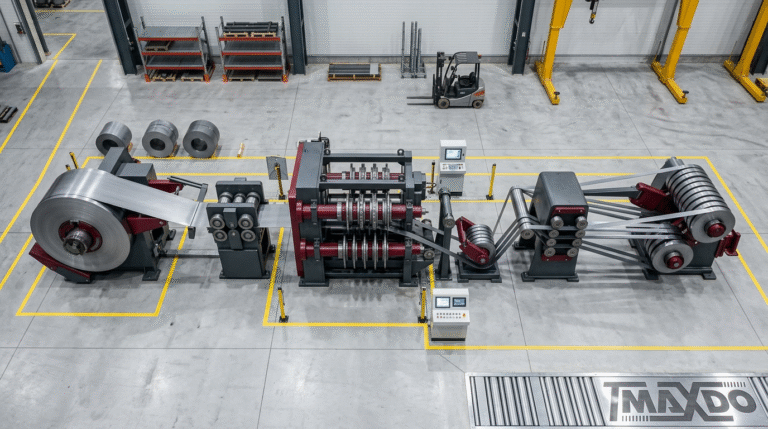
Slitting lines use rotary knives arranged on precision arbors to longitudinally cut a wide master coil into multiple narrower strips while maintaining coil form. The process allows service centers and OEMs to derive multiple SKUs from a single coil, each rewound as an individual narrow coil for downstream coil‑fed operations.
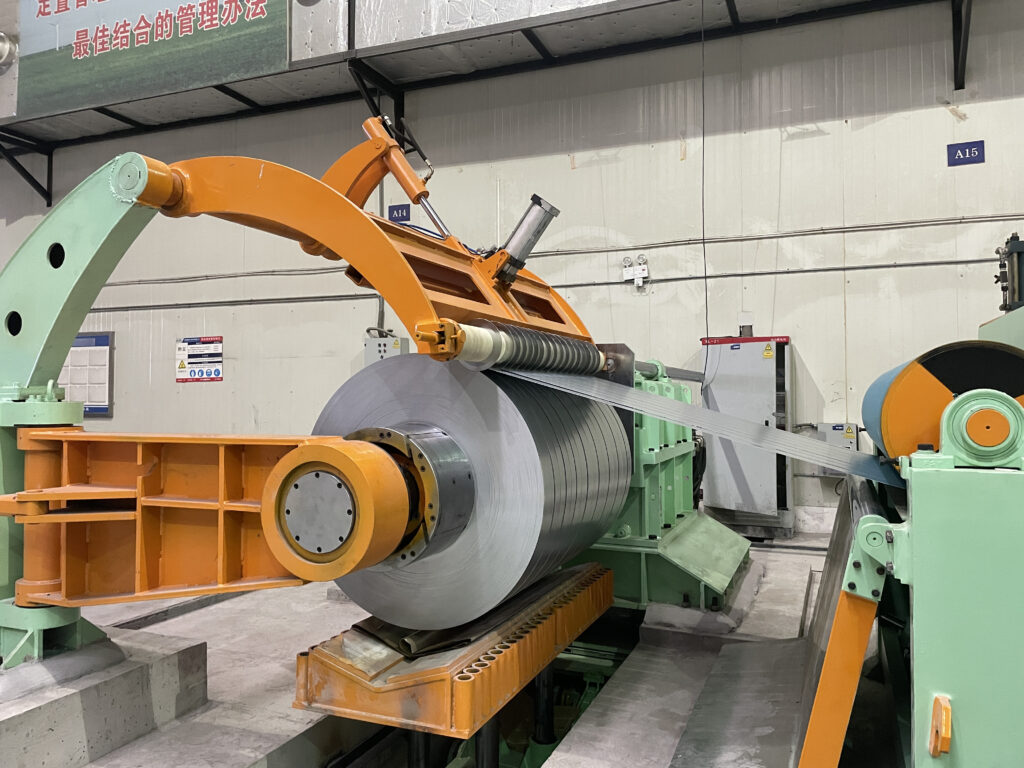
Primary slitting line system components:
- Hydraulic uncoiler with expandable mandrel sized to common coil inner diameters and equipped with braking/tension control
- Servo‑controlled slitting head providing precise knife positioning, axial clearance, and overlap adjustment
- Multi‑zone tension control (entry, slitter, recoiler) to maintain stable strip tracking and edge quality
- Synchronized recoilers or recoiler plus scrap winders that prevent telescoping and preserve coil integrity
Typical slitting line capability envelopes:
- Thickness capacity: approximately 0.3–12.0mm, depending on knife metallurgy and drive sizing
- Width processing: up to 2,100–2,150mm for standard wide coil formats
- Material types: cold‑rolled and hot‑rolled steel, stainless steel, aluminum, coated steels, and specialty alloys
- Processing speeds: from crawl speeds up to 150–300 m/min, depending on material and tolerance targets
Архитектура линии с разрезом по длине
Cut‑to‑length lines uncoil material, level it to remove coil set and shape defects, then shear it into discrete sheets of precise length, often followed by automated stacking. The leveling stage is central, as it defines the flatness and residual stress profile of the final sheet.
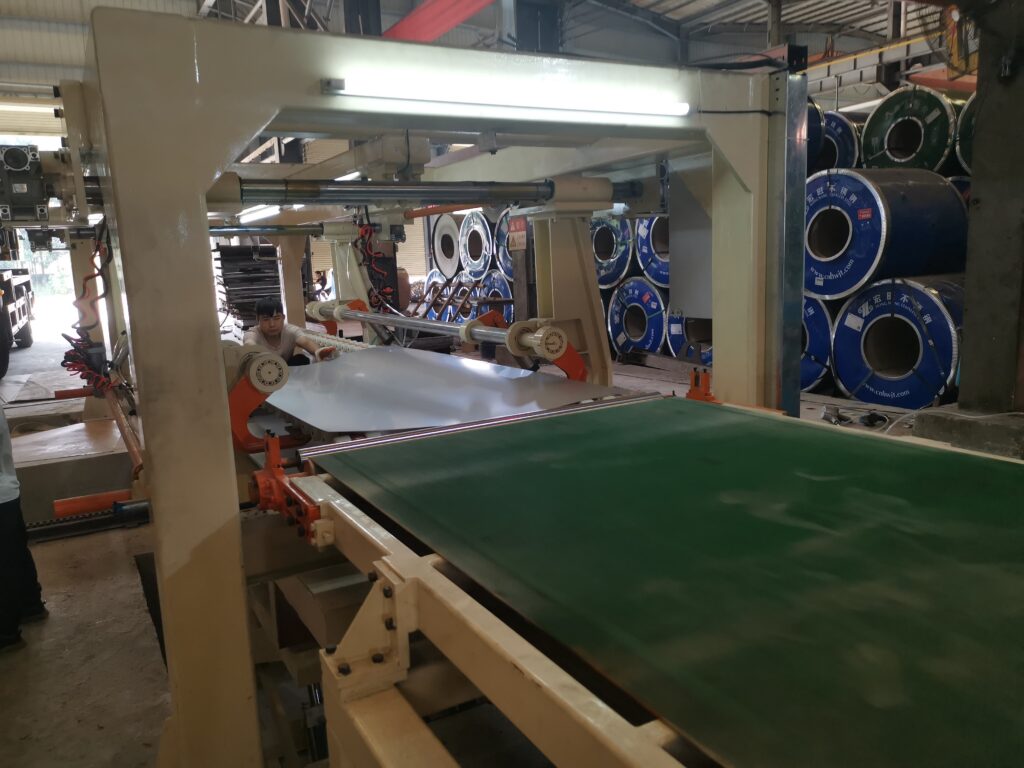
Core CTL system elements:
- Heavy‑duty uncoiler with servo‑driven payoff and integrated braking for consistent feed
- Multi‑roll or temper leveling unit (often 5–15 work rolls) to remove coil set and correct cross‑bow or wavy edges
- Precision length measurement using encoder‑based feed systems or servo roll feed controllers
- Mechanical, hydraulic, or flying shears for clean, square cuts at target line speed
- Stacking systems with adjustable support and drop heights to protect surface finish and edge integrity
Representative CTL line performance specifications:
- Thickness range: approximately 0.5–20.0mm, depending on leveler and shear design
- Width capacity: commonly up to 2,000mm for industrial sheet formats
- Length accuracy: ±0.15mm standard, with select systems achieving ±0.05mm under optimized conditions
- Processing speeds: typically 15–40 m/min for medium‑gauge sheet, higher for light‑gauge applications
| ROI Driver | Slitting Line (Typical) | CTL Line (Typical) | Best Fit Scenario |
|---|---|---|---|
| Main product | 10–300mm strips from master coils maxdomachine+1 | Standardized flat sheets maxdomachine+1 | Strip vs sheet dominant |
| Yield impact | 96–98% coil yield with optimized widths maxdomachine+2 | Trim and rework down to 2–3% with proper nesting selmach+1 | Material cost per ton |
| Tolerance focus | Width ±0.1–0.3mm, edge quality critical maxdomachine+2 | Length ±0.10–0.15mm, flatness 1–2 I‑units maxdomachine+2 | Dimensional specs |
| Changeover | 30–90 min; big leverage from auto knife setup maxdomachine+1 | 15–45 min for similar sheet families maxdomachine+1 | High‑mix, short runs |
| Typical payback | 14–24 months at 1,000–3,000 t/month maxdomachine+2 | 18–30 months, faster where flatness issues are chronic maxdomachine+2 | Capital planning |
Пошаговая схема реализации
Этап 1: Оценка требований и выбор оборудования
A structured requirements assessment is the foundation of an optimal investment decision. Before specifying a slitting or CTL line, document:
- Material specifications: grade families, thickness ranges, coating types, and surface finish constraints
- Product dimensions: target strip widths or sheet sizes and their associated tolerance requirements
- Volume projections: current and forecast monthly tonnage, plus seasonal or project‑driven peaks
- Quality standards: industry norms (e.g., automotive, construction) and key customer specifications
Use these criteria to compare candidate equipment:
- Processing capacity versus peak demand, including line speed and uptime assumptions
- Precision capabilities aligned to your tightest dimensional and flatness requirements
- Automation level appropriate for product mix complexity and available labor skills
- Maintenance requirements, critical spare parts availability, and OEM service support
Этап 2: Подготовка участка и планирование инфраструктуры
Slitting and CTL lines impose significant structural and utility demands that must be engineered into the facility. Proper foundations, power, and handling capacity directly influence long‑term performance and reliability.
Typical infrastructure specifications include:
- Foundations: reinforced concrete designed for machine mass and dynamic loads, often in the 3,000–4,000+ PSI range
- Power: three‑phase industrial supply sized for main drives, levelers, and auxiliary systems, plus surge margin
- Compressed air: stable flow and pressure with filtration for pneumatic actuators and safety devices
- Material handling: overhead cranes or coil cars appropriately rated for coil weights, often 20–40 tons in service centers
- Safety systems: distributed emergency stops, guarding, lockout/tagout points, and safe operator access platforms
Этап 3: Процесс установки и ввода в эксплуатацию
A disciplined, phased installation and commissioning process is vital to achieving target throughput and quality levels within the planned ramp‑up window. Typical commissioning windows run 2–4 weeks, depending on line complexity and integration scope.
A representative installation sequence:
- Foundation survey and alignment checks against OEM tolerances
- Mechanical assembly and precision alignment of uncoiler, leveler or slitter, and recoiler/stacker
- Electrical installation including power distribution, control panels, and safety circuits
- Hydraulic and pneumatic system connection, flushing, and pressure testing
- Control system programming, recipe setup, and HMI configuration
- Performance testing under load with representative materials and validation of dimensional and flatness results
Стратегии оптимизации и повышения производительности
Настройка оборудования и протоколы технического обслуживания
Preventive and predictive maintenance are central to maintaining edge quality, flatness, and uptime. For slitting lines, knife condition and alignment dominate edge quality; for CTL lines, leveler settings and shear condition drive flatness and cut quality.
Typical maintenance structure:
- Daily tasks: visual knife inspection, lubrication checks, tension system verification, safety function tests
- Weekly checks: knife wear measurement and replacement scheduling, bearing inspections, electrical connection tightening, high‑level performance review
- Monthly activities: complete knife set inspection and reconditioning, hydraulic fluid testing, calibration verification of length and width measurement systems, comprehensive safety validation
Контроль процессов и оптимизация качества
Modern lines increasingly use automation and analytics to stabilize quality and reduce operator dependency. Integrated process monitoring helps facilities close the performance gap between median and top‑quartile line utilization.
Key process optimization tools:
- Automated knife positioning to reduce setup times and improve strip width repeatability
- Real‑time quality monitoring with dimensional feedback and statistical process control
- Predictive maintenance using vibration, temperature, and runtime data to preempt failures
- Production data analytics to identify chronic losses, optimize changeovers, and lift OEE
Quality control implementation often includes:
- In‑line width and length measurement for immediate detection of drift
- Surface inspection using cameras or vision systems in high‑value applications
- SPC charts tied to automatic parameter adjustments within defined control windows
- Traceability systems linking coil and process data to each outgoing bundle or coil
Поиск и устранение неисправностей
In slitting operations, edge quality problems—burrs, edge wave, and sliver generation—are among the most frequent challenges. The majority of burr‑related defects trace back to dull knives or incorrect clearance, with optimal clearances typically a single‑digit percentage of material thickness.
Typical countermeasures:
- Define material‑specific clearance windows (for example, roughly 8–12% of strip thickness as a starting guideline)
- Implement condition monitoring and scheduled knife changes based on processed tonnage
- Match knife hardness to material tensile strength to avoid rapid wear or chipping
- Use documented troubleshooting trees for recurring issues such as telescoping, camber, or cross‑bow after slitting
ROI Modeling and Investment Justification
Core ROI Drivers
Well‑structured ROI models for slitting and CTL lines quantify both direct and indirect impacts:
- Material yield: reduced trim and edge scrap from improved width/length tolerances and nesting
- Throughput: higher tons per hour via higher line speeds and fewer changeovers
- Labor: lower handling, measuring, and rework time through automation and stable quality
- Energy: lower kWh per ton as a result of continuous operation and efficient drives
- Rework and claims: fewer customer returns and less re‑leveling, re‑cutting, or re‑slitting
Facilities implementing automation upgrades and setup‑time reduction measures on slitting lines often report 40–60% improvement in setup duration and typical payback periods in the 12–18 month range, driven by reduced setup scrap and improved utilization. CTL lines that replace manual leveling and shearing frequently achieve ROI in 18–30 months, especially where chronic flatness and length‑tolerance issues previously drove substantial rework.
Typical Payback Windows
- High‑volume operations (>2,000 tons/month): 12–18 month payback for well‑matched slitting or CTL investments
- Medium‑volume facilities (500–2,000 tons/month): 18–30 month payback, depending on product mix and scrap baseline
- Specialty processing: ROI increasingly driven by premium pricing for tight tolerances, surface quality, or just‑in‑time supply capabilities
Факторы успеха внедрения
Обучение и развитие навыков
Comprehensive operator and maintenance training is essential to realizing the theoretical capabilities of any new line. Plants that invest early in structured training typically see start‑up time reduced by 40–60% and fewer quality problems in the first months of operation.
A robust training program typically covers:
- Safe equipment operation and emergency procedures
- Quality control methods, inspection techniques, and documentation
- First‑level troubleshooting and routine maintenance
- Advanced optimization, job recipe management, and data interpretation
Проверка эффективности и постоянное совершенствование
Defining and tracking clear KPIs helps ensure that equipment continues to operate at planned performance levels:
- Overall equipment effectiveness (OEE): often targeting >80–85% for highly automated lines
- First‑pass yield: aiming for >98% conformance to dimensional and flatness specifications
- Setup time per changeover: benchmarked and continuously improved via SMED‑style initiatives
- Material yield: monthly tracking of scrap and trim percentages against baseline
Заключение и рекомендации по выбору оборудования
The choice between metal slitting lines and cut‑to‑length systems must be precision‑tailored to your production profile, balancing volume mix, product specifications, and operational constraints to maximize ROI. When narrow strip outputs consistently exceed 65% of tonnage and downstream equipment is coil‑fed, slitting lines typically deliver the lowest cost per ton, often reducing width‑related scrap by up to 10–15% and lifting throughput by 20–25% once automation and setup optimization are fully implemented.
Where standardized flat sheets define your core product set, CTL lines equipped with advanced leveling and automation usually provide the stronger business case. Length accuracies around ±0.10–0.15mm and robust flatness control reduce rework, enhance fit‑up in fabrication, and support just‑in‑time workflows with changeovers routinely held under 45 minutes, which is particularly valuable for construction, appliance, and general sheet‑metal fabrication segments.
Industry trends through 2026 emphasize IoT‑enabled monitoring, downtime tracking, and AI‑driven predictive maintenance that improve uptime, stabilize quality, and further compress payback periods for both slitting and CTL platforms. Partnering with an OEM that combines technical consulting, pre‑engineering support, and long‑term service allows manufacturers to convert these technologies into sustained competitive advantage and predictable financial returns across the full lifecycle of the line.