


High Precision Slitting Technology: Achieving Tight Tolerances in Metal Processing
Discover how high precision slitting achieves ±0.1mm accuracy in metal processing. Expert guide covering tolerance standards, blade technology, and material yield optimization for manufacturers.
Precision matters in metal processing. When automotive manufacturers require strips within ±0.1mm tolerance or electronics fabricators demand burr-free edges, the difference between standard and high precision slitting becomes critical to production success and material yield.
High precision slitting represents the convergence of advanced blade technology, servo-driven control systems, and rigorous quality standards that enable metal processors to achieve tolerances previously considered impossible in high-speed coil processing. Modern precision slitting systems now routinely deliver ±0.05mm to ±0.1mm width accuracy while maintaining line speeds up to 250 meters per minute—a combination that directly impacts material waste, downstream processing efficiency, and final product quality.
This technical guide examines the engineering principles, technologies, and operational factors that enable tight tolerance achievement in metal slitting operations. Production managers and industrial engineers will find actionable insights on blade positioning systems, tension control mechanisms, material-specific considerations, and the real-world performance benchmarks that define precision slitting in today’s competitive manufacturing environment.
Whether you’re evaluating equipment upgrades, troubleshooting tolerance issues, or seeking to understand how precision metal processing equipment achieves micron-level accuracy, this comprehensive analysis provides the technical foundation for informed decision-making.
Understanding Precision Slitting Tolerances
Precision slitting transforms wide metal coils into narrower strips through controlled rotary knife cutting, where blade positioning accuracy directly determines the dimensional consistency of finished strips. Unlike blanking operations that produce discrete sheets, slitting must maintain continuous accuracy across thousands of linear meters, making tolerance control both critical and technically demanding.
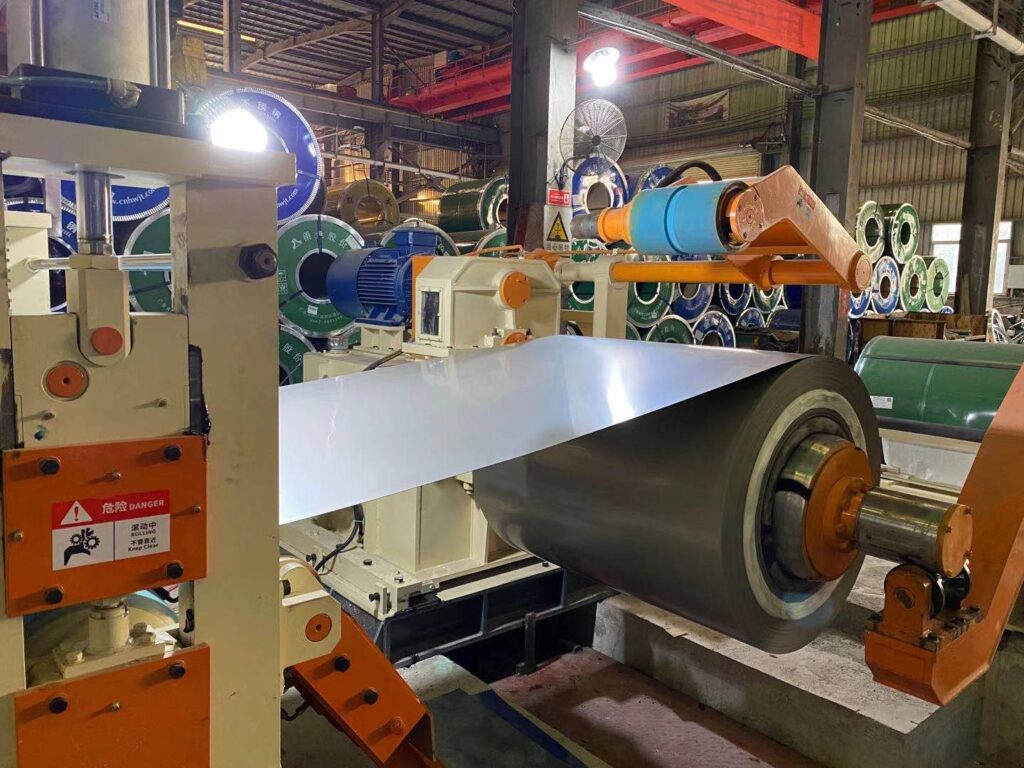
Industry tolerance standards follow ISO 2768 specifications, which establish acceptable dimensional variations based on material thickness and intended application. For metal coil slitting, tolerance ranges typically span from ±0.005 inches (±0.127mm) for thin-gauge precision applications to ±0.030 inches (±0.762mm) for thicker construction-grade materials. These standards provide a framework, but actual achievable tolerances depend on equipment capability, material properties, and operational parameters.
The distinction between standard and high precision slitting becomes evident in real-world applications. Standard slitting systems typically achieve ±0.3mm width tolerance, suitable for construction materials, HVAC ducting, and general fabrication where dimensional variation has minimal impact on final assembly. High precision systems, by contrast, deliver ±0.05mm to ±0.1mm accuracy—the tolerance level required for automotive stamping blanks, electronics enclosures, and appliance components where part interchangeability and tight assembly fits are non-negotiable.
MaxDo’s MD series machines exemplify this precision tier, achieving ±0.1mm positional accuracy across their complete product range from the compact MD-850 to the heavy-duty MD-2200. This performance level places these systems in the top tier of precision slitting capability, enabling processors to serve demanding markets while achieving 96%+ material yield through reduced edge trim and scrap generation.
Critical Factors Affecting Slitting Precision
Three interconnected factors determine whether a slitting operation achieves standard or precision-grade tolerances: mechanical systems, material characteristics, and process control. Understanding how these elements interact provides the foundation for both equipment selection and operational optimization.
Blade sharpness and positioning accuracy form the first critical control point. Dull blades create inconsistent cutting forces that push material laterally, introducing width variation even when blade spacing remains constant. Precision slitting systems employ tool holders with positioning accuracy to 0.01mm, combined with blade materials that maintain sharp cutting edges through extended production runs. The positioning system must compensate for thermal expansion, vibration, and wear—any uncontrolled movement at the blade translates directly into strip width variation.
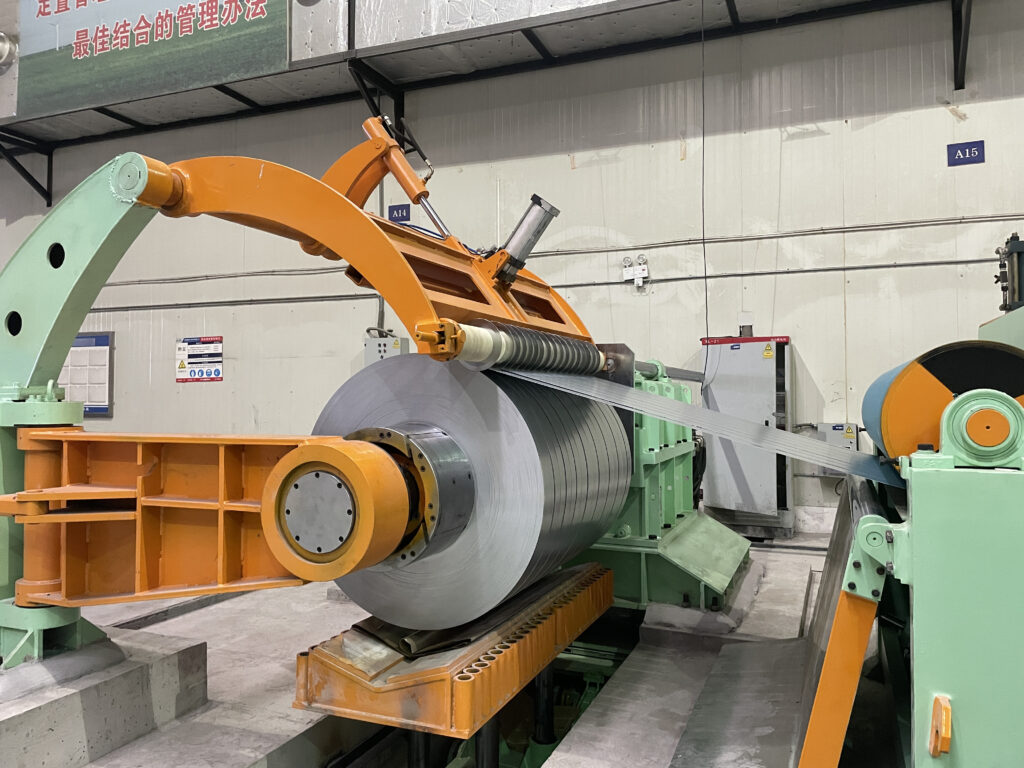
Machine rigidity and linear guide systems provide the structural foundation for micron-level accuracy. Heavy-duty frames resist deflection under cutting forces, while precision linear guides maintain blade positioning throughout the stroke cycle. The difference between standard and precision equipment often lies in frame construction—precision systems use reinforced welded structures with vibration dampening, where standard machines may exhibit flex under load. This rigidity becomes increasingly critical as line speed increases and material thickness grows.
Temperature control, vibration dampening, and tension management represent the environmental and process factors that impact precision. Metal coil temperature affects material properties and dimensional stability during slitting. Uncontrolled vibration—from motor imbalance, bearing wear, or resonance—introduces cyclic positioning errors. Material tension must remain constant across the web width; tension variation creates edge wave, camber, and dimensional inconsistency. Advanced tension control systems use multi-zone monitoring and servo-driven correction to maintain uniform strip quality.
Real-world production demonstrates these differences clearly. A standard slitting line processing 1.5mm stainless steel at ±0.3mm tolerance may accept blade positioning variation of ±0.15mm and tension fluctuation of 8-10%. A high precision slitting operation targeting ±0.1mm tolerance on the same material requires blade positioning stability within ±0.03mm and tension control within 2-3%. The precision operation demands more sophisticated equipment, but delivers material yield improvements of 3-5% and eliminates downstream rejection from dimensional non-conformance.
Core Technologies Enabling Tight Tolerances
Achieving and maintaining tight tolerances in precision slitting requires integration of advanced mechanical, electronic, and control technologies. Each system component contributes to overall accuracy, creating a performance level greater than individual elements alone.
Advanced blade positioning systems with servo control replace traditional mechanical adjustment with electronically controlled precision. Servo motors drive ball screws or linear actuators that position blade holders with resolution to 0.01mm, while encoders provide continuous position feedback. This closed-loop control enables rapid setup changes, automatic compensation for wear or thermal drift, and consistent positioning accuracy across the full width of the slitting line. The servo system can store setup parameters for different materials and widths, reducing changeover time while maintaining tolerance specifications.
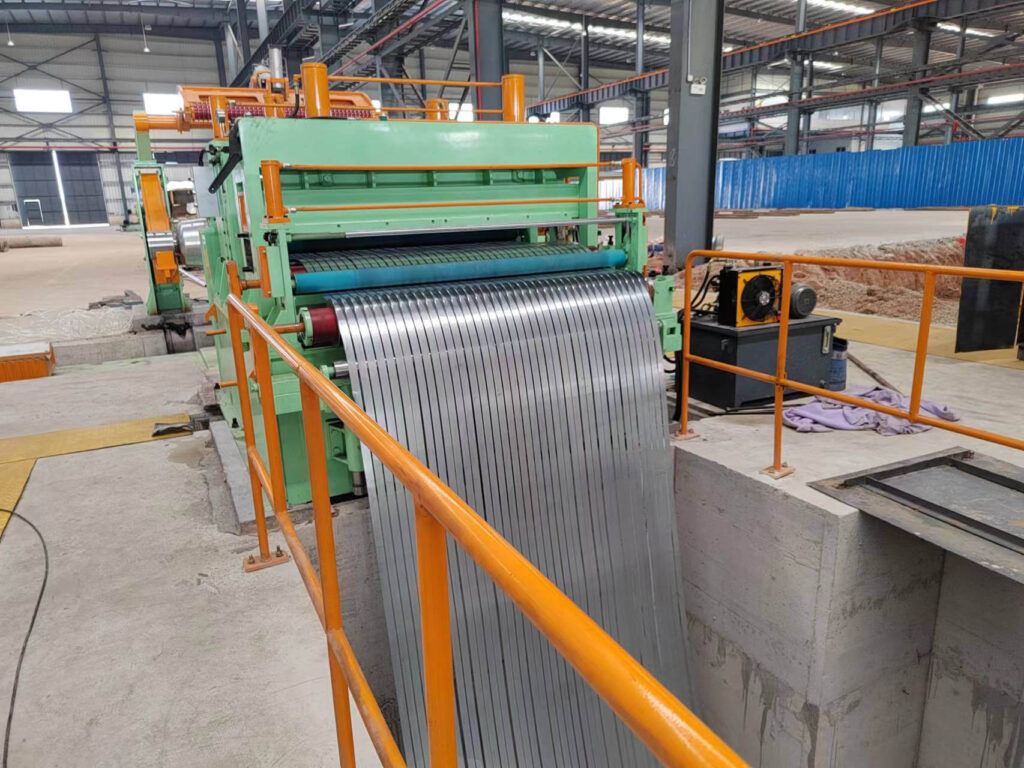
Precision linear guides and high-rigidity frames form the mechanical platform that supports electronic control systems. Linear guides use hardened steel rails and recirculating ball bearings to provide motion with minimal friction and zero backlash. Guide accuracy typically ranges from 5-10 microns over their full travel length. The supporting frame structure must resist deflection under cutting forces—precision systems often use reinforced steel construction with finite element analysis optimization to minimize flex while maintaining acceptable machine weight. Frame deflection of 0.1mm under load can negate even the most sophisticated positioning control.
Real-time tension monitoring and compensation systems address the dynamic challenge of maintaining uniform strip tension during slitting. Multiple tension zones—uncoiler, slitter entrance, slitter exit, and recoiler—each require independent monitoring and control. Load cells measure actual tension forces, while servo-driven motors adjust rotational speed to maintain setpoints. The control system must respond to transient events like coil splices, thickness variation, or speed changes within milliseconds to prevent tension-related defects. Advanced systems employ predictive algorithms that anticipate tension changes based on coil geometry and material properties.
Tool holder stability and blade quality requirements complete the mechanical precision package. Tool holders must resist torsional and bending loads while maintaining precise blade spacing. Quick-change designs that enable rapid blade replacement without sacrificing positioning accuracy represent a significant engineering challenge—the clamping mechanism must provide repeatable positioning to within 0.05mm across hundreds of change cycles. Blade quality affects both initial precision and tolerance stability over production runs. Premium blades using high-speed steel or carbide maintain cutting edge geometry longer, reducing the frequency of blade changes and associated setup time.
These technologies integrate through a programmable logic controller (PLC) that coordinates all system functions. The PLC receives input from position encoders, tension sensors, line speed measurements, and operator interface, then outputs control signals to servo drives, hydraulic valves, and monitoring systems. Sophisticated PLC programming enables features like automatic edge trim optimization, predictive maintenance alerts, and production data logging—capabilities that extend beyond basic tolerance control to improve overall equipment effectiveness.
Material-Specific Tolerance Requirements
Different metals present unique challenges for precision slitting due to variations in mechanical properties, work hardening characteristics, and edge behavior during cutting. Understanding these material-specific factors enables realistic tolerance expectations and appropriate process parameter selection.
Tolerance ranges for different metal thicknesses follow predictable patterns, but with material-dependent variations. Thin-gauge materials (0.3-2.0mm) generally enable tighter tolerances because cutting forces remain low and blade deflection is minimal. Mid-range thickness (2.0-6.0mm) requires increased blade rigidity and positioning force, potentially widening achievable tolerances by 0.02-0.05mm. Heavy-gauge materials (6.0-12.0mm) present the greatest tolerance challenge—high cutting forces can deflect even rigid blade positioning systems, and material springback after slitting may cause dimensional variation independent of blade positioning accuracy.
Aluminum demonstrates excellent slittability across the thickness range. Its relatively low yield strength minimizes cutting forces, while good thermal conductivity reduces heat buildup that might affect dimensional stability. Precision slitting of aluminum routinely achieves ±0.05mm to ±0.08mm tolerance in thicknesses from 0.5mm to 6.0mm. The primary challenge with aluminum is edge burr formation—the material’s tendency to tear rather than shear cleanly requires careful blade geometry and sharpness maintenance to prevent edge defects that compromise downstream processing.
Stainless steel presents greater difficulty due to high tensile strength and significant work hardening during cutting. The material’s strain hardening rate means that each successive blade pass through the material encounters increasing resistance, potentially affecting blade positioning stability. Precision slitting of stainless steel typically achieves ±0.08mm to ±0.12mm tolerance depending on thickness and grade. Austenitic stainless grades (304, 316) prove easier to slit than martensitic grades due to lower hardness and better ductility. Edge quality in stainless steel slitting depends heavily on blade sharpness—dull blades create work hardening, edge roughness, and potential for edge cracking.
Mild steel and carbon steel offer balanced slitting characteristics with moderate strength and minimal work hardening. These materials enable precision slitting tolerances of ±0.06mm to ±0.10mm across typical thickness ranges. Surface coatings (galvanized, pre-painted) add complexity—the coating layer may flake or delaminate at slit edges if blade geometry or cutting speed is incorrect. Coated steel slitting requires attention to blade clearance and cutting angle to maintain both substrate and coating integrity at the edge.
Material properties impact achievable tolerances through multiple mechanisms. Yield strength determines cutting force magnitude and blade deflection potential. Elongation percentage affects edge stretching during cutting—high-elongation materials may show greater width variation from edge deformation. Surface finish influences friction between material and guides, affecting tension stability. Coil set (inherent curvature from coiling) requires leveling before slitting to achieve tight tolerances—attempting to slit material with significant coil set introduces cyclic tension variation that appears as width inconsistency.
Understanding these material-specific factors enables realistic tolerance specification during custom slitting line design and prevents over-specification that increases cost without improving actual production outcomes.
MaxDo MD Series: Engineering for ±0.1mm Accuracy
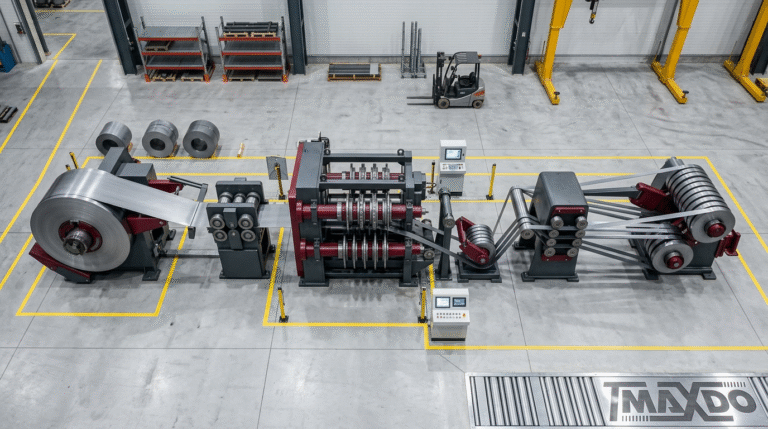
The MD series slitting lines from MaxDo demonstrate how integrated engineering achieves consistent ±0.1mm positional accuracy across varying production requirements. Four models—MD-850, MD-1350, MD-1650, and MD-2200—address different width and thickness ranges while maintaining equivalent precision performance through common technology platforms.
MD-850 precision capabilities target compact applications requiring slitting of 300-820mm wide coils in thickness ranges from 0.3mm to 12mm depending on material grade. The machine achieves line speeds up to 250 meters per minute while maintaining ±0.1mm positional accuracy through servo-controlled blade positioning and high-rigidity linear guides. Despite its compact footprint, the MD-850 incorporates vibration dampening systems and multi-zone tension control typically found only in larger machines. This enables processors serving HVAC, appliance, and electronics markets to achieve precision performance in space-constrained facilities.
MD-1350 and MD-1650 mid-range performance extends precision slitting to wider materials (1,300mm and 1,650mm respectively) while maintaining identical ±0.1mm tolerance capability. These models incorporate heavier frame construction and increased motor power (136kW and 294.5kW) to handle higher cutting forces without sacrificing positioning accuracy. The wider operating envelope makes these machines suitable for automotive blank production, construction panel slitting, and steel service center operations where material width variation requires operational flexibility. Servo-driven blade positioning enables rapid width changes—complete tool setup can occur in under 15 minutes on stored programs, minimizing production interruption during product changeovers.
MD-2200 heavy-duty precision addresses the most demanding slitting applications requiring processing of materials up to 2,200mm width and 12mm thickness. Despite the significantly higher cutting forces involved, the machine maintains ±0.1mm accuracy through enhanced frame rigidity, high-capacity linear guides, and advanced tension control algorithms. Heavy coil handling (10-35 tons) requires sophisticated uncoiling systems that prevent shock loads from translating through the line—any sudden tension change could compromise precision during actual slitting. The MD-2200’s multi-zone tension monitoring system uses predictive algorithms to anticipate coil behavior and adjust tension preemptively rather than reactively.
96%+ material yield performance across the MD series results from the compound effect of precision control. Tight width tolerance reduces edge trim requirements by 2-4mm per edge compared to standard equipment—on a 1,500mm coil producing 100mm strips, this precision saves 40-80mm per coil, representing 3-5% yield improvement. Consistent edge quality eliminates downstream rejection from burrs or dimensional non-conformance. Reduced setup time and scrap during product changeovers further improves overall material utilization. For processors running high-value materials like stainless steel or aluminum alloy, these yield improvements generate payback periods of 18-24 months on precision equipment investment.
Advanced blade positioning systems throughout the MD series employ common servo control architecture with model-specific scaling for force requirements. Position encoders provide feedback resolution of 0.001mm, while control algorithms update positioning commands at 1kHz frequency. This responsiveness enables the system to compensate for dynamic forces during acceleration, deceleration, and speed changes—maintaining tolerance during transient conditions as well as steady-state operation. Blade holders use tapered interfaces that provide positioning repeatability within 0.02mm during tool changes, enabling operators to switch blade sets without compromising dimensional accuracy.
Real-time monitoring and correction systems provide continuous verification that actual performance matches specification. Strip width measurement systems using laser sensors or mechanical gauges check every strip produced, comparing actual dimensions against setpoints. When deviations approach tolerance limits, the control system alerts operators and can automatically adjust blade positioning to correct trending errors before out-of-specification material is produced. Data logging captures all production parameters, enabling post-production analysis to identify patterns, optimize processes, and demonstrate quality compliance to customers requiring certified material.
Industry Tolerance Standards and Benchmarks
ISO 2768 provides the internationally recognized framework for general tolerances in metal fabrication, establishing four tolerance classes (fine, medium, coarse, very coarse) based on dimensional ranges. For metal slitting operations, these standards inform tolerance specification but require interpretation for continuous strip processing versus discrete part manufacturing.
Width tolerance ranges in production slitting operations typically follow these industry benchmarks:
- Precision applications (±0.05-0.1mm): Automotive stamping blanks, electronics enclosures, precision appliance components, medical device components
- Standard applications (±0.15-0.25mm): General fabrication, HVAC components, construction materials, agricultural equipment parts
- Commercial applications (±0.3-0.5mm): Structural components, large appliance bodies, industrial equipment frames
These ranges reflect practical capability of equipment classes rather than theoretical limits. Achieving precision-tier tolerances requires high precision slitting equipment with servo controls, rigid construction, and sophisticated tension management. Standard tolerance levels remain achievable with conventional mechanical adjustment systems and basic tension control.
Edge quality and burr control requirements complement dimensional tolerances in defining slit strip quality. Burr height specification typically ranges from “no visible burr” for precision applications to “maximum 0.1mm burr height” for standard applications. Edge roughness measurements using Ra (average roughness) values indicate surface quality—precision slitting targets Ra values below 3.2μm, while standard operations may accept up to 6.3μm. These edge characteristics impact downstream processing efficiency: excessive burr requires secondary deburring operations, while rough edges may cause tooling wear during stamping or forming operations.
Comparison with alternative cutting methods demonstrates precision slitting’s competitive position. Laser cutting achieves ±0.05-0.1mm tolerances with excellent edge quality but operates at significantly slower speeds (5-20 meters/minute versus 100-250 meters/minute for slitting) and higher operating costs due to energy consumption and consumable usage. Waterjet cutting provides similar tolerance capability without heat-affected zones but faces identical speed and cost limitations. Plasma cutting offers faster speeds but coarser tolerances (±0.5-1.5mm) that disqualify it from precision applications. Mechanical shearing varies from ±0.1-0.5mm depending on material thickness but produces discrete lengths rather than continuous strip.
For production scenarios requiring narrow strips from wide coils with tight tolerances and high throughput, precision slitting offers the optimal combination of accuracy, speed, and economic efficiency. Understanding these process differences enables appropriate technology selection based on actual production requirements rather than over-specification that increases capital cost without improving final product quality.
Industry benchmarking studies indicate that precision slitting equipment investment typically carries a 25-40% premium over standard systems. For processors serving markets where tight tolerances enable premium pricing, eliminate downstream rejection, or reduce material costs through improved yield, this premium generates positive return on investment. Processors serving tolerance-insensitive markets should specify standard equipment to avoid unnecessary capital expenditure on precision capability that provides no value to their customer base or competitive position.
Optimizing Precision in Your Operations
Achieving specified tolerances requires more than capable equipment—operational discipline, preventive maintenance, and continuous monitoring ensure that precision capability translates into actual production performance. Production managers and maintenance teams should focus on these critical control points.
Blade management programs significantly impact tolerance consistency. Establish blade sharpness inspection criteria using visual examination (edge reflection under magnification) or practical tests (edge quality on sample strips). Replace or resharpen blades before edge quality degradation affects dimensional accuracy—waiting until defects appear in production creates scrap and potential customer rejection. Implement blade rotation schedules that distribute wear across the blade set, maximizing usable life before sharpening is required. For critical applications, maintain statistical process control (SPC) charts tracking strip width measurements to detect blade wear trends before they violate tolerance specifications.
Setup procedures and verification deserve equal attention. Document setup parameters for each product including blade spacing, tension setpoints, and line speed. Verify critical dimensions before full production—produce sample strips and measure actual width at multiple points along the length to confirm accuracy. Check edge quality visually and tactically for burrs or roughness that indicate setup problems. Allow new setups to stabilize—tension distribution across the line may require 5-10 meters of production before reaching steady state. Retain setup documentation for future production runs to enable rapid changeovers without extensive trial-and-error adjustment.
Environmental factors affecting precision often receive insufficient attention. Maintain consistent facility temperature to minimize thermal expansion of machine components—a 10°C temperature change can cause 0.1mm dimensional change in a 10-meter machine structure. Control coil storage temperature to prevent condensation that creates surface friction variation and tension control problems. Ensure proper facility vibration isolation—mounting slitting equipment on structural floors rather than suspended slabs prevents building vibration from affecting machine precision. Monitor and maintain hydraulic system temperature within specification—viscosity changes from temperature variation affect actuator response and positioning accuracy.
Maintenance protocols should prioritize precision-critical components. Inspect linear guide systems quarterly for contamination, wear, or damage—any degradation in guide performance directly impacts positioning accuracy. Verify servo motor encoder function and position feedback calibration annually using precision measurement tools. Check blade holder clamping force and wear—loose or worn holders compromise positioning repeatability during blade changes. Maintain tension control system calibration by verifying load cell accuracy against reference standards. Document all maintenance activities and correlate with production quality data to identify patterns and optimize maintenance intervals.
Continuous improvement processes leverage production data to refine operations progressively. Collect strip width measurements systematically and analyze for patterns—consistent bias in one direction indicates systematic positioning error that calibration can correct, while random variation suggests mechanical wear or inadequate process control. Track material yield by product and identify opportunities for edge trim optimization. Monitor blade life by material type and thickness to identify applications requiring more frequent blade changes or alternative blade materials. Compare actual production rates against theoretical capacity to identify bottlenecks and optimization opportunities.
Processors committed to these operational disciplines achieve tolerance performance approaching equipment capability limits while maximizing equipment uptime and material yield. Modern precision metal processing succeeds through the integration of capable equipment with disciplined operations.
Conclusión
High precision slitting technology has evolved from specialized capability to production necessity for metal processors serving automotive, electronics, appliance, and precision fabrication markets. The convergence of servo-driven control systems, advanced blade positioning, real-time tension management, and sophisticated monitoring enables modern slitting lines to achieve ±0.05-0.1mm tolerances while maintaining the high production speeds that make coil slitting economically competitive.
Success in precision slitting requires understanding the interconnected factors that enable tolerance achievement: blade sharpness and positioning accuracy, machine rigidity and vibration control, material-specific characteristics, and environmental factors. Equipment selection should balance precision capability against actual production requirements—over-specification increases capital cost without improving product quality, while under-specification creates ongoing quality problems and competitive disadvantage.
The MaxDo MD series demonstrates how integrated engineering delivers precision performance across varying production scales, from the compact MD-850 to the heavy-duty MD-2200, while maintaining consistent ±0.1mm accuracy and 96%+ material yield. These performance benchmarks represent industry-leading capability that enables processors to serve demanding markets while optimizing material costs through improved yield.
For production managers evaluating slitting equipment or troubleshooting tolerance issues, focus on the engineering fundamentals: mechanical precision, servo control responsiveness, tension management sophistication, and real-time monitoring capability. Operational discipline in blade management, setup verification, environmental control, and preventive maintenance ensures that equipment capability translates into actual production performance.
Ready to implement high precision slitting in your operation? Contact MaxDo’s engineering team to discuss your specific tolerance requirements, material characteristics, and production volume. Our application engineers provide technical consultation, equipment selection guidance, and operational support to help you achieve precision performance that drives competitive advantage.
*
PREGUNTAS FRECUENTES
What tolerance can high precision slitting achieve?
Modern high precision slitting systems routinely achieve ±0.05mm to ±0.1mm width tolerance depending on material type, thickness, and line configuration. Thin-gauge materials (0.3-2.0mm) enable the tightest tolerances (±0.05-0.08mm), while heavier gauge materials (6.0-12.0mm) typically achieve ±0.1-0.15mm due to increased cutting forces and blade deflection. Material properties significantly impact achievable tolerance—aluminum and mild steel enable tighter tolerances than high-strength stainless steel or hardened alloys. MaxDo’s MD series machines deliver consistent ±0.1mm accuracy across their operating range through servo-controlled blade positioning, high-rigidity frames, and advanced tension management systems.
How does blade quality affect slitting precision?
Blade quality impacts precision slitting through three primary mechanisms: cutting edge sharpness, dimensional consistency, and wear resistance. Sharp blades create clean cutting action with minimal lateral force that could deflect material or positioning systems—dull blades increase cutting forces by 30-50% and generate inconsistent strip width even when blade spacing remains constant. Dimensional consistency of blade manufacturing affects positioning accuracy—premium blades maintain thickness and diameter specifications within 0.01mm, while economy blades may vary by 0.05mm or more. Wear resistance determines how long blades maintain sharp edges and dimensional consistency—high-speed steel and carbide blades retain cutting performance through extended production runs, reducing changeover frequency and associated setup time.
What industries require high precision slitting?
Automotive parts manufacturing demands precision slitting for stamping blanks used in body panels, structural components, and trim parts where dimensional consistency ensures proper assembly fit and surface appearance. Electronics manufacturing requires tight-tolerance strips for enclosures, brackets, and shielding components where micron-level variation can prevent proper assembly. Appliance manufacturers use precision slitting for critical visible components and structural elements requiring exact dimensions for automated assembly processes. Aerospace component fabrication specifies precision-slit material for safety-critical parts requiring full material traceability and dimensional certification. Medical device manufacturing demands precision slitting of stainless steel and specialty alloys for surgical instruments and implantable device components where tolerance violation creates product liability risk.
How does material thickness affect slitting accuracy?
Material thickness influences achievable slitting accuracy through cutting force magnitude, blade deflection potential, and material behavior during cutting. Thin-gauge materials (under 2.0mm) generate relatively low cutting forces that minimize blade deflection and enable tight tolerances (±0.05-0.08mm) even on moderate-precision equipment. Mid-range thickness (2.0-6.0mm) requires increased blade positioning force and structural rigidity to maintain accuracy—tolerances typically widen to ±0.08-0.12mm unless premium equipment with enhanced rigidity is employed. Heavy-gauge materials (6.0-12.0mm and above) present the greatest accuracy challenge due to high cutting forces, increased blade deflection, and material springback after cutting—achieving ±0.1-0.15mm tolerance requires high precision slitting equipment with heavy-duty frames, high-capacity servo systems, and sophisticated tension control.
What’s the difference between precision slitting and standard slitting equipment?
Precision slitting equipment differs from standard systems in five critical areas: positioning accuracy, frame rigidity, control sophistication, tension management, and monitoring capability. Precision systems employ servo-controlled blade positioning with 0.01mm resolution versus mechanical adjustment with 0.1mm typical resolution. Precision equipment uses reinforced frames with finite element optimization to minimize deflection under load, while standard equipment may use lighter construction accepting greater flex. Control systems in precision machines provide closed-loop feedback, automatic compensation, and predictive algorithms versus open-loop or simple PID control in standard equipment. Multi-zone tension monitoring with millisecond response enables precision systems to maintain ±2% tension consistency versus ±8-10% in standard systems. Real-time monitoring with SPC integration provides continuous verification in precision equipment versus periodic manual inspection in standard operations. These differences translate into ±0.05-0.1mm tolerance capability for precision equipment versus ±0.3-0.5mm for standard systems—a performance gap that justifies 25-40% premium pricing for applications where tolerance control drives product quality and material yield.