

MaxDo High-Precision Cut to Length Line Delivered to Poland: Steel Service Center Case Study
The Łódź service center's procurement team evaluated four CTL line suppliers: a German manufacturer, a Taiwanese manufacturer, a Chinese tier-1 brand, and MaxDo.
| Detail | Information |
|---|---|
| Client Location | Łódź, Poland (Central Poland industrial zone) |
| Business Type | Independent steel service center supplying fabricators, laser cutting subcontractors, and sheet metal workshops |
| Markets Served | Poland domestic; Czech Republic; Slovakia; Germany (small-format sheet distribution) |
| Products Processed | Carbon steel (DC01, DC04, S235, S355) and stainless steel (SS 304, SS 316L) flat sheet, cut to customer-specified lengths |
| Coil Width Input | 600–1,500 mm |
| Gama de espesores | 0.5–4.0 mm (primary; specified for thicker gauge to 6.0 mm) |
| Equipment Supplied | MaxDo High-Precision Stainless/Carbon Combined CTL Line |
| Sheet Length Range | 500–6,000 mm |
| Length Tolerance Required | ±0.3 mm (stainless); ±0.5 mm (carbon) |
| Flatness Required | ≤ 3 mm/m² (stainless); ≤ 5 mm/m² (carbon) |
| Daily Output Target | 15–25 tons/shift |
| Investment Driver | Replace manual guillotine shear line; achieve precision tolerance for laser-cutting customers |
The Eastern European Service Center Market Context
Poland has emerged as the manufacturing backbone of Central and Eastern Europe — one of the EU’s leading producers of fabricated metal components, furniture, construction products, and automotive subcomponents. The country’s steel service center sector has grown to match: dozens of independent service centers operate across Łódź, Wrocław, Poznań, Katowice, and Warsaw, supplying flat sheet, strip, and processed coil to a dense base of metal fabricators.
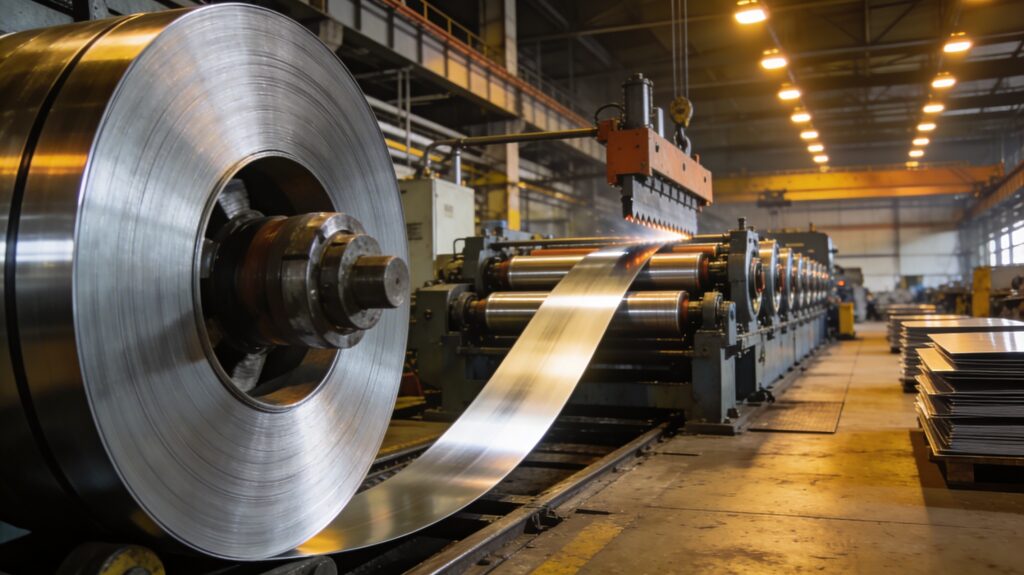
The structural challenge facing Polish service centers in 2024–2025 was a customer base that had upgraded to fiber laser cutting — a technology that demands tight sheet flatness (≤ 3 mm/m² to maintain focal distance at high cutting speeds) and precise length dimensions. Manual guillotine shears and older CTL lines without precision levelers could not consistently meet these requirements. Service centers that upgraded to precision CTL equipment gained a measurable commercial advantage with laser-cutting customers — and those that did not were losing sheet supply contracts to better-equipped competitors.
The Łódź client was in this exact position: a well-established service center with strong customer relationships but aging shear equipment that was producing flatness of 8–12 mm/m² on thin stainless — three to four times above the 3 mm/m² requirement of their largest laser-cutting customer.
Why the Client Chose MaxDo
The Łódź service center’s procurement team evaluated four CTL line suppliers: a German manufacturer, a Taiwanese manufacturer, a Chinese tier-1 brand, and MaxDo.
German option: Superior engineering reputation; fully CE-certified with comprehensive EU documentation. Price: approximately 2.8× MaxDo’s quotation for comparable specifications. The client’s return-on-investment calculation showed a 5.2-year payback at the German price — beyond the 3-year threshold the ownership required.
Taiwanese option: Competitive quality; CE certification available. Price: 1.6× MaxDo’s quotation. Payback calculation: 3.1 years — marginally above threshold. Technical review noted that the Taiwanese proposal specified a 13-roll leveler; MaxDo proposed a 17-roll leveler for the same stainless 0.5 mm capability — the higher roll count is materially important for thin-gauge stainless flatness.
Chinese tier-1 competitor: Price similar to MaxDo; CE certification not available (relevant for EU installation). The client’s legal team flagged CE marking as a requirement under the EU Machinery Directive — without it, the machine could not be legally commissioned in Poland. This eliminated the tier-1 competitor.
MaxDo: CE-certified machine (EU Machinery Directive 2006/42/EC); 17-roll precision leveler for stainless; ±0.3 mm length tolerance specification documented and guaranteed at FAT; price producing a 2.4-year payback calculation at the client’s projected throughput. Selected.
Equipment Configuration
MaxDo High-Precision Stainless/Carbon Combined CTL Line
Decoiler section:
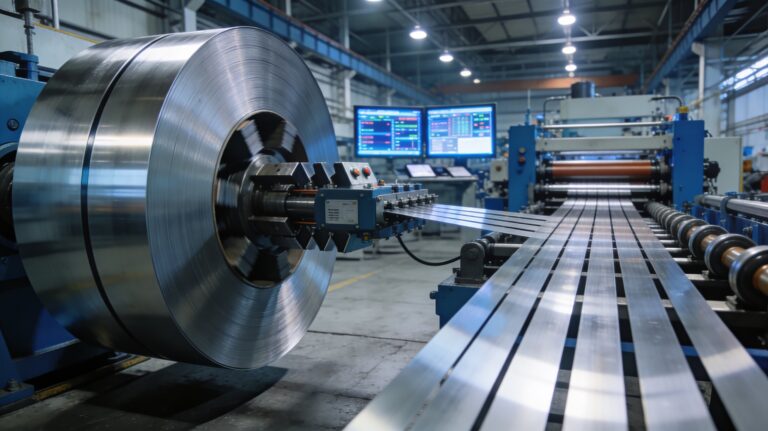
- Capacity: 15-ton coil, hydraulic mandrel expansion (600–1,550 mm coil ID)
- Coil car: motorized, aligns coil to line centerline automatically
- Safety guard: pneumatic pinch roll guard at coil entry
Straightener / pre-leveler:
- 7-roll heavy-duty straightener for initial coil curvature removal
- Roll diameter: 120 mm (suitable for 4.0 mm carbon steel)
Precision leveler (critical specification):
- 17 upper + lower rolls, diameter 60 mm
- Individual upper roll pressure adjustment (hydraulic) — each upper roll independently controlled
- Stainless steel mode: upper roll engagement depth adjusted deeper for work-hardened stainless
- Carbon steel mode: standard engagement depth
- Flatness achieved: ≤ 2.5 mm/m² on SS 304, 0.5–1.5 mm; ≤ 4.0 mm/m² on S355, 3.0–4.0 mm (both verified at FAT)
Shear section:
- Flying shear type (cuts while material moves — no stop-and-cut)
- Blade material: SKD11; stroke: servo-driven for precise cut initiation
- Length measurement: Siemens servo encoder + incremental encoder redundancy
- Length tolerance verified: ±0.28 mm (stainless, 0.8 mm material) at FAT — within ±0.3 mm specification
Stacking section:
- Magnetic stacker (lifts ferromagnetic sheet — carbon steel and 409/430 grades)
- Vacuum stacker attachment (for non-magnetic stainless 304/316L): included as standard
- Stack height: up to 800 mm; automatic de-stack alarm
- Output: stacks delivered to roller conveyor for forklift collection
Control system:
- Siemens S7-1500 PLC (specified by client — matches their existing equipment platform)
- HMI: 15″ touchscreen, English and Polish language switchable
- Recipe storage: 200 product recipes (coil width, material grade, target length, quantity)
- Remote diagnostics: Siemens TeleService module for MaxDo engineer remote access
CE compliance package:
- CE Declaration of Conformity (EU Machinery Directive 2006/42/EC)
- Risk assessment documentation
- Safety circuit: Category 3 PLd per ISO 13849
Flatness Performance: The Critical Technical Differentiation
The 17-roll precision leveler is the component that justifies the entire investment for this client. Understanding why it matters:
Fiber laser cutting machines (the Bystronic and Trumpf machines used by the client’s customers) use a height-sensing nozzle that follows the sheet surface during cutting. The nozzle maintains a constant focal distance from the sheet surface to keep the laser beam precisely focused. On a sheet with flatness of 8 mm/m², a 1,500 mm × 3,000 mm sheet can vary 24 mm in height across its length — far exceeding the nozzle’s tracking range and causing defocused cuts on undulating sections.
On a sheet with flatness ≤ 3 mm/m², the same 3,000 mm sheet varies ≤ 9 mm — within the nozzle’s tracking range for all common laser cutting parameter sets.
The commercial consequence is direct: the client’s laser-cutting customers went from rejecting 15–20% of sheet deliveries from the old guillotine line for flatness failure to rejecting less than 1% of MaxDo CTL output at 12 months post-installation.
Installation and Commissioning in Poland
EU-specific logistics and compliance notes:
- Sea freight to Hamburg (Hafen), truck delivery to Łódź
- CE documentation pre-cleared Polish customs without delay
- Polish electrical code (230V/50Hz, TN-C-S earthing) — MaxDo specified correct voltage at order; no transformer required
- Installation: MaxDo 2-engineer team, 10 days on-site
Timeline:
| Fase | Duración |
|---|---|
| Engineering and manufacturing | 65 days |
| FAT at MaxDo (client’s technical director attended in person) | 2 days |
| Sea freight: Foshan → Hamburg + truck to Łódź | 28 days |
| EU customs clearance (CE documentation, HS 8462 classification) | 3 days |
| Installation and electrical connection | 10 days |
| Commissioning and operator training (2 operators) | 3 days |
| Total: order to commercial production | ~111 days |
FAT highlights: The client’s technical director attended the Foshan FAT — a decision that proved immediately valuable. At FAT, a flatness test on 0.5 mm SS 304 produced 3.8 mm/m² — above the 3.0 mm/m² target. MaxDo’s engineer adjusted the leveler’s upper roll individual pressure settings (rolls 8–12, which address the mid-strip wave pattern common on thin-gauge stainless) and re-ran the test: result 2.4 mm/m². The client approved the FAT with this result documented. Had the client sent no representative, this item would likely have been caught during commissioning in Poland — requiring MaxDo engineer travel to resolve.
Production Results After 12 Months
Throughput: 18–22 tons/shift — within the 15–25 ton target. Performance varies by product mix: thin-gauge SS 304 requires slower line speed for optimal flatness; heavier carbon steel processes at maximum speed.
Flatness performance: Monthly random sampling by the client’s QC team: average flatness ≤ 2.7 mm/m² on stainless; ≤ 3.8 mm/m² on 3–4 mm carbon. Both consistently within customer specification.
Length tolerance: Internal audit of 500 random cut sheets across 3 months: 99.1% within ±0.3 mm on stainless; 99.6% within ±0.5 mm on carbon.
Sheet rejection rate from laser-cutting customers: Reduced from 15–20% to < 1% as described above. The reduction in rejected material has effectively eliminated one of the client’s largest operational cost items — handling and reprocessing rejected flatness-failure sheets.
New customers acquired: The precision CTL capability has enabled the client to acquire 3 new laser-cutting customers in the 12 months since installation — customers who had previously refused to purchase sheet from the service center due to flatness consistency concerns. One of these customers is a German contract manufacturer requiring DIN EN 10051 flatness certification, which MaxDo’s documented CTL flatness data supports.
Frequently Asked Questions from European Buyers
Is CE marking standard on MaxDo CTL lines, or an option?
CE marking under EU Machinery Directive 2006/42/EC is standard on all MaxDo CTL lines supplied to EU customers. The CE package includes Declaration of Conformity, risk assessment, and safety circuit documentation (ISO 13849 PLd Category 3). No additional charge.
Can MaxDo provide documentation for IMMEX, ATA Carnet, or EU VAT import purposes?
MaxDo provides a complete export documentation package including EUR.1 movement certificates (for EU-China FTA goods where applicable), commercial invoice, packing list, and technical specification sheets. Country-specific import documentation (VAT, customs classification) is the buyer’s customs broker’s responsibility; MaxDo pre-classifies under HS 8462 with product documentation to support smooth clearance.
What remote support capability exists for a machine installed in Poland?
MaxDo’s remote diagnostic module (Siemens TeleService or equivalent) allows MaxDo engineers to connect to the machine PLC and HMI remotely for diagnosis. For mechanical issues, MaxDo can dispatch an engineer to Europe within 5–7 business days. Local third-party engineering support can be arranged through MaxDo’s European distributor contacts.
Is Polish-language HMI available?
Polish-language HMI is available on request. The Łódź client selected English + Polish switchable. MaxDo supports HMI localization in English, Polish, Spanish, Turkish, Arabic, and Vietnamese as standard options; other languages on request with 2-week lead time addition.
Next Steps for European and Eastern European Buyers
Steel service centers, steel distributors, and metal fabricators in Poland, Czech Republic, Slovakia, Hungary, and the broader CEE region evaluating CTL line investment can request:
- Precision leveler specification matched to your material grade and minimum thickness requirement
- CE documentation sample package for review before order placement
- FAT protocol — MaxDo recommends in-person FAT for European buyers (Guangzhou direct flights from Warsaw, Prague, and Vienna; 10–12 hours travel)
- Reference contact at the Łódź installation for direct buyer-to-buyer discussion
→ Contact MaxDo for a CTL line proposal for European service center operations