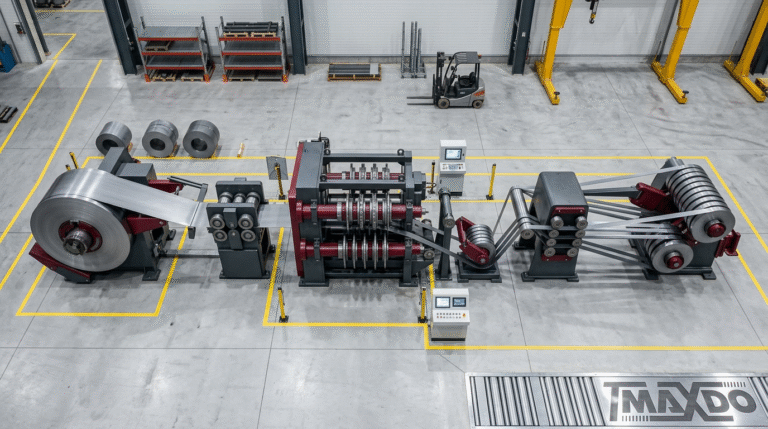



Slitting Line Blade Setup: Verified 2026 Guide for Burr Control and Repeatability
Manage slitting-line blade setup by tooling condition, spacer control, burr risk, and first-coil approval with this 2026 guide.
Blade setup is where slit quality starts. If the stack is wrong, the line may still run, but the output will show the problem later as burr, width instability, strip wander, weak coil build, or downstream rejects. A serious setup standard therefore has to cover more than knife placement. It has to cover tooling condition, spacer accuracy, entry stability, recoiling behavior, and first-coil approval.
Good slitting results come from a controlled setup system, not from memorizing one
universal clearance table.
What Blade Setup Actually Controls
A blade setup is not only a knife decision. It is the operating condition that connects tooling, strip path, spacing logic, tension behavior, and finished coil quality.
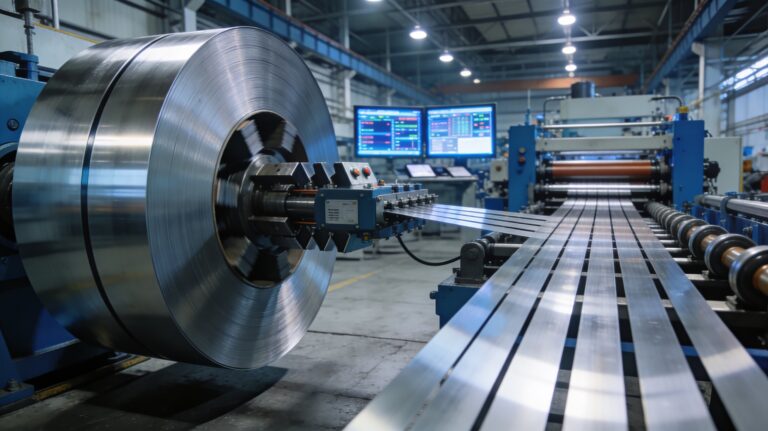
Slit-coil quality is directly tied to width tolerance, edge quality, strip tracking, downstream forming, and recoiling consistency. Final slitting is also the point where edge condition, coil support, coil size, and accumulation method are all determined. That means setup quality influences not just the cut itself, but also how the slit product leaves the line and performs later in the plant.

If the setup standard is weak, the slitting line can produce output that looks acceptable at startup but fails commercially once the coil reaches the next operation.
The Setup Variables That Matter Most
The most useful way to think about blade setup is as a system of controlled variables.
| Setup Variable | Why It Matters | What The Plant Should Control |
|---|---|---|
| Knife condition | Clean cutting depends on stable knife performance and edge condition | Inspect wear, damage, and edge quality before every critical setup |
| Spacer precision | Spacer accuracy affects width control and repeatable knife positioning | Treat spacer condition and thickness control as part of the width strategy |
| Clearance discipline | Clearance has to match the material, tooling state, and process condition | Record approved setup conditions by material and job family instead of relying on memory |
| Entry stability | Stable strip entry affects tracking before the strip reaches the full cutting load | Confirm centering, guiding, and startup behavior before production speed |
| Recoiling and tension | Post-cut stability determines whether slit coils remain usable | Check separator, tension, and recoiler behavior as part of setup release |
Even when the knife stack is technically correct, unstable entry conditions or weak recoiling can still destroy the commercial value of the output.
What a Proper Setup Sheet Should Define Before Startup
Plants lose time and material when the slitting recipe exists only in the operator’s memory. A repeatable setup starts with a repeatable document.
| Setup-Sheet Item | Why It Has To Be Defined |
|---|---|
| Material family and thickness range | Tooling behavior and inspection expectations change with the actual material |
| Coil width and finished strip widths | Width planning determines blade count, spacer sequence, and separator demands |
| Trim requirement | Edge trim changes the full stack logic and saleable-width math |
| Tooling list | Operators should not discover missing knives or spacers at the machine |
| Separator and recoiling notes | Stable post-cut strip handling is part of setup, not a later correction |
| First-coil inspection points | The team should know what has to pass before the run is released |
The setup sheet is not paperwork for its own sake. It is the control document that keeps one setup mistake from becoming one full-coil or full-order loss.
Clearance Should Be Treated as an Application Variable
The practical operating rule on clearance is straightforward:
- Clearance is not one universal static number
- It has to match the material, tooling state, and process condition
- Operators adjust clearance during setup to minimize burr — that adjustment is intentional, not improvisation
- Stable clearance, combined with flatness, parallelism, and consistent material characteristics, produces repeatable cutting performance and cleaner slit edges
- Clearance should be recorded as an approved application setting, not passed down as shop folklore
This is the safer way to build a setup standard. If a tooling vendor provides a starting clearance window, that number should be validated in the plant’s approved recipe and tied to a specific material family, thickness range, and quality target.
Spacer Logic Is Part of Width Control
Spacer planning is often treated like clerical preparation. In reality, it is part of the width-control system. Spacer thickness, flatness, and repeatability are not support details — they are part of the cutting result.
| Spacer-Planning Question | Why It Matters In Production |
|---|---|
| Are the finished strip widths final and approved? | A late width change can force a different stack, not just a last-minute note |
| Has the trim strategy been defined? | Trim affects total available width and can change the slit pattern |
| Are enough knife pairs and spacer sets available? | A recipe that cannot be assembled correctly is not a real recipe |
| Are separator and recoiler requirements linked to strip count? | A good knife stack still fails if the post-cut strip handling is unstable |
| Is the approved stack documented for reuse? | Repeatability depends on recorded setups, not on memory |
Offline preparation matters here. A plant that prebuilds knife and spacer assemblies in a disciplined way usually cuts setup risk much more effectively than a plant that improvises at the machine.
First-Coil Approval Should Be a Formal Release Gate
The line is not truly set up when it starts moving. It is set up when the first coil proves that the chosen stack and the line condition are producing commercially acceptable output.
The machine can rotate successfully while the product is still commercially wrong. Edge condition, coil support, and accumulation characteristics are only confirmed once the first coil is in hand — not when the arbor starts turning.
| First-Coil Checkpoint | What Should Be Reviewed |
|---|---|
| Width check | Critical slit widths measured with the plant’s defined method |
| Edge check | Burr behavior, edge appearance, and visible damage |
| Strip-path check | Tracking, separation behavior, and strip stability |
| Recoil check | Coil tightness, winding stability, and visible handling quality |
| Documentation check | Final approved setup recorded for reuse and shift handover |
If any of those fail, the correct action is to stop and correct the setup before ramping speed. Pushing forward with a questionable first coil is usually a scrap decision disguised as a production decision.
Defect Escalation: When the Setup Has to Be Rechecked Immediately
Not every defect comes from the same root cause, but several symptoms justify reopening
the setup without delay.
| Symptom | Why Setup Review Is Justified |
|---|---|
| Burr growth | Burr is directly linked to setup condition, tooling state, and clearance discipline |
| Inconsistent edge quality | Edge condition is a core slitting-quality outcome, not a cosmetic detail |
| Strip wander or unstable tracking | Tracking problems often start at entry stability or post-cut strip control |
| Poor recoiling or unstable coil build | Recoiling is part of the approved setup condition, not a separate issue |
| Unexpected width variation | Spacer condition, knife position, entry stability, or measurement discipline may no longer match the approved recipe |
The correct response is not always a full restack, but it should always include a disciplined review of the approved setup against the actual line condition.
Material-Family Setup Logic Without Relying on One Universal Chart
Different materials do change setup behavior, but the setup standard should express that
in operational terms rather than pretending one clearance chart covers every job.
Acero inoxidable
Stainless programs are less forgiving on edge condition and tooling wear. Setup approval
should emphasize burr control, edge appearance, and repeatability before output speed
becomes the main concern.
Coated or Galvanized Steel
Coated material adds surface-risk management to the setup discussion. The stack can be
mechanically correct and still create unacceptable surface damage if strip handling or
post-cut support is weak.
Aluminum and Light-Gauge Strip
Light-gauge and surface-sensitive programs demand tighter control of handling and post-cut behavior. Setup review should emphasize edge quality, strip stability, and how the slit
product survives recoiling and packaging.
Higher-Strength Steel
Higher-strength programs increase the burden on tooling condition, line rigidity, and setup consistency. At that point, the plant should evaluate knife life, stability, and approval discipline together rather than discussing thickness alone.
How to Use This Guide With Our Slitting Line Lineup
Our slitting line models cover a range of working widths and production speeds. The setup
principles in this guide apply across the full lineup. Always confirm exact specifications against your signed technical datasheet before freezing a setup package.
| Our Current Live Page | Key Specs |
|---|---|
| MD-850 | Working size: 300–820 mm · Speed: 1–60 m/min · Power: 93 kW · Coil weight: 10–35 t (customizable) · Automatic feeding and recoiling, PLC controls, multi-material capable |
| MD-1350 | Working size: 300–1350 mm · Speed: 1–80 m/min · Power: ~136 kW · Coil weight: 10–35 t (customizable) · Similar control and safety architecture |
| MD-1650 | Working size: 300–1650 mm · Speed: 1–80 m/min · Power: ~294.5 kW · Coil weight: 10–35 t (customizable) · Automatic coil handling, touchscreen PLC controls |
| MD-2200 | Working size: 300–2150 mm · Speed: 1–250 m/min · Power: ~422.5 kW · Coil weight: 10–35 t · Widest model in our current lineup, automatic feeding and recoiling |
Common Setup Mistakes That Still Cost Real Money
Common mistake: Treating blade setup as an operator-only issue. Setup is a production-control issue because it defines whether the line can produce
saleable output consistently.
Common mistake: Reusing the previous stack without revalidating the new job. Similar material labels do not guarantee identical setup conditions.
Common mistake: Judging setup success by machine motion alone. The machine starting up is not the same thing as the first coil being approved.
Common mistake: Ignoring spacer accuracy. Spacer condition is part of width control, not a passive accessory detail.
Ready to Tighten Your Slitting Setup Standard?
- Request a custom quote → request a custom quote
- Browse our product catalog → our product catalog
- Schedule a factory tour → our factory tour