

Cut-to-Length (CTL) Lines: Complete Process & Equipment Guide 2026
CTL process explained: how coils become precision flat sheets. Covers leveling, shearing, stacking — with thickness charts, ROI data & equipment specs.
A cut-to-length (CTL) line is a coil processing system that converts master coils into precision-flat sheets — cut to exact dimensions, leveled to remove coil-set defects, stacked, and ready for downstream processing. Every flat metal sheet in construction, appliance manufacturing, and general fabrication began as a coil.
This guide explains the CTL process step by step, compares equipment options, and provides real cost data so you can make an informed purchasing decision.
What Is the Cut-to-Length Process?
Cut-to-length (CTL) processing takes a master coil of metal and produces flat sheets with four controlled parameters per industry standards (ASTM A568 for thickness tolerance, EN 10051 for flatness):
- Length — cut to within ±0.5 mm (standard) or ±0.25 mm (precision)
- Flatness — leveled to remove coil set, crossbow, and edge wave
- Width — either full coil width or pre-slit (from an upstream slitting line)
- Surface quality — no scratches, dents, or roll marks
The CTL Process Flow
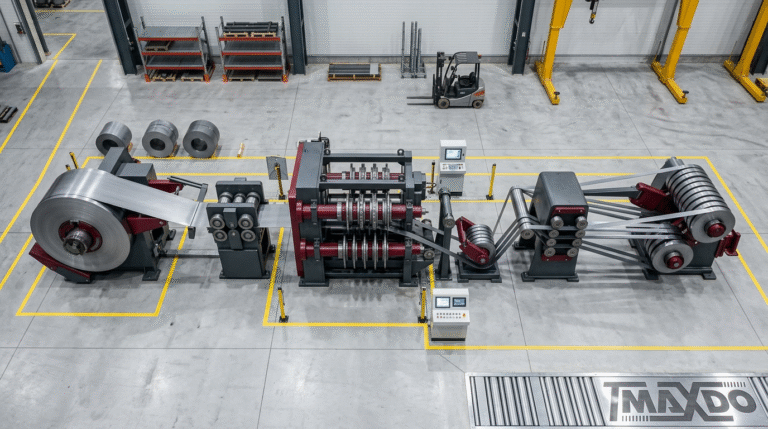
Coil Loading → Uncoiling → Leveling → Measuring → Shearing → Stacking
     ↓              ↓           ↓          ↓            ↓          ↓
  Coil car    Hydraulic    Multi-roll   Encoder     Hydraulic   Magnetic/
  + crane    decoiler     leveler      + servo     guillotine   vacuum
                                       feed        or flying    stacker
                                                   shear
Total cycle time: A modern CTL line can process one coil (10–15 tons) in 20–45 minutes, depending on sheet length and gauge.
CTL vs Slitting — What’s the Difference?
| Característica | Línea CTL | Línea de corte longitudinal |
|---|---|---|
| Cutting direction | Transverse (across the width) | Longitudinal (along the length) |
| Salida | Flat rectangular sheets | Narrow coiled strips |
| Primary use | Sheet metal fabrication, construction panels | Tube/pipe, roll forming, narrow-width stamping |
| Control de planicidad | Critical (multi-roll leveler required) | Not critical |
| Output stacking | Sheets stacked on pallets | Strips wound on mandrels |
→ Need both capabilities? Many service centers run a slitting line upstream and a CTL line downstream to slit coils into narrower widths, then cut those to length.
→ Detailed comparison: Slitting vs CTL Lines: Cost, Speed & Precision Compared.
Key Components of a CTL Line
1. Uncoiler (Decoiler)
Same principle as in slitting lines — holds the master coil and pays off strip under controlled tension.
Critical specs:
| Parámetro | Light Gauge CTL | Heavy Gauge CTL |
|---|---|---|
| Coil weight | 5–15 tons | 15–30 tons |
| Coil width | Up to 1,600 mm | Up to 2,500 mm |
| Drive | AC motor with inverter | Hydraulic |
| Velocidad | Synchronized with line speed | Synchronized with line speed |
Tip: A powered coil car with hydraulic centering reduces coil loading time to under 3 minutes. This adds $8,000–$15,000 to the investment but saves 15+ minutes per shift on high-throughput lines.
2. Leveler (Straightener)
The most critical component in a CTL line. The leveler removes three types of coil-induced stress:
| Defect | Description | How the Leveler Fixes It |
|---|---|---|
| Coil set | Strip curves in the direction it was wound | Reverse-bending through multiple rolls |
| Crossbow | Strip arcs across its width | Backup rolls with adjustable crowning |
| Edge wave | Edges are longer than the center | Work-roll bending adjustment |
Leveler types by application:
| Type | Rolls | Gauge Range | Flatness Achieved |
|---|---|---|---|
| Roller leveler | 5–9 rolls | 2–12 mm | ±3 mm/m |
| Precision leveler | 11–17 rolls | 0.3–6 mm | ±1 mm/m |
| Temper pass leveler | 17–23 rolls | 0.1–3 mm | ±0.5 mm/m |
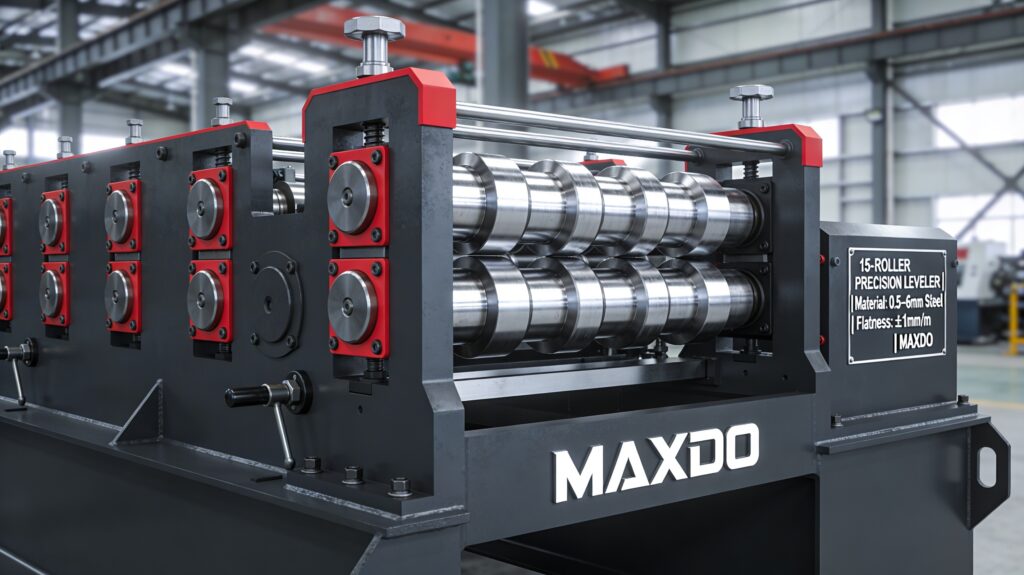
Rule of thumb for roll count: More rolls = better flatness, but at higher cost and slower speed. For general construction-grade flatness, a 9-roll leveler is sufficient. For precision applications (laser cutting feed stock, visible panels), specify 17+ rolls.
3. Measuring & Feed System
Controls sheet length accuracy. Two technologies dominate:
| Technology | Accuracy | Velocidad | Cost |
|---|---|---|---|
| Encoder wheel | ±0.5 mm | Up to 40 m/min | Estándar |
| Servo roll feed | ±0.25 mm | Hasta 60 m/min | 30% premium |
How it works: An encoder wheel rides on the strip surface, measuring the distance traveled. When the target length is reached, the feed stops and the shear fires. Servo roll feeds add active strip positioning for tighter tolerances.
4. Shear (Cut)
Two types based on production requirements:
Hydraulic guillotine shear:
- Clean, straight cuts across full width
- Cycle time: 8–15 cuts/minute
- Best for: Heavy gauge (>3 mm), lower-volume production
Flying shear (rotary or crank):
- Cuts while the strip is moving — no stop-start
- Cycle time: 30–60 cuts/minute
- Best for: Light gauge (<3 mm), high-volume production
- Higher capital cost (20–40% more than guillotine)
→ Processing various materials? Our Material Processing Guide covers optimal settings by metal type.
5. Stacking System
Collects finished sheets onto pallets for transport.
| Type | Lo mejor para | Velocidad |
|---|---|---|
| Drop stacker | Light gauge, short sheets | Fast, simple |
| Magnetic conveyor stacker | Ferrous metals, medium gauge | Gentle sheet handling |
| Vacuum stacker | Non-ferrous (aluminum, copper), coated surfaces | Prevents surface damage |
| Robotic stacker | Mixed sizes, heavyweight sheets | Flexible, high investment |
CT Series Specifications Comparison
MaxDo’s CT series covers the full light-to-heavy gauge range:
| Especificación | CT-850 | CT-1350 | CT-1650 |
|---|---|---|---|
| Coil width range | 200–850 mm | 200–1,350 mm | 200–1,650 mm |
| Gama de espesores | 0.3–3.0 mm | 0.5–6.0 mm | 1.0–12.0 mm |
| Sheet length range | 500–6,000 mm | 500–6,000 mm | 500–8,000 mm |
| Length tolerance | ±0.25 mm | ±0.25 mm | ±0.5 mm |
| Flatness | ±1 mm/m | ±1 mm/m | ±2 mm/m |
| Line speed | Hasta 60 m/min | Up to 40 m/min | Up to 25 m/min |
| Leveler rolls | 15 rolls | 15 rolls | 11 rolls |
| Shear type | Flying shear | Hydraulic guillotine | Hydraulic guillotine |
| Coil weight | 10 tons | 15 tons | 20 toneladas |
| Best for | HVAC panels, appliance skins | General sheet metal service | Structural, plate processing |
Material Processing Guide
Different metals require different CTL settings. Here’s a quick reference:
| Material | Gama de espesores | Leveler Setting | Blade Clearance | Special Considerations |
|---|---|---|---|---|
| Mild steel (CR) | 0.5–6.0 mm | Estándar | 5–8% | Most forgiving; baseline settings |
| Mild steel (HR) | 1.5–12.0 mm | Aggressive (more penetration) | 8–12% | Scale removal may be needed upstream |
| Stainless 304/316 | 0.5–4.0 mm | Extra passes, lighter penetration | 6–10% | Higher spring-back; use more leveler rolls |
| Aluminum 3003/5052 | 0.5–6.0 mm | Lighter penetration | 10–15% | Non-marking rollers; wider clearance to prevent edge cracking |
| Galvanized | 0.5–3.0 mm | Estándar | 5–8% | Avoid damaging zinc coating; felt-lined guides |
| Pre-painted | 0.3–1.5 mm | Light touch | 5–8% | Film-protected processing; non-contact handling |
→ For material-specific best practices, see our CTL Material Processing Guide.
ROI & Cost Analysis
Gama de inversión
| Tipo de línea | Price Range (FOB) | Installed Cost |
|---|---|---|
| Light gauge CTL (CT-850 class) | $80,000–$180,000 | $100,000–$220,000 |
| Medium gauge CTL (CT-1350 class) | $200,000–$450,000 | $250,000–$550,000 |
| Heavy gauge CTL (CT-1650 class) | $400,000–$900,000 | $500,000–$1,100,000 |
Payback Example
Scenario: A construction materials distributor currently buys pre-cut sheets from a service center.
| Item | Value |
|---|---|
| Pre-cut sheet cost from service center | $850/ton |
| Coil cost (direct from mill) + in-house CTL processing | $720/ton |
| Net saving per ton | $130/ton |
| Monthly volume | 300 tons |
| Monthly saving | $39,000 |
| Annual saving | $468,000 |
| Investment (CT-1350, installed) | $380,000 |
| Payback period | 9.7 months |
Additional value drivers:
- Custom sheet sizes on demand (no minimum order from service center)
- 2-day delivery to customers vs. 10-day from external suppliers
- Quality control under your own inspection process
→ Calculate your specific ROI: CTL Line Cost Analysis.
Buyer’s Checklist: 10 Questions to Ask Before Purchasing
Use this checklist when evaluating CTL line suppliers:
- What is the guaranteed length tolerance? (Get it in writing — ±0.25 mm or ±0.5 mm?)
- How many leveler rolls? (More rolls = better flatness, especially for thin gauges)
- What is the shear cycle rate? (Affects throughput on short sheets)
- What is the maximum coil weight? (Must exceed your heaviest coils by 20%)
- Is a powered coil car included? (Essential for high-volume operations)
- What is the changeover time for different sheet lengths? (Should be <2 minutes on servo systems)
- What spare parts are included? (First set of shear blades, leveler roll bearings)
- What is the installation and commissioning timeline? (Typical: 60–90 days after arrival)
- What training is provided? (Look for on-site operator training — 3 to 5 days minimum)
- What is the warranty period and after-sales service coverage? (Standard: 12 months parts, 24 months structural)
→ Download the full CTL Buyer’s Checklist PDF.
Preguntas frecuentes
What does CTL stand for?
CTL stands for Cut-to-Length. It describes both the process (cutting a coil into flat sheets at specified lengths) and the equipment (CTL line or CTL machine) used to perform it.
What is CTL line speed?
Typical CTL line speeds range from 15 m/min (heavy gauge, 8–12 mm) to 60 m/min (light gauge, 0.3–3 mm). Note that speed also depends on sheet length — shorter sheets mean more shear cycles per minute, which can be the bottleneck.
CTL vs blanking line — what’s the difference?
A CTL line produces rectangular sheets with straight cuts across the full coil width. A blanking line produces shaped blanks (often with irregular contours) using a blanking die. CTL lines are simpler and cheaper; blanking lines are required when parts need specific shapes before stamping.
Can a CTL line process pre-painted or coated steel?
Yes, but you need: (1) felt-lined or rubber-coated guide rollers to prevent scratching, (2) a protective film applicator before the leveler (optional but recommended), (3) non-contact sheet handling on the stacker (vacuum cups instead of magnetic conveyors), and (4) wider blade clearance to avoid edge chipping of the coating.
What flatness can a CTL line achieve?
Standard lines with 9-roll levelers achieve ±3 mm/m. Precision lines with 15–17 roll levelers achieve ±1 mm/m. Premium temper-pass lines with 21+ rolls can reach ±0.5 mm/m — required for visible panels and laser-cutting feedstock.
Get a Quote for Your CTL Line
MaxDo’s CT Series covers the full light-to-heavy gauge range with precision levelers and servo feed systems. Whether you’re processing mild steel, stainless, or aluminum:
- Request a custom quote — Tell us your material, gauge, and volume; we’ll recommend the right configuration
- View the CT Series product lineup — Full specs, photos, and videos
- Schedule a factory tour — See your line being built
Related Resources
Metal Slitting Lines: Complete 2026 Guide
Slitting vs CTL Lines: Cost, Speed & Precision Compared
Slitting vs Blanking vs CTL: Which Process Fits Your Plant?