

Slitting vs Blanking vs CTL Lines: Complete Equipment Selection Guide for Metal Processors
Compare slitting and blanking processes for metal coil processing. Technical specifications, efficiency metrics, and selection criteria for manufacturers.
MaxDo’s MD-series machines define industry standards in metal coil processing, helping manufacturers worldwide choose between three primary methods: slitting, blanking, and cut-to-length (CTL) processing. Understanding what is the difference between slitting and blanking directly impacts production efficiency, material yield, equipment investment, and ultimate product quality. Slitting transforms master coils into continuous narrow strips through longitudinal cutting, while blanking and CTL lines produce discrete flat sheets through transverse shearing operations. Each process delivers distinct advantages depending on throughput requirements, tolerance specifications, and downstream fabrication needs.
This comprehensive equipment selection guide examines performance metrics, equipment architecture, application criteria, and economic considerations to support data-driven purchasing decisions. With 500+ MD-series installations achieving 96%+ material yield and ±0.1mm accuracy across 30+ countries, production managers and industrial engineers gain the technical framework needed to match processing technology with facility requirements, volume projections, and quality specifications.
What Is the Difference Between Slitting and Blanking? Core Process Fundamentals
MaxDo’s MD-series coil processing equipment serves metal fabricators through two fundamental methods that differ in cutting direction, output format, and material continuity. The difference between slitting and blanking centers on how each process transforms master coils: slitting maintains coil form through longitudinal cutting, while blanking breaks material continuity through transverse shearing to produce individual sheets.

Slitting Process: How Longitudinal Cutting Creates Continuous Strips
Slitting operates as a longitudinal cutting process that divides wide metal coils into multiple narrow strips using precision rotary knives. The master coil feeds continuously through a slitter head containing multiple circular blade stations positioned at specific intervals corresponding to desired strip widths. Each knife pair—consisting of an upper and lower circular blade—creates a shearing action that cuts through the material while maintaining continuous coil form throughout processing.
The slit strips exit simultaneously and wind onto individual recoiler stations, preserving the coil configuration for downstream operations. This precision slitting equipment handles materials from 0.3mm to 12mm thickness, with MD-series systems processing 8-12 strips simultaneously from 1300mm master coils.
Blanking & CTL Lines: How Transverse Shearing Produces Discrete Sheets
Blanking functions as a transverse cutting process that produces discrete flat sheets or shaped parts from coil stock. Metal coil feeds through leveling rollers to flatten material before entering a cutting zone where either guillotine shears or rotary cutting mechanisms make perpendicular cuts across the coil width. Each cutting cycle produces a finished-length sheet that separates completely from the coil, advancing to automated stacking systems for bundling and shipment.
The blanking process, commonly called cut-to-length (CTL) processing, delivers sheets ready for immediate use in stamping, forming, or assembly operations without additional unwinding steps. CTL lines and CTL machines serve steel service centers, metal distributors, and fabrication facilities requiring pre-cut sheet lengths for downstream operations.
Quick Comparison Table: Slitting vs Blanking at a Glance

| Process Characteristic | Прорезь | Blanking/CTL |
|---|---|---|
| Cutting Direction | Longitudinal (parallel to coil length) | Transverse (perpendicular to coil width) |
| Output Format | Recoiled narrow strips maintaining coil form | Flat discrete sheets ready for use |
| Лучшие приложения | High-volume continuous production for coil-fed equipment | Varied-length orders for flat-stock fabrication |
The fundamental distinction drives divergent equipment architectures, production workflows, and application suitability between the two metal coil processing methods.
Slitting vs Blanking: Performance Metrics Comparison
MD-1350 slitting lines achieve ±0.1mm width accuracy across continuous production runs, while CTL blanking systems deliver ±0.15mm length precision per sheet. These performance differentiators directly impact equipment selection for applications with specific tolerance requirements, throughput demands, and edge quality specifications.
| Performance Parameter | Прорезь | Blanking/CTL Lines |
|---|---|---|
| Допуск по ширине | ±0.1mm continuous | Not applicable |
| Length Tolerance | Not applicable | ±0.15mm per sheet |
| Пропускная способность Скорость | 80-250 m/min | 20-60 cuts/min |
| Толщина материала | 0.3-12mm across four gauge bands | 0.3-12mm with heavy-duty leveling |
| Качество кромки | Sheared edges, minimal burr | Burr-free with rotary shears |
| Accuracy Control | Servo tension management | Servo feed positioning |
| Processing Mode | Continuous material flow | Discrete cutting cycles |
| Burr Management | Blade clearance optimization | Rotary contact cutting action |
Tolerance & Precision: Width Control vs Length Control
MD-series slitting lines achieve ±0.1mm width accuracy through rigid knife mounting systems, servo-controlled tension management, and minimal thermal expansion during high-speed operation. Width tolerances remain stable across material thickness ranges from 0.3mm to 12mm, enabling tight specification compliance for applications requiring exact strip dimensions. This precision slitting equipment maintains consistent strip dimensions regardless of coil length during continuous production runs.
Blanking systems deliver ±0.15mm length precision per sheet, with accumulation potential across multiple cuts depending on feed control accuracy. Servo roll feed controllers synchronize material advancement with cutting cycles, positioning each cut location with repeatable precision. Length tolerance performance depends on feed mechanism type—servo-driven systems outperform mechanical feeding by 3-5x in positioning accuracy, making servo feed controllers standard on modern cut-to-length production lines.
Throughput Speed: Continuous Processing vs Cycle Cutting
High-speed 1350mm slitting lines process 80-250 m/min depending on material thickness and strip count. The MD-1350 slitting machine operates at 1-250 m/min across its 0.3-12mm thickness range, with higher speeds achieved on thinner gauges. Production rates scale with the number of simultaneous strips produced—a single pass through an MD-1350 can generate 8-12 strips from a 1300mm master coil.
Blanking systems optimize for 20-60 cuts per minute based on material thickness and sheet length requirements. Thicker materials and longer sheet lengths reduce cutting frequency, while thin-gauge short sheets maximize cycle rates. CTL lines balance cutting speed against length precision through programmable servo feed systems that adjust advancement timing between cycles.
Material Thickness Capabilities Across Slitting and CTL Lines
Material thickness ranges demonstrate comparable capabilities between MD-series slitting and CTL equipment. Slitting lines handle 0.3-12mm gauge materials across four distinct thickness bands: 0.3-3.0mm for light gauge applications, 1.5-6mm for medium gauge processing, 2-8mm for medium-heavy operations, and 4-12mm for heavy-gauge production.
Heavy gauge CTL lines accommodate similar ranges with different handling requirements—heavier gauges demand increased cutting force and more robust leveling capacity to manage coil set before cutting. Aluminum cut to length lines typically process lighter gauges (0.5-6mm) due to material characteristics, while both processes maintain performance specifications across stainless steel, mild steel, aluminum, and copper materials when properly configured.
Edge Quality & Burr Control Comparison
Slitting produces sheared edges with minimal burr formation when blade clearances match material properties through proper metal slitting machine precision width tolerance settings. Proper knife maintenance and setup generate edges requiring no secondary deburring for most applications, though specialized edge conditioning can enhance surface finish for demanding uses like HVAC ductwork fabrication where edge quality directly affects seam integrity.
Blanking delivers burr-free edges when properly tooled, particularly with rotary shearing mechanisms that employ rolling contact cutting action. Rotary shears engage material progressively across the cut width, distributing shear forces to minimize edge distortion. Guillotine-style blanking may produce small exit burrs requiring light finishing depending on material hardness and blade condition.
MD-Series Equipment Architecture: Slitting vs CTL Line Design
MaxDo’s MD-series coil processing equipment integrates proven component architectures refined across 500+ global installations. As a leading coil processing equipment manufacturer, MaxDo designs slitting and CTL line configurations to deliver 96%+ material yield through optimized mechanical systems, precision controls, and automated material handling.
Slitting Line Components: MD-1350 Architecture Breakdown
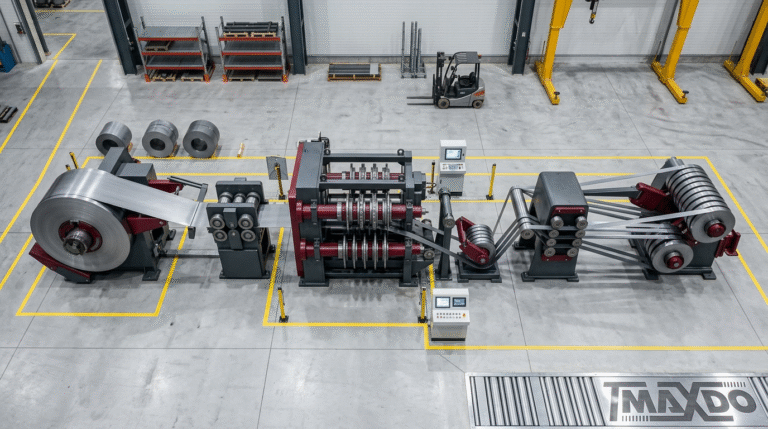
The MD-1350 integrates five primary components in sequential arrangement: uncoiler, leveler, slitter head with multiple knife stations, tension control system, and recoiler stations for simultaneous strip winding. The uncoiler supports master coils ranging from 10-35 tons, employing hydraulic expansion mandrels to secure coil inside diameter. Material feeds into multi-roll levelers that remove coil set and flatness defects before entering the slitter head.
The slitter head houses matched pairs of circular knives mounted on precision arbors, with independent position adjustment for each knife pair to set strip widths. Following slitting, individual strips pass through tension control systems that maintain proper web tension across all strips simultaneously. Tension bridle rolls or dancer arm assemblies prevent strip stretching while ensuring adequate tension for clean recoiling.
Each strip winds onto dedicated recoiler stations equipped with tension controls, coil building systems, and automated coil discharge mechanisms. The MD-1350 slitting machine integrates touchscreen PLC controls coordinating all component functions, from feed speed to tension management to recoiling parameters across the entire system.
CTL Blanking Line Design: Servo Feed & Stacking Systems
CTL lines machine architecture comprises uncoiler, multi-roll leveler, servo-controlled feed system, cutting mechanism (rotary or guillotine shear), and automated stacking unit. The uncoiler and leveler assemblies mirror slitting line components but with heavier construction to manage the additional leveling demands of cut-to-length CTL coil line processing. Coil set removal becomes more critical in blanking since any residual curvature transfers directly to finished sheets rather than being managed through recoiling tension.
The servo feed system represents the CTL blanking line’s precision control center, synchronizing material advancement with cutting cycles through encoder feedback and closed-loop positioning. Feed accuracy directly determines length tolerance performance, making servo systems standard on modern cut to length production lines. The cutting mechanism—either rotary shears or guillotine-style blades—performs transverse cuts across full coil width. Rotary shears employ two counter-rotating circular knives that engage material in a rolling action, while guillotine shears use straight blades that descend vertically through the material.
Automated stacking units collect cut sheets, typically with programmable count functions for bundle formation and automated strapping integration. These systems handle sheet lengths from 500mm to 6000mm+ depending on CTL machine configuration and downstream handling requirements.
Power Consumption & Footprint Comparison
| Installation Requirement | Линии продольной резки | CTL Blanking Lines |
|---|---|---|
| Linear Floor Space | 15-25m + recoiler width (8-10m for 12-strip) | 12-20m + stacking area (3-5m extension) |
| Потребляемая мощность | 318.5KW (MD-1350 continuous draw) | 300-350KW (cyclic demand patterns) |
| Floor Loading | Distributed across recoiler stations | Concentrated at stacking/bundle zones |
| Utility Requirements | Hydraulics for mandrels, pneumatics for tension | High-capacity hydraulics for cutting force |
Slitting lines maintain relatively constant power draw during production runs since material flows continuously through all components simultaneously. The MD-1350’s 318.5KW power requirement supports continuous operation at maximum throughput without peak demand cycles.
CTL blanking systems exhibit cyclic power demands as cutting mechanisms engage and retract, levelers process material intermittently, and stacking systems activate periodically. Despite comparable installed power capacity, blanking’s cyclic operation may reduce actual energy consumption by 15-25% versus nameplate ratings during typical production.
Application-Based Selection: When to Choose Slitting vs CTL Lines
Production managers and industrial engineers face critical equipment selection decisions based on downstream process compatibility, order pattern diversity, and material handling infrastructure. The choice between slitting vs blanking metal processing fundamentally depends on whether your fabrication operations require continuous coil feeding or discrete flat sheet processing.
Slitting-Optimal Applications: Continuous Coil-Fed Operations
Slitting optimization occurs in applications requiring continuous strip production for downstream coil-fed operations. HVAC ductwork fabrication benefits from consistent-width strips that feed directly into roll forming lines without intermediate unwinding steps. Automotive trim components, door panels, and structural reinforcements utilize slit coils in progressive stamping operations where continuous feeding maximizes press utilization.
Appliance manufacturers processing refrigerator cabinets, washing machine drums, and range components specify slit coils for their panel forming and deep drawing operations. A tier-1 automotive supplier processing 8,000 tons annually achieved 18-month ROI through MD-1350 installation, leveraging high-speed continuous production (180 m/min average) to eliminate bottlenecks in progressive die operations.
The key advantage in these applications centers on material handling efficiency—slit coils remain in optimal form for coil-fed equipment, eliminating sheet stacking, unstacking, and individual sheet positioning operations. Material utilization reaches optimal levels when part width aligns closely with standard slit widths, minimizing edge trim waste during subsequent fabrication. Effective slitting line setup time reduction strategies further enhance productivity in high-mix environments.
Blanking/CTL-Ideal Scenarios: Flat Sheet Requirements
Blanking-ideal scenarios involve flat sheet requirements for stamping operations, construction panels, and discrete part production with specific length demands. Metal stamping facilities processing progressive dies benefit from pre-cut sheet lengths that match die progression distances, eliminating scrap from coil end conditions. Construction material suppliers serving metal roofing, wall panel, and ceiling tile markets require finished-length sheets for direct installation without job site cutting.
Laser cutting and plasma cutting operations specify blanked sheets to eliminate coil handling equipment and simplify part nesting across flat sheet geometry. A steel service center handling 200+ different length specifications achieved 24-month ROI through CTL line installation, leveraging automated length programming to process orders ranging from 1000mm to 6000mm without manual measurement operations.
Decision Framework: 5 Critical Factors for Equipment Selection
- Annual Throughput Volume: Operations processing 5,000+ tons annually with consistent specifications favor slitting’s high-speed advantages (80-250 m/min), while facilities handling 10-15+ different length specifications benefit from CTL flexibility
- Order Pattern Diversity: High-mix production with frequent length changes justifies CTL’s programmable servo feed systems, whereas dedicated long-run products suit slitting’s throughput optimization
- Downstream Process Compatibility: Evaluate existing equipment—operations with coil-fed stamping presses, roll forming lines, or continuous welding systems maximize efficiency with slitting; facilities with laser cutters, panel assembly systems, or operations lacking uncoiling capacity require CTL pre-cut sheets
- Tolerance Requirements: Applications demanding ±0.1mm width control specify slitting equipment, while ±0.15mm length precision applications utilize CTL servo feed systems with closed-loop positioning
- Floor Space & Budget Constraints: Compare 15-25m slitting footprint + recoiler width against 12-20m CTL space + stacking area, factoring capital investment differences (CTL lines typically require 15-25% higher initial investment due to servo systems and heavy-duty cutting mechanisms)
Cut to Length vs Slitting: Understanding CTL Line Advantages
The cut to length vs slitting decision fundamentally separates manufacturers into two processing philosophies: those requiring material continuity for coil-fed operations versus those needing discrete sheet formats for flat-stock fabrication. Understanding CTL line advantages clarifies when transverse cutting outperforms longitudinal slitting in specific production environments.
What Is a CTL Line? Cut-To-Length Machine Overview
CTL (Cut-To-Length) lines represent specialized blanking systems engineered for high-precision transverse cutting of metal coils into finished-length flat sheets. The CTL machine full form—Cut-To-Length—describes equipment that transforms master coils into discrete sheets through servo-controlled feeding and synchronized shearing operations. CTL lines machine configurations integrate leveling, servo feed positioning, rotary or guillotine cutting mechanisms, and automated stacking to deliver production-ready sheets.
CTL steel processing serves steel service centers, metal distributors, and fabrication facilities requiring pre-cut inventory in multiple standard lengths. The relationship between CTL and blanking is direct: all CTL operations are blanking processes, but not all blanking qualifies as precision CTL—the distinction lies in servo feed accuracy, automated length programming, and tight tolerance control that defines modern cut-to-length ctl coil line equipment.
CTL Line vs Slitting Line: When Sheets Outperform Coils
CTL lines deliver distinct advantages in laser cutting facilities, steel service centers, and multi-specification order processing environments. Laser cutting operations benefit from pre-cut sheet formats that eliminate dedicated coil handling equipment, simplify part nesting software integration, and reduce material handling complexity. A CTL operator can program length sequences to match customer specifications without manual measurement, automating order fulfillment for 100+ different sheet sizes from common coil stock.
Steel service center operations leverage CTL steel processing to maintain ready inventory across standard sheet dimensions (2440mm, 3048mm, 6096mm lengths), shipping finished products without customer-side cutting operations. Construction material suppliers specify CTL equipment when serving markets requiring direct-install sheets for metal roofing, wall panels, and ceiling applications where job site cutting introduces quality and safety concerns.
The CTL line advantage crystallizes when order diversity exceeds 10-15 different length specifications regularly, production schedules involve frequent length changes (multiple times per shift), and downstream operations lack coil unwinding infrastructure. For comprehensive technical specifications, review our precision cut-to-length systems engineering guide.
Multi-Blanking Technology: Integrated Slitting + CTL in One Pass
MaxDo’s multi-blanking technology eliminates traditional two-stage workflows by performing simultaneous width slitting and transverse blanking in single-pass processing. This progressive die innovation addresses hybrid production requirements where manufacturers need both width division and specific length control across varied order patterns.
How Multi-Blanking Combines Slitting and CTL Operations
Multi-blanking integrates slitting’s longitudinal knife arrangements with blanking’s transverse cutting mechanisms in a unified machine architecture. Material flows through width-division knife stations that create multiple strips across coil width, then immediately enters synchronized cutting zones that shear all strips to identical lengths in coordinated cutting cycles. The integrated system eliminates intermediate coil handling—material processes from master coil to finished-length strips without recoiling, transport, or secondary uncoiling operations.
Efficiency Gains: 40-60% Throughput Improvement
Throughput increases 40-60% versus separate slitting-then-blanking workflows while maintaining ±0.1mm accuracy in both width and length dimensions. Production rates compound as strip count increases: a 6-strip multi-blanking configuration produces 6x the output of single-width blanking at equivalent line speed. Material yield optimization achieves 96%+ efficiency through coordinated nesting of width divisions and length cutting that minimizes throwaway material.
Labor requirements decrease 30-50% compared to separate slitting and blanking lines since one operator manages integrated processing versus separate crews for each operation. Floor space consolidates from 30-40m combined linear space to 18-25m for integrated equipment, yielding significant facilities cost reductions. Equipment capital investment runs 60-75% of combined slitting and blanking line costs, improving ROI timelines to 15-20 months for high-mix production environments requiring both width and length flexibility.
The technology suits automotive tier suppliers, appliance component producers, and construction material distributors processing varied customer orders requiring different combinations of strip widths and sheet lengths from common base materials. Learn more in our dedicated multi-blanking line material flexibility technical guide.
Economic Comparison: Capital Investment, Operating Costs & ROI Timelines
Equipment selection decisions crystallize when production managers evaluate total cost of ownership across capital investment, operating expenses, and ROI timelines. Economic analysis reveals distinct cost profiles between slitting and cut to length line configurations based on production volume, order diversity, and material specifications.
Capital Investment: Slitting vs CTL Line Pricing
Entry-level slitting lines processing 850mm width coils with basic recoiling capability start at lower investment thresholds than equivalent CTL/blanking systems. The simpler cutting mechanism—rotary knives versus high-force shearing assemblies—reduces component costs, while continuous processing without discrete cutting cycles simplifies control systems. Mid-range slitting configurations like the MD-1350 deliver comprehensive capabilities including automated coil handling, precision knife positioning, and multi-strip recoiling at moderate investment levels typically 15-25% below comparable CTL equipment.
CTL blanking systems require higher initial capital due to servo feed precision, heavy-duty cutting mechanisms, and automated stacking systems. The cutting force requirements for transverse shearing—particularly in heavy-gauge materials—demand robust press frames, high-capacity hydraulics, and reinforced blade mounting systems. Servo feed controllers add significant cost versus the simpler tension controls of slitting lines, though the investment delivers essential length tolerance performance for varied-length sheet production.
Custom metal processing line configurations for specialized applications (non-standard widths, exotic materials, industry-specific tolerances) typically add 10-20% to base equipment costs for both slitting and CTL systems through engineering customization, specialized tooling, and extended validation testing.
Operating Costs: Blade Maintenance, Energy & Material Waste
| Operating Cost Category | Линии продольной резки | CTL Blanking Lines |
|---|---|---|
| Blade Maintenance | 0.5-1.5% equipment value annually | 2-5% equipment value annually |
| Regrinding Intervals | 30-90 days (20-30 cycles per blade) | 15-60 days (15-25 cycles per blade) |
| Material Waste | 2-4% edge trim (width changeovers) | 3-5% end scrap (coil starts/stops) |
| Потребление энергии | Continuous 318.5KW draw (MD-1350) | Cyclic demand (15-25% below rating) |
| Replacement Parts | Circular knife pairs, tension components | Guillotine/rotary blades, servo systems |
Slitting knife maintenance involves periodic regrinding when blade edges dull from cutting action. Total annual knife costs average 0.5-1.5% of equipment value for standard steel processing, increasing to 2-3% when processing abrasive materials like high-strength steel or titanium. Material waste profiles show slitting generating minimal edge trim—typically 2-4% of master coil width for optimal strip nesting, with negligible coil end waste since recoiling preserves material.
Blanking blade replacement schedules vary by cutting mechanism type and material processed. Guillotine blades typically process 200,000-500,000 cuts before replacement, with costs ranging from 2-5% of equipment value annually depending on production volume and material hardness. Blanking produces end-scrap at coil starts and stops ranging from 3-5% depending on length optimization and coil end conditions.
ROI Analysis: Payback Periods Across Production Scenarios
| Production Scenario | Slitting ROI | CTL Blanking ROI | Multi-Blanking ROI |
|---|---|---|---|
| High-Volume Continuous (5,000+ tons/year, consistent widths) | 18-24 months | 30-36 months | Not applicable |
| Varied-Length Orders (10-15+ lengths, frequent changes) | 36-48 месяцев | 24-36 месяцев | 20-28 months |
| Hybrid Production (width + length flexibility required) | Sequential processing required | Sequential processing required | 15-20 months |
High-volume continuous strip production—automotive components, appliance panels, HVAC ductwork—favors slitting equipment investment. Annual processing exceeding 5,000 tons with consistent width specifications generates ROI within 18-24 months through throughput advantages (80-250 m/min) and lower operational costs. For a 5,000 tons/year operation, slitting saves approximately $45,000-$65,000 annually through reduced labor (30% fewer operators), higher material yield (96%+ efficiency), and lower maintenance costs (0.5-1.5% equipment value) compared to equivalent CTL processing.
Varied-length sheet requirements justify blanking system investment when order diversity exceeds 10-15 different length specifications regularly. Flexibility advantages offset the higher capital and operational costs when production schedules involve frequent length changes. Steel service centers and metal distributors achieve ROI within 24-36 months through eliminated outsourcing costs ($25-$40/ton for external cutting services) and improved delivery performance (same-day fulfillment for standard lengths).
Real-World Applications: 500+ MD-Series Installations Worldwide
MaxDo’s MD-series equipment serves manufacturers across 30+ countries with proven performance in automotive, steel service, appliance, and construction sectors. These real-world installations demonstrate equipment selection frameworks applied to specific production requirements, validating ROI projections across diverse operating environments.
Case Study: Automotive Tier-1 Supplier Chooses MD-1350 Slitting
A North American automotive tier-1 supplier processing 8,000 tons annually of 1.5-3.0mm cold-rolled steel selected MD-1350 slitting configuration for door panel and structural reinforcement production. The operation required tight width tolerances (±0.1mm) across 150mm to 400mm strip widths feeding progressive stamping presses running continuous 3-shift operations.
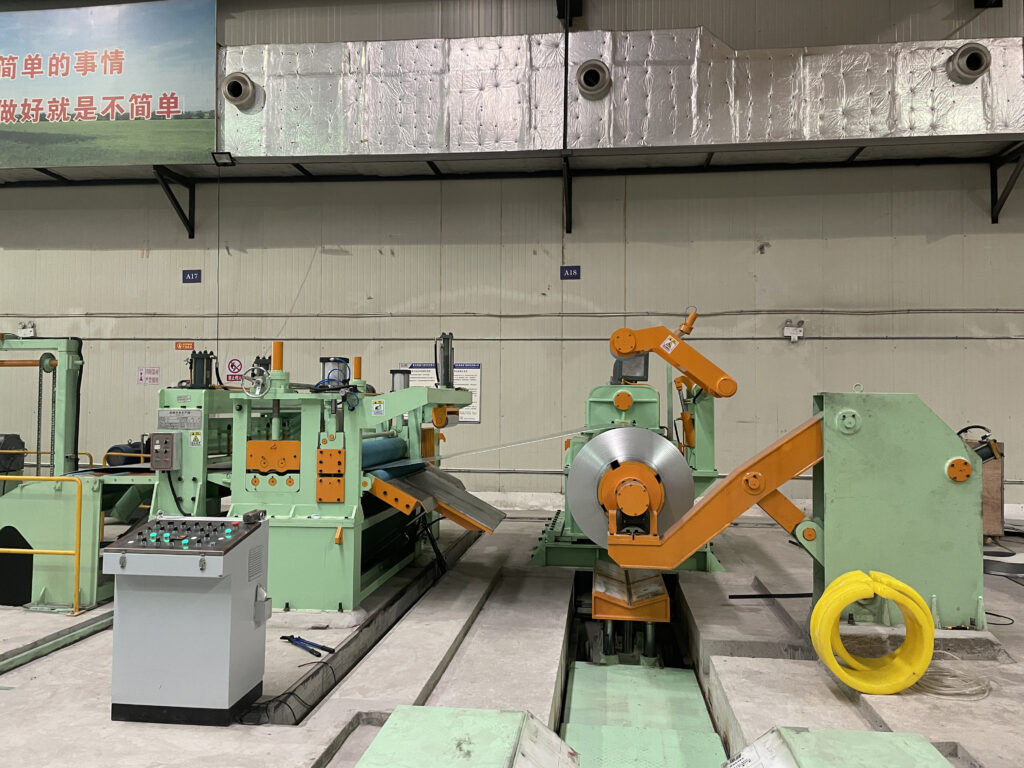
Equipment selection factors prioritized throughput speed (target: 150+ m/min average), width accuracy for tight die clearances, and automated coil handling to minimize changeover time between part families. The MD-1350 installation achieved 18-month ROI through 40% throughput improvement versus previous sequential processing, 96.8% material yield optimization, and elimination of width re-work (previously 2-3% rejection rate from tolerance drift).
Case Study: Steel Service Center Optimizes with CTL Blanking Line
A European steel service center handling 12,000 tons annually across 200+ SKUs (length specifications from 1000mm to 6000mm in 100mm increments) installed CTL blanking line to replace outsourced cutting operations. Order patterns showed 60% of volume concentrated in 15 standard lengths, with remaining 40% distributed across custom specifications changing weekly.
The CTL machine selection prioritized servo feed accuracy (±0.15mm length tolerance), programmable length sequencing for automated order processing, and stacking capacity for 50-sheet bundles. CTL line installation achieved 24-month ROI through eliminated outsourcing costs ($32/ton average for external cutting), 35% reduction in order fulfillment time (same-day vs. 3-5 day outsource turnaround), and 4.2% material yield improvement through optimized length nesting algorithms.
Case Study: Appliance Manufacturer Adopts Multi-Blanking Technology
An Asian appliance manufacturer producing refrigerator side panels, washing machine drums, and range components from 0.8-2.0mm stainless steel and pre-painted coils selected multi-blanking technology for hybrid production requirements. Manufacturing specifications required both width division (cutting 1250mm master coils into 2-4 strips) and specific length control (sheet lengths 600mm to 1800mm) across 80+ part numbers.
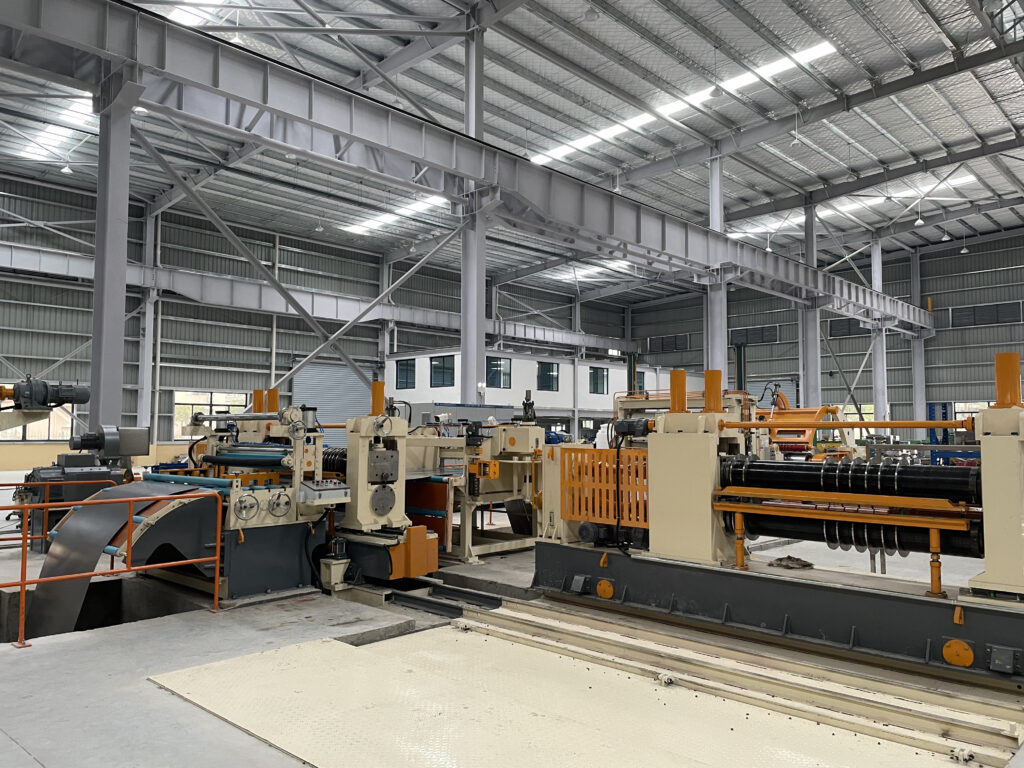
Multi-blanking equipment selection consolidated previous sequential slitting-then-blanking workflow (two separate lines, 35m combined footprint, 3 operators) into integrated single-pass processing. Installation achieved 15-month ROI through 42% throughput improvement (processing 6 tons/hour vs. 4.2 tons/hour previous), 30% labor reduction (single operator vs. separate crews), and 18m floor space consolidation enabling additional manufacturing capacity in existing facility.
Frequently Asked Questions: Slitting vs Blanking
What is the difference between slitting and blanking?
The difference between slitting and blanking centers on cutting direction and output format. Slitting performs longitudinal cutting parallel to coil length, producing continuous narrow strips that maintain coil form for recoiling. Blanking performs transverse cutting perpendicular to coil width, producing discrete flat sheets that separate completely from the coil. Slitting suits high-volume continuous production for coil-fed equipment (HVAC, automotive stamping), while blanking serves varied-length sheet requirements for flat-stock fabrication (laser cutting, construction panels).
What is blanking in metal working?
Blanking in metal working is a transverse shearing process that cuts metal coils into discrete flat sheets or shaped parts through guillotine or rotary cutting mechanisms. The blanking process—also called cut-to-length (CTL) processing—feeds coil stock through leveling rollers before perpendicular cuts across full coil width produce finished-length sheets. Modern blanking employs servo feed controllers for ±0.15mm length precision and automated stacking systems for bundle formation, serving applications requiring pre-cut sheet formats.
What is slitting used for?
Slitting is used for dividing wide metal coils into multiple narrow strips for downstream coil-fed operations. Primary applications include HVAC ductwork fabrication (consistent-width strips feeding roll forming lines), automotive components (door panels, trim, structural reinforcements for progressive stamping), appliance manufacturing (refrigerator cabinets, washing machine drums requiring panel forming), and electrical enclosures. Slitting maintains material in optimal coil form, eliminating sheet handling operations while achieving 80-250 m/min throughput for high-volume production.
Which is more cost-effective: slitting or blanking?
Cost-effectiveness depends on production volume and order pattern diversity. Slitting delivers 18-24 month ROI for operations processing 5,000+ tons annually with consistent width specifications through higher throughput (80-250 m/min), lower maintenance costs (0.5-1.5% equipment value), and 96%+ material yield. Blanking achieves 24-36 month ROI when order diversity exceeds 10-15 different length specifications through eliminated outsourcing costs and improved delivery performance. For hybrid requirements requiring both width and length flexibility, multi-blanking technology achieves 15-20 month ROI.
What does CTL stand for in metal processing?
CTL stands for Cut-To-Length in metal processing, referring to specialized blanking systems that transform master coils into finished-length flat sheets through servo-controlled feeding and precision transverse cutting. CTL lines differ from basic blanking through servo feed accuracy (±0.15mm length tolerance), automated length programming for multiple specifications, and integrated leveling-cutting-stacking operations. CTL equipment serves steel service centers, metal distributors, and fabrication facilities requiring pre-cut inventory across standard and custom sheet lengths.
Can one machine do both slitting and blanking?
Yes, multi-blanking technology performs simultaneous slitting and blanking in single-pass processing. Multi-blanking machines integrate longitudinal knife stations for width division with synchronized transverse cutting mechanisms for length control, processing material from master coil to finished-length strips without intermediate handling. This integrated approach delivers 40-60% efficiency improvement versus separate slitting-then-blanking workflows while maintaining ±0.1mm accuracy in both dimensions, achieving 15-20 month ROI for operations requiring width and length flexibility.
What is the typical ROI for slitting vs CTL equipment?
Typical ROI varies by production scenario: slitting equipment achieves 18-24 month payback for high-volume continuous production (5,000+ tons annually, consistent specifications) through throughput advantages and lower operating costs; CTL blanking systems reach 24-36 month ROI for varied-length requirements (10-15+ specifications) through eliminated outsourcing and delivery improvements; multi-blanking technology delivers 15-20 month ROI for hybrid production combining width and length flexibility requirements. ROI calculations factor capital investment differences (CTL typically 15-25% higher), operating costs (blade maintenance, energy, material waste), and production value (throughput, yield, labor efficiency).
How accurate are MD-series slitting and blanking lines?
MD-series slitting lines achieve ±0.1mm width accuracy across continuous production runs through rigid knife mounting systems, servo-controlled tension management, and thermal-stable operation across 0.3-12mm material thickness. MD-series CTL blanking lines deliver ±0.15mm length precision per sheet through servo roll feed controllers with closed-loop positioning and encoder feedback systems. Both equipment types maintain accuracy specifications across stainless steel, mild steel, aluminum, and copper materials, with 500+ global installations validating performance across automotive (tight die clearances), appliance (panel forming), and construction (direct-install sheets) applications.
Заключение
The distinction between slitting and blanking processes extends beyond simple cutting direction to encompass fundamental differences in equipment architecture, performance capabilities, application suitability, and economic profiles. Production managers face clear selection criteria: choose slitting for high-volume continuous strip production exceeding 5,000 tons annually with consistent width specifications; select CTL blanking lines for varied-length sheet requirements with 10-15+ different length specifications; adopt multi-blanking technology for hybrid operations requiring both width division and length control flexibility.
Technical specifications guide equipment selection across tolerance requirements (±0.1mm width accuracy for slitting vs. ±0.15mm length precision for CTL), throughput demands (80-250 m/min continuous processing vs. 20-60 cuts/min discrete shearing), and material handling infrastructure (coil-fed downstream equipment vs. flat-stock fabrication operations). Economic analysis reveals divergent ROI timelines—18-24 months for slitting in high-volume scenarios, 24-36 months for CTL in diverse order environments, and 15-20 months for multi-blanking in hybrid production—driven by capital investment differences, operating cost profiles, and material yield optimization.
MaxDo’s MD-series equipment defines industry benchmarks with 500+ installations achieving 96%+ material yield and ±0.1mm accuracy across 30+ countries. As an ISO 9001 certified coil processing equipment manufacturer with 20+ years of R&D experience, MaxDo serves production managers and industrial engineers through detailed application analysis matching process capabilities to facility requirements, volume projections, and quality specifications.
Schedule a Technical Consultation with MaxDo’s engineering team for equipment selection analysis tailored to your production requirements, including ROI modeling, throughput projections, and material yield optimization across slitting, CTL, and multi-blanking technologies.
Download our Slitting vs Blanking Comparison PDF featuring detailed performance specifications, application decision frameworks, and total cost of ownership calculators for data-driven equipment investments.
Ready to optimize your metal processing operations? Explore MD-1350 slitting machine specifications for precision width control applications or review slitting line control system upgrades to enhance existing equipment performance. Contact MaxDo today to match proven processing technology with your production objectives.