


Slitting vs Blanking Output Format Decision Map
A focused slitting vs blanking support map for output format, cutting direction, coil continuity, width vs length tolerance, scrap path, RFQ data, and equipment routing.
Slitting vs blanking should be decided from the required output state. A master coil can remain continuous as narrow slit coils, or it can be indexed and cut into flat blanks or sheets. That state change determines the equipment path, tolerance driver, scrap pattern, inspection method, and the RFQ data MaxDo needs before recommending a slitting line or a cut-to-length/blanking line.
This page is a narrow support decision map in the MaxDo output-format topic network. It owns only the slitting vs blanking question: whether the buyer needs continuous narrow strip coils or flat sheets/blanks, and which RFQ data proves that output state. It is not the main slitting vs CTL comparison page and should not repeat the full coil-processing workflow hub.
For the main slitting vs CTL comparison, use the metal slitting vs CTL main comparison matrix. For a broader slitting-vs-CTL production planning view, use the slitting vs CTL order-mix support page. For quality acceptance after the process is selected, use the slit vs blanked product acceptance support page.
Start With Output Geometry
The first decision is not machine speed. It is whether downstream equipment consumes continuous strip coils or individual flat pieces. Slitting makes narrow coils for roll forming, tube mills, stamping feeds, and other coil-fed operations. Blanking or CTL produces sheets and blanks for fabrication, stacking, forming, or shipment as flat stock.
| Required output | Best starting process | Decision reason |
|---|---|---|
| Narrow recoiled strips | Slitting | Material continuity stays useful for coil-fed downstream work. |
| Flat sheets or rectangular blanks | Blanking or CTL | Length control, leveling, stacking, and sheet handling become primary. |
| Both strip width and final length matter | Map the workflow first | The process sequence must avoid extra handling, surface marks, and scrap. |
Map the Material Flow State
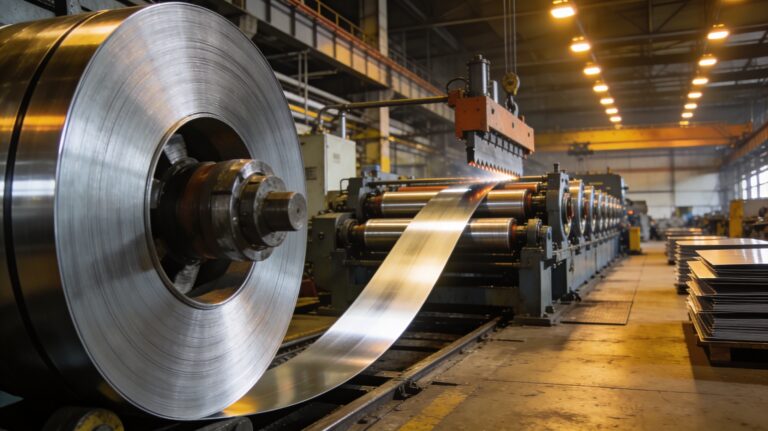
A practical way to compare slitting and blanking is to draw the material state graph: incoming master coil, width conversion, length conversion, finished package, and downstream consumption. Slitting changes width while preserving coil continuity. Blanking changes length and separates the material into discrete pieces. CTL adds leveling and length control before stacking.
When the buyer can describe this state transition clearly, machine selection becomes much less ambiguous. For the CTL side of the graph, review the cut-to-length process guide. For the slitting side, review the metal slitting line process guide.
Separate Width Tolerance From Length Tolerance
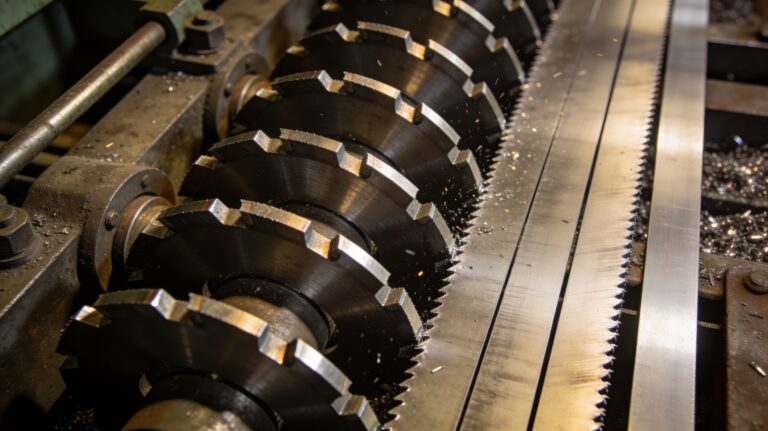
Slitting projects are usually controlled by finished strip width, edge quality, burr, camber, tension, recoiling, and strip separation. Blanking and CTL projects are controlled by sheet length, flatness, squareness, surface handling, stacking, and the accuracy of indexed feed. If the purchase discussion mixes these tolerance systems together, the specification becomes noisy and the equipment recommendation becomes weaker.
For a deeper slitting tolerance discussion, use the precision width tolerance guide. For CTL equipment selection, use the precision cut-to-length systems guide.
Use Production Rhythm as the Second Filter
Slitting favors continuous production rhythm: feed, cut longitudinally, separate strips, and rewind. Blanking favors indexed rhythm: feed a measured length, cut across the width, transfer, and stack. The best choice depends on order repeatability, coil change frequency, strip count, sheet length variation, stacking requirements, and how often operators must reset tooling.
If setup time is the bottleneck in a slitting operation, compare the slitting line setup-time reduction checklist. If the project is mainly sheet output, compare the metal cut-to-length line category.
RFQ Inputs That Prevent Process Confusion
- Incoming coil width, thickness range, material grade, coil weight, ID, OD, and surface sensitivity.
- Finished output form: slit coils, sheets, blanks, or a workflow that needs both width and length conversion.
- Slitting data: strip widths, strip count, trim allowance, burr target, camber target, and recoiling method.
- Blanking or CTL data: sheet length range, length tolerance, flatness target, stacking method, and bundle requirement.
- Order rhythm: batch size, changeover frequency, downstream process, inspection method, and delivery format.
Connect the Decision to Equipment Families
If the decision points toward slit coils, start with the metal slitting machine category and compare models such as the MA-1350 metal slitting machine. If the project points toward flat sheets, start with the CTL category and models such as the CT-1350 cut-to-length line.
To move from comparison to specification, send MaxDo the output format, material data, tolerance target, order rhythm, package requirement, and downstream process through the contact form. That information lets the engineering team choose the right process family before discussing model width, automation level, and commissioning scope.