Consiga ya su equipo

Formulario de contacto

Cut-to-Length Line Suppliers 2026: Engineer’s Buying Guide

A velocidades de producción superiores a 150 m/min, las fuerzas dinámicas que intervienen en la manipulación del material, el corte y el apilamiento crean perturbaciones que pueden superar fácilmente las tolerancias dimensionales que exigen las aplicaciones de fabricación modernas.

Every metal service center manager eventually faces the same moment: standing in front of the board trying to justify why a cut-to-length line that costs more than the building will pay for itself in three years. The math works, but only if you pick equipment that matches what you’re aTransparency disclosure: This guide is published by Máquina MaxDo, a manufacturer of cut-to-length and slitting lines based in China. MaxDo is included in the supplier profiles below with full specification disclosure. All other suppliers are assessed based on publicly available technical documentation and verified reference projects.

Every metal service center manager eventually faces the same moment: standing in front of the board trying to justify why a cut-to-length line that costs more than the building will pay for itself. The math works — but only if you pick equipment that matches what you are actually cutting, not what a salesperson claims you might need someday.

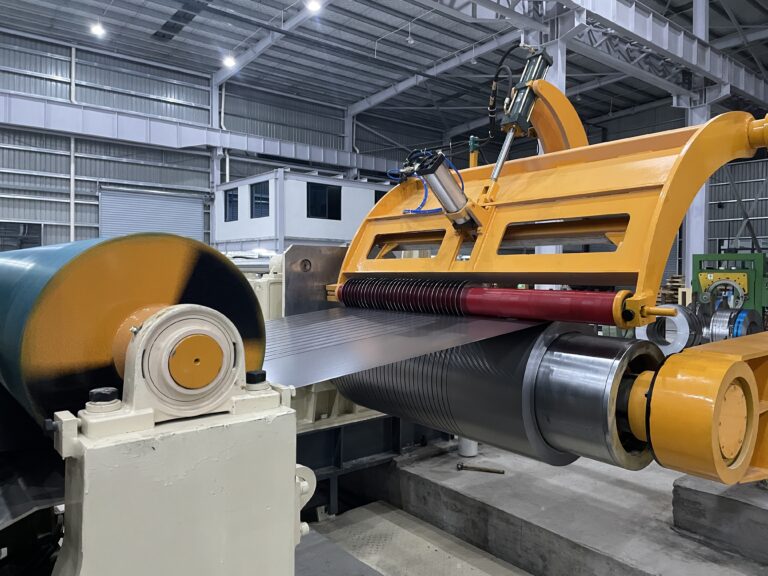
Modern cut-to-length line processing steel coil in an industrial factory

This guide covers eight verified CTL line manufacturers with confirmed technical specifications. Each profile includes what the equipment actually handles, what it is best suited for, and what it does not do well. A side-by-side comparison table and a decision framework follow the profiles.

Who this guide is for:

  • Metal service center managers evaluating first-purchase or replacement lines
  • Engineering teams specifying equipment for automotive, appliance, or construction supply applications
  • Procurement teams comparing European, North American, and Chinese suppliers on a cost-performance basis

What this guide does not do: It does not fabricate ROI figures, make up market statistics, or name suppliers that could not be verified against public technical documentation.

Por qué la precisión dimensional es más difícil de lo que parece

CTL line process flow: Uncoiler → Leveler → Servo Feed → Flying Shear → Stacker

Running material at speed while holding length tolerance within ±0.3 mm requires compensating for forces most engineers do not account for at first. Steel under tension stretches along its length — meaning a 6-meter sheet measured under processing tension is physically longer than the same sheet at rest. The cutting operation itself creates a momentary compression event. Spring-back after the blade clears the material adds further dimensional variation.

The four variables every CTL control system has to manage simultaneously:

  1. Material stretch under feed tension — proportional to yield strength, thickness, and processing speed
  2. Cutting compression — the blade deflects material downward before shearing; the amount varies with blade sharpness, gap setting, and material hardness
  3. Spring-back — high-strength steels (AHSS, UHSS) recover elastically after cutting; recovery magnitude varies by grade
  4. Blade wear drift — as blades wear, cutting force increases and dimensional consistency degrades; premium systems compensate automatically

Advanced servo-driven CTL lines address all four with closed-loop measurement and predictive correction algorithms. Entry-level encoder-based systems address items 1 and 4 partially and require operator intervention for items 2 and 3. Understanding this distinction is the fastest way to filter supplier proposals for your actual accuracy requirement.

CTL length accuracy benchmarks by application:

AplicaciónTypical Tolerance RequirementControl System Required
Structural steel blanks±1.0 mmStandard encoder-based
Appliance panels±0.5 mmServo with basic compensation
Automotive exposed body panels±0.2–0.3 mmServo with predictive algorithms
Precision electronics enclosures±0.15–0.2 mmFull closed-loop servo + edge measurement

Supplier Profiles

1. ANDRITZ (Austria) — Heavy-Duty and High-Strength Steel

Sede central: Graz, Austria | Fundada: 1852 | Relevant division: ANDRITZ Metals

ANDRITZ builds CTL lines for steel plants, service centers, automotive OEM suppliers, and aerospace applications. Their equipment covers the widest specification range of any supplier in this guide.

Verified technical specifications ():

  • Strip width: up to 2,850 mm
  • Strip thickness: 2 mm to 15 mm (finishing lines); up to 25 mm for heavy plate applications
  • Sheet length: up to 15 meters
  • Materials: carbon steel, stainless, coated, high-strength grades

Verified reference project: In February 2025, ANDRITZ was contracted to supply a new CTL line to Olympic Steel (Minneapolis, USA). The line processes coils up to 3.5 mm × 1,525 mm wide × 27 metric tons at 91 meters per minute, handling material with yield strengths to 80,000 PSI. It processes cold-rolled, pickled-and-oiled, stainless, and coated materials. Commissioning was scheduled for Q4 2025.

The Olympic Steel line uses a split leveler drive system that applies greater separating loads — this is ANDRITZ’s approach to maintaining flatness when processing high-strength grades that would deflect a conventional leveler frame under full load.

ANDRITZ Schuler Laser Blanking (2025 development): ANDRITZ Schuler — the German press technology division now operating under the ANDRITZ group — released a Laser Blanking Line 1.18 DFT in April 2025. The line processes 0.6–6 mm material directly from coil, including high-strength steels above 1,000 MPa, and measures approximately 25–30 meters in total length — roughly half the footprint of a conventional shear-based CTL line. This eliminates the need for a loop pit and complex foundation work.

Best suited for: Steel mills, large service centers processing heavy-gauge or high-strength material, automotive OEM suppliers needing sheets up to 15 meters, operations requiring full-line supply with engineering, commissioning, and long-term service from one source.

Less suited for: Light-gauge narrow-strip applications where the equipment investment exceeds what the application justifies; job shops with limited capital budgets.

2. Bradbury Group (USA) — Precision Leveling for North American Automotive and Appliance

Sede central: Elbing, Kansas, USA | Fundada: 1945 | Website: bradburygroup.com

Bradbury’s market position is built on leveling technology. Their proprietary e-Drive® and e-Drive 3 roller leveling system is the most frequently cited differentiator in their customer references. The company manufactures both light-gauge and heavy-gauge CTL lines.

Verified technical specifications:

  • Light-gauge CTL lines: gauge range .020″ to .625″ (approximately 0.51 mm to 15.9 mm)
  • Heavy-gauge CTL lines: available (specific maximum thickness specs are application-dependent; contact Bradbury for configuration)
  • e-Drive® leveling system: achieves flatness that Bradbury describes as “within fractions of ASTM standard tolerance”

Product line breadth: Bradbury manufactures CTL lines alongside slitting lines, precision roller levelers, packaging lines, and coil handling equipment. This means a single-supplier integration path is possible for facilities building or expanding a full coil processing department.

Best suited for: North American automotive and appliance manufacturers requiring repeatable flatness over high-volume production runs; facilities where ASTM flatness compliance is a contractual requirement with downstream customers.

Less suited for: Applications requiring widths beyond standard North American coil dimensions; operations primarily processing metric-specification coils sourced from Asian or European mills.

3. Fagor Arrasate (Spain) — High-Speed Automotive and Advanced Material Integration

Sede central: Mondragón, Basque Country, Spain | Parent group: Mondragon Corporation | Website: fagorarrasate.com

Fagor Arrasate focuses on high-speed automotive stamping supply chains. Their CTL lines are frequently integrated directly upstream of progressive die stamping presses, reducing intermediate material handling steps.

Verified technical specifications ():

  • Thickness range: 0.25 mm to 4 mm
  • Materials: standard grades plus “advanced materials” (AHSS, UHSS explicitly mentioned)
  • Multi-format cutting lines for flat packaged parts are available as a separate product line

Integration capability: Fagor Arrasate’s CTL lines are engineered to feed directly into stamping operations, which is significant for Tier 1 automotive suppliers running just-in-time schedules with frequent model-mix changes. The servo-driven architecture enables rapid changeover between part dimensions without extended setup downtime.

Best suited for: Automotive Tier 1 suppliers processing 0.25–4 mm advanced high-strength steels with direct stamping integration; operations where changeover speed and material traceability matter more than maximum thickness capacity.

Less suited for: Heavy-gauge structural applications above 4 mm; service centers processing diverse material mixes without a stamping press integration requirement.

4. Butech Bliss (USA) — Stretch Leveling and Temper Mill Specialization

Sede central: Salem, Ohio, USA | Years in operation: 135+ years | Website: butechbliss.com

Butech Bliss occupies a distinct position in the North American market through their stretch leveling CTL lines and temper mill CTL lines — configurations that most standard CTL suppliers do not offer. Stretch leveling changes the crystalline structure of the metal under tension to permanently reduce internal stresses, producing material that remains flat even after laser or plasma cutting operations downstream.

Verified product lines:

  • Roller leveling CTL lines — hydraulic roller leveler configurations with shape improvement to 800–1,000 I-units
  • Stretch leveling CTL lines — for operations where downstream laser cutting will release residual stress; multi-material, multi-thickness on a single line
  • Temper mill CTL lines — combines precision temper rolling with cutting and stacking in one continuous process for enhanced surface finish
  • Multi-blanking lines — integrates slitting and CTL in a single pass

Best suited for: Service centers supplying laser-cut part blanks where post-cut distortion is a documented customer complaint; operations processing material destined for precision welding or tight-tolerance fabrication where internal stress elimination has measurable downstream quality impact.

Less suited for: Standard sheet production where roller leveling quality is sufficient; operations with limited floor space, as stretch leveling lines have a larger footprint than standard roller leveling configurations.

5. Braner USA — Wide-Format and Heavy-Gauge Coil Processing

Sede central: Schiller Park, Illinois, USA | Website: braner.com

Braner USA (operating as Braner/Loopco) manufactures CTL and multi-blanking lines covering one of the widest specification ranges available from a North American supplier.

Verified technical specifications:

  • Coil width capacity: up to 100″ (2,540 mm); select configurations up to 120″ (3,050 mm)
  • Gauge range: .018″ (0.46 mm) stainless through .750″ (19.0 mm) high-strength hot-rolled
  • Coil weight: up to 50 tons
  • Materials: carbon steel, aluminum, stainless steel

Multi-blanking line capability: Braner’s CTL and Multi-Blanking Lines (MBL) process ferrous and non-ferrous coils into sheets, blanks, and plate products in a single pass. This matters for service centers that cut blanks to multiple lengths from a single coil in one operational sequence.

Best suited for: Service centers and steel processors handling wide or heavy coils; operations requiring both standard sheet and precision blank output from the same line configuration; plate processing applications up to 19 mm.

Less suited for: Applications requiring laser-cut profiles or integrated stamping; operations processing primarily light-gauge automotive-specification material where European suppliers’ advanced AHSS-specific control systems may be warranted.

6. Dimeco (Belgium) — Precision Blanking and Punching Integration

Sede central: Manage, Belgium | Website: dimeco-group.com

Note: Dimeco’s current CTL line specifications were not independently verifiable from public technical documentation at the time of writing. The following profile is based on the general market positioning described in industry sources. Readers should request current specification sheets directly from Dimeco before using this information for procurement decisions.

Dimeco specializes in blanking lines that combine CTL cutting with precision punching operations in a single automated sequence. Their systems target automotive applications requiring complex part geometries cut from coil — eliminating secondary punching operations and reducing work-in-process inventory between cutting and forming stages.

Best suited for: Automotive component manufacturers who currently perform CTL cutting and punching as sequential separate operations and want to evaluate integrated single-pass production; operations where WIP reduction between cutting and forming is a documented cost driver.

7. LOTOS Slitting (China) — Customizable Mid-Range CTL and Slitting Lines

Sede central: China | Website: lotosslitting.com

LOTOS manufactures slitting lines, CTL lines, and packaging lines with a focus on customization across size, speed, blade configuration, and control systems. Their slitting lines achieve width precision of ≤±0.05 mm at 1.0 mm thickness — a verified specification from their product documentation. CTL line specifications are application-dependent and configured to order.

Verified capability for slitting lines:

  • Blade material: SKD-11
  • Width precision (slitting): ≤±0.05 mm (T = 1.0 mm)
  • Light-gauge material: 0.15–1.5 mm thickness, up to 1,000 mm width (light-gauge slitting line configuration)
  • Control: fully customizable including control system type

For CTL-specific line specifications, request a configuration sheet directly from LOTOS. Published CTL line specs were not available from their website at the time this guide was written.

Best suited for: Service centers and fabricators evaluating Chinese-manufactured equipment for standard-grade steel and light-gauge applications; operations with in-house maintenance capability who can manage longer parts lead times in exchange for lower capital cost.

8. MaxDo Machine (China) — This Guide’s Publisher

Sede central: China | Fundada: 2008 | Certificaciones: ISO certified, 25+ patents | Website: maxdomachine.com

Full disclosure: MaxDo Machine publishes this guide. The specifications below are drawn directly from MaxDo’s own product documentation and are presented for reader comparison alongside other suppliers, not as a recommendation.

MaxDo manufactures MD-series cut-to-length and slitting lines for light-to-medium gauge applications across four standard configurations. All models process coil widths from a narrow minimum up to 2,150 mm (MD-2200), at processing speeds up to 250 m/min, with length accuracy to ±0.15–0.2 mm.

Verified MD-series CTL line specifications:

ModeloAnchura de trabajoGama de espesoresVelocidad máximaPeso de la bobinaPotencia total
MD-85020–820 mm0,3-12 mm250 m/min10–35 t (customizable)~138.5 kW
MD-1350300–1,300 mm0,3-12 mm250 m/min10–35 t (customizable)~318.5 kW
MD-1650300–1,650 mm0,3-12 mm250 m/min10–35 t (customizable)~422.5 kW
MD-2200300–2,150 mm0,3-12 mm250 m/min10–35 t (customizable)~422.5 kW

Length accuracy: ±0.15–0.2 mm with servo-controlled systems and closed-loop length measurement.

Material compatibility: Cold-rolled steel, stainless steel, aluminum alloys, galvanized steel, pre-painted coil.

Leveling system: Multi-roll leveling unit eliminates coil set and residual stress before cutting. Material stress variation reduction: 85–90% compared to unleveled material (per MaxDo technical documentation).

System architecture: Heavy-duty uncoiler with servo-driven feed control → multi-roll leveling unit → precision length measurement (encoder + laser positioning) → hydraulic shear → automated stacking with adjustable pressure for surface protection.

Typical applications by model:

  • MD-850 — HVAC ductwork, metal roofing strips, precision decorative trim, narrow electronics enclosures
  • MD-1350 — Appliance housing panels, aluminum façade components, mid-width structural blanks
  • MD-1650 / MD-2200 — Automotive panels, construction sheeting, large-format industrial blanks, architectural cladding

View MD-850 product page
View MD-1650 product page
Compare slitting vs. CTL lines for your application

Supplier Comparison: Verified Specifications at a Glance

ProveedorCountryAnchura máximaGama de espesoresKey DifferentiatorBest Fit Application
ANDRITZAustria2,850 mm2–25 mmSplit leveler; laser blanking division; full-line supplySteel mills, heavy-gauge, high-strength automotive
Grupo BradburyUSAApplication-dependent~0.5–15.9 mme-Drive® leveling system; ASTM flatness complianceNorth American automotive & appliance
Fagor ArrasateSpainApplication-dependent0.25–4 mmAHSS-capable; direct stamping integrationAutomotive Tier 1, advanced materials
Butech BlissUSACustomCustomStretch leveling; temper mill CTLLaser-cut blank supply; stress-critical applications
Braner USAUSA3,050 mm0.46–19 mmWide-format + heavy-gauge; MBL capabilityService centers, plate, wide-coil processing
DimecoBelgium— (待核实)CTL + punching integrationAutomotive blanks requiring punched features
LOTOS SlittingChinaCustom0.15 mm + (custom)Fully customizable; competitive pricingStandard-grade service centers, light gauge
Máquina MaxDoChina2,150 mm0,3-12 mm±0.15–0.2 mm accuracy; 250 m/min; ISO certifiedAutomotive, appliance, HVAC, construction

The Decision Framework: Matching Line to Application

CTL line selection decision tree: material thickness, production pattern, and accuracy requirements

Avoid over-specifying. A fully automated heavy-gauge line with predictive maintenance and Industry 4.0 connectivity is the right answer for a 24/7 steel service center processing mixed high-strength grades. It is the wrong answer for a fabricator cutting standard mild steel sheets in a single daily shift.

Step 1 — Define your material envelope first, not your production volume.

Your material mix sets hard constraints: maximum width, maximum thickness, yield strength range, and surface sensitivity. A line that cannot process your hardest material or widest coil is not a candidate, regardless of price. Use the comparison table above to filter suppliers before asking for quotations.

Step 2 — Match automation level to your changeover frequency.

Production PatternAppropriate Automation Level
Single material, continuous productionFully automated (robotic coil loading, autonomous stacking)
Mixed materials, 3–5 changeovers per shiftSemi-automatic with automated measurement, manual coil loading
Job shop, 10+ different specs per dayFlexible semi-automatic with fast manual setup

Oversized automation on a job shop line creates setup complexity without throughput benefit. Undersized automation on a continuous production line creates labor cost that compounds over equipment life.

Step 3 — Evaluate supplier support infrastructure with the same rigor as equipment specs.

Response time for technical issues and spare parts availability determines whether a production stop lasts two hours or two weeks. For operations running just-in-time schedules, this is not secondary to equipment capability — it is equal to it. Ask each supplier:

  • Where is your nearest service engineer located?
  • What is your standard lead time for wear parts (blades, leveler rolls)?
  • What remote diagnostics capability does the line include?
  • What is your commissioning timeline and who bears cost overruns?

Step 4 — Conduct a professional site assessment before finalizing specifications.

Generic quotations miss facility-specific constraints: existing coil handling equipment interfaces, floor load capacity, power supply specifications, and operator skill levels. Equipment that performs perfectly in a factory acceptance test can underperform in a facility whose material flow or workforce was not part of the specification process.

Preguntas frecuentes

Q: What is the difference between a flying shear and a stop-start CTL line?

A flying shear cuts material while it is moving at full processing speed. The shear travels in sync with the strip during the cutting stroke, then returns to position before the next cut. Stop-start lines (roll feed / stop-start) decelerate material to a stop for each cut, then re-accelerate. Flying shear lines achieve higher throughput for standard sheet production. Stop-start lines achieve higher dimensional accuracy for short, precise cuts because there is no dynamic compensation required during the cutting stroke.

Q: How much does a cut-to-length line cost?

Entry-level configurations for thin-gauge standard applications start significantly below heavy-gauge fully automated systems. Price varies with material range, leveling type, automation level, and supplier region. Request itemized quotations rather than package prices — this lets you identify where cost is concentrated and where you can engineer to a lower specification without sacrificing your actual requirements. Specific pricing figures are not published in this guide because they change with material costs, lead times, and configuration.

Q: What is I-unit flatness measurement, and when does it matter?

I-units measure the percent length difference between the longest and shortest fibers across a strip’s width, expressed as a dimensionless number. Zero I-units means perfect flatness. For most structural applications, 20–50 I-units is acceptable. For laser cutting operations, material above 50–100 I-units can lift off the cutting table and cause focal length variation. Butech Bliss’s stretch leveling CTL lines achieve flatness with shape improvement to 800–1,000 I-units before leveling, reducing to near-zero after processing — a specification that matters specifically for operations supplying laser cutting services.

Q: Can a single CTL line process both mild steel and stainless steel?

Yes, but requires blade material changes, blade gap adjustments, and different processing parameters. Stainless work-hardens during cutting — meaning the material becomes harder at the cut edge as the blade passes through — which increases blade wear rate and can affect edge quality if blade gap is not adjusted for the grade. Premium lines with automatic blade gap control and material-specific processing profiles can switch between materials without manual reconfiguration. Verify this capability explicitly in supplier specifications if your operation processes both grades regularly.

Q: What is the difference between roller leveling and stretch leveling?

Roller leveling passes the strip through a series of interleaved rolls that progressively bend the material past its yield point in alternating directions, removing coil set and surface-to-surface length differentials. Stretch leveling applies tension above the material’s yield point while it passes through the leveling zone, permanently changing its crystalline structure and eliminating internal stresses that roller leveling cannot reach. Stretch-leveled material remains flat after downstream cutting operations such as laser or plasma cutting that would cause roller-leveled material to distort as internal stresses are released.

Related Resources on maxdomachine.com

Last reviewed: March 2026. Supplier specifications are subject to change; verify current configurations directly with each manufacturer before procurement decisions. ANDRITZ Olympic Steel reference project details sourced from ANDRITZ newsroom (February 2025) and Metalforming Magazine (February 2025).

Comparte tu amor