

1350mm Slitting Line Supply: Specifications, Suppliers & Cost Analysis
Complete guide to 1350mm slitting line supply with MD-1350MM specs, supplier selection criteria, TCO analysis, and procurement strategies for metal processors.
MD-1350MM Slitting Line: Complete Buyer’s Guide (Specs, Suppliers & ROI)
Steel service centers and metal processors face three critical challenges when sourcing 1350mm slitting line equipment: matching technical specifications to production requirements, verifying supplier reliability beyond marketing claims, and calculating true total cost of ownership beyond initial price tags. MD-1350MM delivers the optimal solution for facilities processing standard 1000-1250mm coil widths, achieving ±0.1mm cutting accuracy across 0.3-12mm thickness ranges while maximizing material yield rates beyond 96%—a 4-percentage-point improvement over conventional slitting technologies that typically achieve 92-94% yields.
This buyer’s guide provides procurement-focused intelligence across seven decision dimensions: capacity class positioning, technical specifications decoded for business value, a 12-point supplier evaluation framework, total cost of ownership modeling, ROI break-even analysis, material compatibility matrices, and automation system comparisons. Production managers and industrial engineers will gain actionable frameworks supported by real-world case studies, competitive benchmarking data, and contract negotiation strategies to support data-driven equipment investment decisions.
Why MD-1350MM Dominates the Mid-Range Slitting Market
MD-1350MM captures the market sweet spot for steel service centers and metal processors handling standard coil widths between 1000-1250mm—a specification range that represents approximately 70% of coil processing volume in automotive, appliance, and HVAC manufacturing sectors. This capacity class eliminates the inefficiency of oversized equipment consuming unnecessary floor space and energy while avoiding the throughput limitations of smaller systems that create production bottlenecks during high-volume runs.
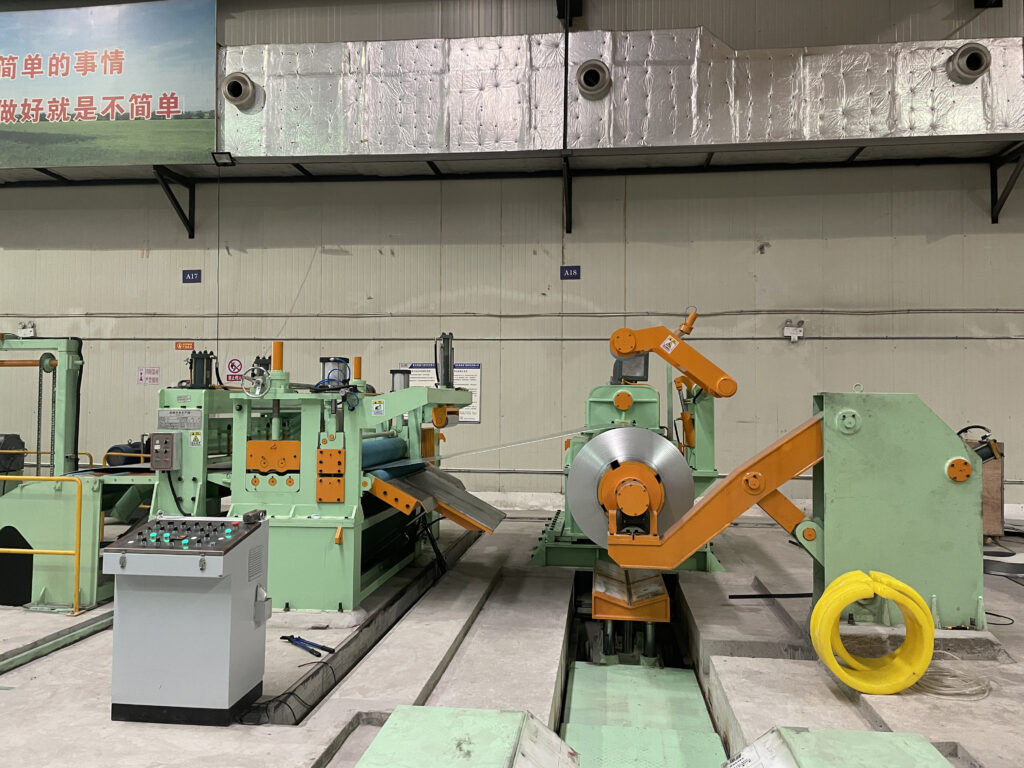
MaxDo engineered MD-1350MM to balance three critical performance factors: precision tolerance (±0.1mm across all thickness ranges), energy efficiency (318.5KW optimized for continuous operation), and production flexibility (1-250 m/min variable speed operation). Facilities processing 300-500 tons monthly achieve optimal equipment utilization rates between 65-85%, whereas smaller MD-850 systems reach capacity constraints at 200 tons monthly and larger MD-1650 platforms operate below efficient utilization thresholds until monthly volumes exceed 600 tons.
Capacity Class Positioning: MD-850 vs MD-1350MM vs MD-1650MM
Understanding capacity class trade-offs requires analyzing working width ranges, power consumption profiles, speed capabilities, target industries, and investment thresholds across the MD series platform architecture.
| Модель | Рабочая ширина | Потребляемая мощность | Диапазон скоростей | Primary Industries | Price Range |
|---|---|---|---|---|---|
| 300-820 мм | 93kW | 1-60 m/min | Electronics, precision stamping, narrow strip production | $280K-420K | |
| MD-1350MM | 300-1300 мм | 318,5 кВт | 1-250 m/min | Steel service centers, automotive, appliance, HVAC | $350K-800K |
| 300-1650 мм | 294.5kW | 1-80 m/min | Construction materials, wide coil processing, appliance manufacturing | $480K-950K | |
| MD-2200 | 300-2150 мм | 422,5 кВт | 1-250 m/min | Large-scale steel distribution, structural components | $650K-1.2M |
MD-1350MM establishes the optimal price-performance ratio for facilities processing standard coil widths. The 15-25% cost premium versus MD-850 delivers 20-30% throughput capacity gains, while avoiding the 35-40% cost increase associated with MD-1650 systems that exceed capacity requirements for most steel service center applications.
MaxDo’s Engineering Edge in 1350mm Systems
MaxDo differentiates MD-1350MM through three proprietary technological innovations developed across 20+ years of R&D experience with 500+ installations spanning 30+ countries:
Closed-loop tension control architecture utilizes load cell feedback integrated with dancer roll positioning to maintain 200-800 kg tension forces with ±3% variation throughout processing runs—compared to ±8-12% variation in competitor systems using open-loop hydraulic tension controls. This precision eliminates edge wave defects in thin gauge materials (0.3-1.5mm) and prevents coil telescoping during high-speed recoiling operations.
Quick-change blade assembly systems reduce setup time to 45-90 minutes compared to industry-average 2-3 hour changeover periods required by conventional bolt-mounted arbor designs. MaxDo’s cartridge-style tooling mechanism enables rapid setup time transitions between material types without requiring complete arbor disassembly, supporting mixed-material production schedules common in steel service center environments processing both ferrous and non-ferrous substrates daily.
Predictive maintenance integration combines vibration monitoring sensors, thermal imaging of critical bearing assemblies, and PLC fault code analysis transmitted via ethernet connectivity to MaxDo technical support teams. This IoT-enabled diagnostic capability provides 2-3 week advance warning of component degradation, preventing unplanned downtime that typically costs $8,000-15,000 per incident in lost production capacity and emergency repair expenses.
MD-1350MM Technical Specifications Decoded
MD-1350MM achieves versatile processing capability through four distinct thickness configuration tiers engineered for specific material categories and industrial applications. Production managers must align blade configurations, speed parameters, and tonnage requirements to material specifications to maximize equipment utilization and prevent premature tooling wear.
The fundamental working width range spans 300mm-1300mm with customizable coil handling capacity from 10-35 tons to accommodate varying coil weights across different material types and gauge thicknesses. Total power consumption of 318.5KW supports continuous operation across single-shift, two-shift, and three-shift production schedules with electrical infrastructure requiring 400-480V three-phase power at appropriate transformer capacity.
Thickness Capability Matrix: Matching Blade Config to Your Material
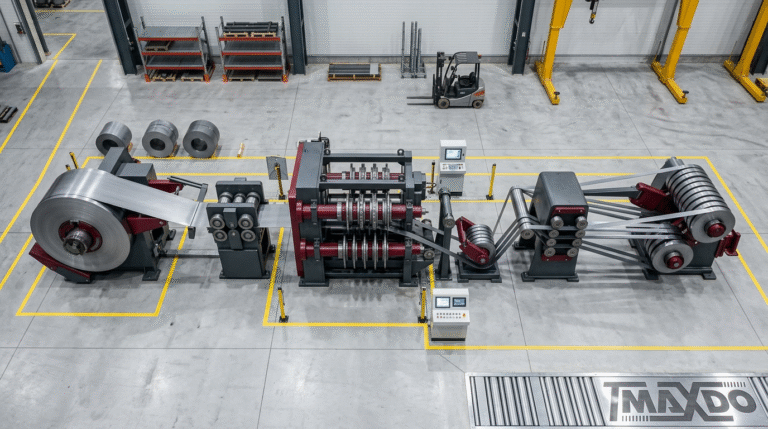
MD-1350MM eliminates frequent changeover downtime through optimized blade configuration categories aligned to material thickness bands and substrate hardness characteristics:
Thin gauge processing (0.3mm-3.0mm) deploys high-speed steel (HSS) blades running at 180-250 m/min for cold-rolled steel and aluminum substrates common in automotive trim panels, appliance outer casings, and HVAC ductwork fabrication. This configuration maintains 0.010-0.020mm blade clearance to prevent edge burrs while achieving material yield rates of 96.5-97.5% through minimized edge trim requirements.
Medium gauge operations (1.5mm-6mm) utilize carbide-tipped tooling at 80-150 m/min processing speeds optimized for galvanized coatings and 300-series stainless steel grades typical in construction materials, appliance interior components, and commercial refrigeration panels. Blade overlap increases 10-15% versus thin gauge settings to compensate for higher material yield strength and work hardening characteristics during slitting operations.
Heavy gauge capabilities (2mm-8mm) implement reinforced blade assemblies with ceramic coating at 40-100 m/min for hot-rolled structural steel, heavy-gauge stainless steel, and abrasive-resistant materials used in industrial equipment fabrication and structural building components. Increased blade rigidity prevents deflection under cutting loads exceeding 4,000 kg while maintaining precision width tolerance requirements.
Extra-heavy gauge processing (4mm-12mm) employs ceramic-coated blade assemblies at 10-60 m/min for the most demanding applications including marine-grade stainless steel, high-strength low-alloy (HSLA) structural steel, and wear-resistant AR400/AR500 plate materials. MaxDo engineers blade geometry specifically for these extreme thickness ranges to extend tooling life to 500,000-800,000 linear meters—a 30-50% improvement over standard blade configurations that typically require replacement at 350,000-550,000 linear meters.
Precision Tolerance: How ±0.1mm Accuracy Reduces Scrap by 4%
MD-1350MM achieves ±0.1mm dimensional accuracy through mechanical tolerance stacking optimization, thermal expansion compensation, and real-time strip width verification systems that continuously monitor slit width dimensions throughout production runs. This precision level translates directly to financial performance through scrap reduction and improved material utilization rates.
A steel service center processing 3,600 tons annually (300 tons monthly) at average material cost of $800/ton faces total annual material expenditure of $2.88 million. Conventional slitting equipment achieving 92-94% material yield generates 216-288 tons of edge trim scrap annually valued at $172,800-230,400. MD-1350MM’s 96%+ yield rate reduces scrap to 144 tons annually, producing $115,200 in edge trim losses—representing $57,600-115,200 annual cost savings through precision tolerance alone.
Additional financial benefits include reduced secondary processing requirements (deburring, edge grinding) that typically add $15-25 per ton in labor costs, and improved customer satisfaction through tighter dimensional consistency that reduces reject rates in downstream fabrication operations. Automotive tier suppliers and appliance manufacturers specify ±0.15mm tolerance requirements that eliminate conventional slitting equipment from consideration, creating competitive advantage for steel service centers operating MD-1350MM systems capable of meeting precision specifications.
12-Point Supplier Evaluation Framework
Successful 1350mm slitting line procurement requires systematic assessment across technical capability verification, after-sales infrastructure evaluation, customization portfolio review, and financial stability analysis. Production managers should implement weighted scoring matrices allocating 40% to technical capability, 30% to after-sales support infrastructure, 20% to pricing competitiveness, and 10% to delivery performance to balance immediate cost considerations against long-term operational reliability.
Technical Capability: Beyond ISO 9001 Certification
ISO 9001 certification establishes baseline quality management standards but provides insufficient differentiation among coil processing equipment manufacturers. Production managers must verify manufacturing experience exceeding 15 years specifically in metal processing equipment rather than general machinery fabrication, as specialized knowledge of material behavior, blade metallurgy, and tension control dynamics separates professional equipment suppliers from commodity vendors.
MaxDo demonstrates verified technical capability through documented installation track records exceeding 500 global deployments across diverse industrial applications including steel service centers, automotive tier suppliers, appliance manufacturers, and construction material processors spanning 30+ countries. Request customer reference lists segmented by material type (cold-rolled steel, stainless steel, aluminum, copper) and thickness range (thin/medium/heavy gauge) to confirm supplier expertise matches your specific processing requirements.
Equipment performance validation should include third-party inspection reports documenting dimensional accuracy measurements, speed capability verification under load conditions, and material yield rate calculations based on actual production data rather than theoretical specifications. Premium suppliers provide factory acceptance testing (FAT) protocols enabling customers to witness equipment operation using representative material samples before final payment authorization.
After-Sales Infrastructure: The Hidden TCO Factor
After-sales support infrastructure represents the critical differentiator impacting 10-year total cost of ownership through spare parts availability, technical service response times, and predictive maintenance support capability. Evaluate local service team availability, regional warehouse locations maintaining critical spare parts inventory, and typical response times for emergency breakdown situations.
MaxDo maintains 48-72 hour parts delivery commitments through strategically positioned regional warehouses in North America, Europe, and Asia-Pacific providing next-business-day delivery for high-wear components including blade arbors, tension roll assemblies, and hydraulic system components. This logistics infrastructure contrasts sharply with overseas suppliers requiring 3-4 week lead times for replacement parts, creating extended production downtime that costs $8,000-15,000 per day in lost throughput capacity.
Technical service support should include 24/7 remote diagnostic capability via ethernet-connected PLC systems transmitting fault codes, production parameters, and sensor data to supplier engineering teams for real-time troubleshooting. MaxDo’s predictive maintenance platform analyzes vibration signatures, bearing temperature profiles, and hydraulic pressure variations to identify developing issues 2-3 weeks before component failure—enabling scheduled maintenance during planned downtime windows rather than unplanned production interruptions.
Training programs represent another critical after-sales consideration, with premium suppliers providing 3-5 days of on-site operator instruction covering setup procedures, material changeovers, preventive maintenance schedules, and troubleshooting protocols. Comprehensive training reduces operator error incidents by 60-75% during the first 12 months of operation compared to equipment installations relying solely on written documentation.
Customization Proof: Case Studies Over Marketing Claims
Customization capabilities for specialized material processing require validated case studies demonstrating successful implementations rather than generic marketing claims. Request documentation proving multi-material processing experience including stainless steel 304/316 grades, aluminum alloys (1100, 3003, 5052 series), copper sheets, and other non-ferrous substrates requiring specialized blade configurations, coolant systems, and edge treatment protocols.
MaxDo’s custom light gauge slitting machine portfolio includes verified installations processing 0.3mm cold-rolled steel for automotive body panels at 250 m/min production speeds, 2.5mm stainless steel 304 for commercial kitchen equipment fabrication, and 1.8mm aluminum 3003 for HVAC ductwork manufacturing. Each case study documents processing parameters, blade configurations, yield rates, and customer production volume data validating equipment performance claims.
Technical documentation quality differentiates professional equipment suppliers through comprehensive packages including 3D CAD models in STEP or IGES format for facility layout planning, PLC programming access with ladder logic documentation enabling customization, preventive maintenance schedules with detailed inspection checklists, and electrical schematics showing control system architecture for integration with existing plant systems.
Total Cost of Ownership: Beyond the Price Tag
Equipment acquisition costs for MD-1350MM systems range from $350,000 for semi-automated configurations featuring manual blade adjustment and basic coil handling to $800,000+ for fully automated production lines integrating advanced material handling, automated thickness gauging, and statistical process control systems. Understanding the three-tier cost structure—acquisition, installation, and operating expenses—enables accurate 10-year TCO modeling essential for capital equipment investment decisions.
Acquisition Cost Breakdown: Standard vs Customized Systems
Standard MD-1350MM configurations include touchscreen PLC controls with graphical HMI interface, hydraulic coil loading systems with manual positioning, pneumatic blade adjustment mechanisms, and basic tension control suitable for single-material, moderate-volume production environments processing 200-350 tons monthly. Base pricing typically falls within the $350,000-480,000 range depending on coil weight capacity (10-ton vs 35-ton configurations) and speed requirements (80 m/min vs 250 m/min maximum line speed).
Customization premiums add 15-40% to initial investment depending on feature complexity and automation level:
| Customization Category | Cost Range | Capability Enhancement |
|---|---|---|
| Servo-driven blade positioning | $25,000-40,000 | ±0.02mm repeatability vs ±0.15mm manual adjustment |
| Automated quick-change tooling | $35,000-55,000 | 20-minute changeover vs 45-90 minute manual setup |
| Integrated thickness gauging | $30,000-50,000 | Real-time verification ±0.01mm vs manual sampling |
| Automated coil cars & bundling | $60,000-95,000 | Unmanned operation capability |
| Статистическое управление процессами | $25,000-45,000 | Automated quality documentation & trend analysis |
Production managers must evaluate customization ROI against processing volume, material variety, and quality requirements. Facilities processing 500+ tons monthly across multiple material grades typically justify automation investments through reduced labor costs ($40,000-60,000 annually for eliminated operator positions) and improved yield rates (0.5-1.5% material savings worth $14,400-43,200 annually at $800/ton material costs processing 3,600 tons).
Operating Expense Calculator: Energy + Blades + Maintenance
Operating expenses accumulate across three primary categories over 10-year equipment lifecycles: energy consumption, consumable replacement (blades, tooling, filters, lubricants), and preventive maintenance labor requirements.
Energy costs at 318.5KW continuous load operating 16 hours daily (two-shift operation), 250 days annually consume 1,274,000 kWh yearly. At industrial electricity rates averaging $0.12/kWh, annual energy expenditure totals $152,880. Single-shift operations (8 hours daily) reduce annual energy costs to $76,440, while three-shift continuous operation (22 hours daily) increases costs to $210,210 annually.
Blade replacement cycles average 500,000-800,000 linear meters depending on material abrasiveness, with replacement sets costing $12,000-18,000 for complete arbor tooling including HSS blades for thin gauge applications. Processing 300 tons monthly at average coil length of 180 meters per ton generates 648,000 linear meters annually, requiring blade replacement every 9-15 months at annual costs of $9,600-24,000 depending on material mix (cold-rolled steel vs stainless steel vs aluminum).
Preventive maintenance schedules require 8-12 hours monthly for critical component inspection including hydraulic system checks, bearing lubrication, tension roll alignment verification, and PLC system diagnostics. At $85/hour maintenance labor rates, annual preventive maintenance costs total $8,160-12,240 not including consumable supplies (hydraulic fluid, lubricants, filters) adding approximately $3,500-5,000 annually.
Hidden cost factors include downtime during blade changeovers (45-90 minutes generating $375-750 lost production capacity per setup at $500/hour opportunity cost), scrap rates from edge trim (2-4% of coil width representing $57,600-115,200 annually at 96% yield vs 92% baseline), and quality control system integration expenses for automated thickness verification ($8,000-15,000 implementation plus $2,000-3,500 annual calibration).
ROI Analysis: When Does In-House Slitting Make Sense?
Break-even processing volumes for in-house slitting equipment occur at approximately 300 tons monthly when comparing internal processing costs against outsourcing to steel service centers charging $120-180 per ton for standard slitting operations. ROI calculations must account for equipment depreciation, operating expenses, and opportunity costs of capital investment versus alternative uses.
Break-Even Volume: 300 Tons/Month Threshold Explained
The fundamental ROI formula compares annual profit contribution from in-house processing against initial equipment investment: ROI = (Annual Profit / Initial Investment) × 100.
Consider a steel service center currently outsourcing 400 tons monthly at $150/ton, generating $720,000 annual outsourcing expenses. Acquiring MD-1350MM at $500,000 initial investment creates the following cost structure:
Annual Operating Costs:
- Labor (two operators, two-shift): $120,000
- Energy (318.5KW, 16hr/day, 250 days, $0.12/kWh): $152,880
- Blade replacement: $18,000
- Preventive maintenance: $12,000
- Consumables & supplies: $8,000
- Total Annual Operating Costs: $310,880
Annual Cost Comparison:
- Outsourcing: $720,000
- In-house processing: $310,880
- Annual Savings: $409,120
Payback Period Calculation:
- Initial Investment: $500,000
- Annual Savings: $409,120
- Payback Period: 1.22 years (14.6 months)
This analysis excludes equipment depreciation tax benefits, increased production control enabling faster turnaround times (competitive advantage worth $50,000-100,000 annually in customer retention), and capability to accept higher-margin precision tolerance work unavailable when outsourcing to service centers with ±0.3-0.5mm accuracy limitations.
Material-Specific Payback: Stainless vs Carbon Steel
Sensitivity analysis reveals material type significantly impacts ROI timelines through variations in outsourcing costs, blade wear rates, and processing speeds affecting throughput capacity.
| Material Type | Outsourcing Cost/Ton | In-House Cost/Ton | Monthly Volume for Break-Even | Payback Period (400 tons/month) |
|---|---|---|---|---|
| Холоднокатаная сталь | $120-140 | $95-108 | 340 tons | 18-24 months |
| Galvanized steel | $135-155 | $102-115 | 320 tons | 16-22 months |
| Stainless 304 | $180-220 | $125-145 | 280 tons | 12-18 месяцев |
| Aluminum alloys | $160-190 | $115-135 | 300 tons | 14-20 months |
| Copper sheet | $200-250 | $140-170 | 260 tons | 10-16 months |
Stainless steel processing achieves fastest payback (12-18 months) due to higher outsourcing costs ($180-220/ton) reflecting specialized tooling requirements and lower service center processing speeds. Facilities processing mixed material portfolios should calculate weighted-average payback periods based on material mix percentages to determine accurate ROI projections.
Mid-tier supplier equipment typically achieves 3-year payback periods processing 300+ tons monthly, while premium supplier systems like MD-1350MM with extended warranties, superior after-sales support, and longer component lifecycles demonstrate 4-5 year payback horizons but deliver lower total cost of ownership over 10-year equipment lifecycles through reduced downtime, fewer emergency repairs, and higher resale values.
Material Compatibility & Multi-Material Processing
MD-1350MM processes diverse ferrous and non-ferrous materials through optimized blade configurations, speed parameters, and edge treatment protocols specific to substrate hardness, yield strength, and work hardening characteristics. Understanding material-specific processing requirements prevents premature blade wear, edge quality defects, and equipment damage while maximizing production efficiency.
Ferrous vs Non-Ferrous: Blade Configuration Guide
Ferrous material processing includes cold-rolled steel, hot-rolled steel, galvanized coatings, and low-alloy structural grades with thickness-specific blade configurations optimized for each substrate:
Cold-rolled steel (0.3-3.0mm thickness) requires high-speed steel (HSS) blades with 0.010-0.020mm blade clearance to prevent edge burrs while maintaining 180-250 m/min processing speeds. Blade overlap of 8-12% provides optimal cutting geometry for automotive body panels, appliance outer casings, and metal furniture components requiring clean edge quality for subsequent powder coating or e-coating operations.
Hot-rolled steel (4-12mm thickness) demands carbide or ceramic-coated tooling with increased blade overlap (15-20%) to compensate for material scale buildup and higher yield strength characteristics. Processing speeds reduce to 10-60 m/min for heavy-gauge applications including structural beams, machinery bases, and industrial equipment frames where edge straightness takes priority over production speed.
Non-ferrous processing capabilities encompass stainless steel 304/316 grades, aluminum alloys (1100, 3003, 5052 series), and copper sheets requiring specialized tooling and coolant systems:
Stainless steel 304/316 processing mandates carbide blades with titanium nitride (TiN) coating and specialized coolant application to manage heat buildup during high-speed operations. Blade overlap increases 15-25% versus mild steel settings to compensate for work hardening characteristics that cause rapid tool wear. Processing speeds range from 60-120 m/min depending on gauge thickness, with preventive blade inspection every 200,000 linear meters to detect edge chipping before quality degradation occurs.
Aluminum alloy processing requires specialized edge treatment including blade angle modifications (increased rake angle 5-8 degrees) and coolant application to prevent galling and material adhesion to blade surfaces. Quick-change tooling options enable blade assembly replacement in 45-90 minutes for facilities processing multiple material types daily, supporting mixed production schedules common in steel service centers serving diverse customer bases. Learn comprehensive material-specific processing parameters in MD Series material compatibility guide.
Industry Application Matrix: Automotive, Appliance, Construction
Industry-specific applications drive material selection and precision requirements across automotive parts manufacturing, appliance production, and construction materials processing:
| Industry | Typical Materials | Диапазон толщины | Precision Requirement | MD-1350MM Suitability |
|---|---|---|---|---|
| Automotive body panels | Cold-rolled steel, aluminum | 0.6-1.5mm | ±0,1 мм | Optimal—high speed + precision |
| Appliance casings | Galvanized steel, stainless 304 | 0.5-2.0mm | ±0.15mm | Optimal—multi-material capability |
| HVAC components | Galvanized steel, aluminum 3003 | 0.8-2.5mm | ±0.2mm | Optimal—medium gauge processing |
| Construction roofing | Galvanized/Galvalume coatings | 0.4-0.8mm | ±0,3 мм | Suitable—thin gauge high-speed |
| Structural components | Hot-rolled steel, HSLA grades | 3.0-8.0mm | ±0,3 мм | Suitable—heavy gauge capability |
| Industrial equipment | Stainless 304/316, AR plate | 4.0-12mm | ±0.2mm | Suitable—extra-heavy gauge option |
Automotive parts manufacturing represents the most demanding application requiring ±0.1mm dimensional accuracy for body panel blanks, structural reinforcements, and trim components where tight tolerances ensure proper fit during assembly operations. MD-1350MM achieves these specifications through rigid machine frame construction, thermal expansion compensation, and real-time strip width verification systems monitoring dimensional accuracy throughout production runs.
Understanding the relationship between slitting and alternative coil processing methods helps production managers select optimal equipment configurations for specific material types and finished product requirements.
Automation & Control Systems: PLC, HMI & Predictive Maintenance
MD-1350MM integrates advanced automation technologies reducing operator skill requirements, improving process consistency, and enabling predictive maintenance strategies that prevent unplanned downtime through real-time monitoring and diagnostic capabilities.
PLC & HMI: Reducing Operator Training from Weeks to Days
Touchscreen PLC controls with intuitive graphical interfaces reduce operator training time by 40% compared to legacy button-panel systems requiring extensive manual programming knowledge and memorization of complex setup sequences. Modern HMI (Human-Machine Interface) systems display real-time production parameters including line speed, coil length processed, strip width verification, and tension control status with color-coded alerts for out-of-tolerance conditions.
MD-1350MM’s coil feed PLC controller integrates automatic coil feeding and recoiling systems incorporating hydraulic mandrel expansion, closed-loop tension control, and optical edge guiding sensors maintaining ±2mm strip positioning accuracy throughout processing runs. Tension control systems utilize load cells and dancer roll feedback maintaining 200-800 kg tension forces appropriate for material thickness and yield strength characteristics—automatically adjusting tension parameters based on material type selections stored in recipe databases.
Recipe management functionality stores processing parameters for up to 500 material/thickness combinations including blade spacing settings, speed profiles, tension curves, and edge trim percentages. Operators select saved recipes via touchscreen interface, initiating automated setup sequences that position blades, adjust tension parameters, and configure speed profiles in 8-12 minutes versus 25-40 minute manual setup procedures required by conventional control systems.
Production data logging captures processing statistics including total linear meters processed, material yield percentages, downtime incidents, and quality control measurements for integration with plant-wide ERP systems. This connectivity enables real-time production monitoring, automated work order tracking, and performance analytics supporting continuous improvement initiatives.
Predictive Maintenance: IoT Integration & Remote Diagnostics
MD-1350MM achieves predictive maintenance capability through vibration monitoring sensors installed on critical rotating components, thermal imaging of bearing assemblies detecting elevated temperatures 5-10°C above normal operating ranges, and PLC fault code analysis transmitted via ethernet connectivity to MaxDo technical support teams for real-time troubleshooting assistance.
Vibration signature analysis monitors bearing conditions, detecting developing defects 2-3 weeks before component failure through characteristic frequency patterns indicating inner race damage, outer race degradation, or rolling element wear. Alert notifications transmitted to maintenance personnel enable scheduled bearing replacement during planned maintenance windows rather than emergency repairs causing unplanned production interruptions costing $8,000-15,000 per incident.
Thermal monitoring tracks hydraulic system temperatures, electrical panel heat buildup, and motor winding conditions identifying cooling system failures, oil contamination, or overload conditions before catastrophic component damage occurs. Integration with plant SCADA systems provides centralized monitoring across multiple production lines, enabling maintenance teams to prioritize service activities based on criticality scoring algorithms.
Firmware updates delivered via ethernet connectivity allow feature additions and process optimization without requiring on-site service visits, reducing technology obsolescence and extending effective equipment lifecycle. MaxDo provides quarterly firmware releases incorporating customer-requested enhancements, improved diagnostic routines, and expanded material processing recipes based on field installation feedback. Explore comprehensive automated metal processing solutions integrating MD-1350MM with upstream coil handling and downstream bundling systems.
Procurement Strategy: RFQ Preparation & Contract Negotiation
Effective procurement strategies begin with comprehensive RFQ (Request for Quotation) preparation documenting processing requirements, accuracy specifications, and operational parameters enabling suppliers to provide accurate quotations reflecting true equipment capabilities rather than generic price estimates.
RFQ Template: 15 Critical Specifications Buyers Often Miss
Complete RFQ documentation should include these frequently overlooked specifications that significantly impact equipment performance and total cost of ownership:
- Material substrate types with percentage mix: cold-rolled steel (40%), galvanized (25%), stainless 304 (20%), aluminum (15%)
- Thickness range requirements by material type: CR steel 0.5-2.5mm, stainless 0.8-3.0mm, aluminum 0.6-2.0mm
- Coil width dimensions: minimum 900mm, maximum 1220mm, typical 1000-1200mm
- Coil weight specifications: minimum 8 tons, maximum 25 tons, typical 12-18 tons
- Accuracy tolerance requirements: ±0.1mm for automotive applications, ±0.15mm for appliance components
- Edge quality standards: maximum burr height 0.05mm, perpendicularity ±0.3mm over coil length
- Processing volume projections: 350 tons monthly Year 1, expanding to 500 tons by Year 3
- Slit width requirements: minimum 25mm, maximum 600mm, typical range 50-200mm strips
- Floor space constraints: maximum footprint 15m × 6m including coil loading zone
- Electrical infrastructure: 480V three-phase available at 600A service capacity
- Foundation specifications: existing 14-inch reinforced concrete pad rated for 60-ton loading
- Operator skill level: two experienced operators plus four trainees requiring comprehensive instruction
- Delivery timeline requirements: equipment arrival within 16 weeks, commissioning within 20 weeks
- After-sales support expectations: 48-hour parts delivery commitment, 24/7 remote diagnostic access
- Integration requirements: compatibility with existing ERP system (SAP) for production data exchange
Supplier evaluation matrices should weight technical capability at 40% (equipment specifications, customization experience, reference customer verification), after-sales support at 30% (service team availability, parts inventory, response times), pricing at 20% (initial cost, payment terms, warranty coverage), and delivery performance at 10% (lead time commitment, installation support, training program quality) to balance immediate cost considerations against long-term operational reliability.
Contract Red Flags: 7 Terms That Signal Supplier Reliability Issues
These contract provisions indicate potential supplier reliability problems warranting deeper due diligence or alternative vendor consideration:
- Refusal to provide customer reference contacts with verified installations processing similar materials and thicknesses suggests limited track record or dissatisfied customer base
- Vague warranty language lacking specific coverage terms for major components (blade arbors, hydraulic systems, PLC controls) indicates supplier may dispute claims
- Extended payment terms requiring >40% deposit before manufacturing start signals cash flow problems or financial instability
- Absence of acceptance testing protocols with measurable performance criteria (accuracy verification, speed capability, yield rate validation) prevents objective equipment qualification
- No spare parts pricing commitments beyond initial 12 months exposes buyers to price increases of 30-50% for consumable components once equipment dependency established
- Limited operator training scope providing <3 days on-site instruction inadequate for complex equipment requiring setup optimization knowledge
- Restrictive PLC access policies preventing customer programming modifications indicates supplier lock-in strategy limiting operational flexibility
Contract negotiation leverage points include payment terms (negotiate 30% deposit, 60% before shipping, 10% after successful commissioning versus suppliers requesting 40%/50%/10% splits), warranty extensions beyond standard 12-18 month coverage (target 24-36 months for critical components including blade arbors and hydraulic systems), operator training packages covering 3-5 days on-site instruction with follow-up remote support, and consumables pricing agreements locking blade and tooling costs for 2-3 years protecting against inflation.
Factory inspection checklists should document production floor tour observations, quality control procedures including CMM (Coordinate Measuring Machine) verification of critical dimensions demonstrating ±0.02mm measurement capability, and spare parts inventory verification showing 2-3 year stock depth for high-wear components ensuring parts availability throughout equipment lifecycle. For custom quotation development and RFQ template access, contact MaxDo’s engineering team for procurement consultation.
MD-1350MM vs Competitor Systems: Benchmarking Analysis
Competitive analysis across leading coil processing equipment manufacturers reveals significant performance and value proposition differences in precision capability, production speed, after-sales support infrastructure, and total cost of ownership over 10-year equipment lifecycles.
Technical Specs Head-to-Head: MD-1350MM vs Market Leaders
Comparative technical specifications highlight MaxDo MD-1350MM advantages across eight critical performance parameters:
| Параметр | MaxDo MD-1350MM | Competitor A | Competitor B | Competitor C |
|---|---|---|---|---|
| Precision tolerance | ±0,1 мм | ±0.15mm | ±0.12mm | ±0.2mm |
| Maximum speed | 250 m/min | 200 m/min | 180 m/min | 220 m/min |
| Потребляемая мощность | 318,5 кВт | 345kW | 325kW | 365kW |
| Blade life (CR steel) | 650K meters | 500K meters | 550K meters | 480K meters |
| Maintenance interval | 500 hours | 350 hours | 400 hours | 300 hours |
| Base price (standard) | $420K | $385K | $445K | $410K |
| Warranty coverage | 24 months | 12 months | 18 months | 12 months |
| Delivery lead time | 14 weeks | 20 weeks | 16 weeks | 22 weeks |
MD-1350MM delivers superior precision and speed capabilities while maintaining competitive pricing and extended warranty coverage. The ±0.1mm tolerance advantage enables processing of automotive body panel applications requiring tighter specifications than Competitor A (±0.15mm) or Competitor C (±0.2mm) can achieve, accessing higher-margin market segments where precision commands 15-25% price premiums.
Higher blade life expectancy (650K meters vs 480K-550K competitive range) reduces annual tooling costs by $6,000-12,000 for facilities processing 400 tons monthly, while extended maintenance intervals (500 hours vs 300-400 hour competitive average) lower annual labor costs by $4,000-8,000 through fewer scheduled service interruptions.
After-Sales Service: Why MaxDo Outperforms Competitors
MaxDo establishes industry-leading after-sales support infrastructure through strategically positioned regional service centers, comprehensive spare parts inventory management, and 24/7 remote diagnostic capability differentiating the company from competitors relying on centralized overseas support models.
48-72 hour parts delivery commitment contrasts sharply with industry average 5-7 day lead times for critical components, reducing emergency downtime incidents from typical 4-5 days (costing $32,000-75,000 in lost production) to 2-3 days (reducing financial impact to $16,000-45,000). MaxDo’s North American distribution center in Chicago, European warehouse in Stuttgart, and Asia-Pacific facility in Singapore maintain $800,000-1.2M inventory investment ensuring immediate availability of blade arbors, hydraulic cylinders, tension rolls, and PLC modules accounting for 85% of emergency repair requirements.
Local technical service teams provide on-site support within 48 hours of service request submission versus 5-10 day response times typical of overseas suppliers requiring international travel logistics. MaxDo employs 45+ field service engineers across primary markets providing native-language support, regional parts inventory access, and familiarity with local electrical codes and safety requirements expediting troubleshooting and repair completion.
Customer satisfaction metrics from MaxDo’s 500+ global installation base demonstrate 94% would recommend MD-1350MM to industry peers, 89% rate after-sales support as “excellent” or “very good”, and 76% have expanded their MaxDo equipment portfolio through repeat purchases—indicating strong customer retention and brand loyalty. Learn more about MaxDo’s manufacturing expertise and global support infrastructure.
Часто задаваемые вопросы
What is the typical lead time for a 1350mm slitting line from order to installation?
Standard lead time for 1350mm slitting line equipment ranges 12-16 weeks total broken into three phases: 6-8 weeks manufacturing completion, 2-3 weeks international shipping and customs clearance, and 1-2 weeks on-site installation and commissioning. Custom configurations incorporating specialized blade assemblies, multi-material processing capability, or integrated quality control systems may add 3-4 weeks to manufacturing schedules.
MaxDo provides detailed project timelines during quotation phase with milestone tracking for manufacturing progress (foundation casting, machining completion, assembly, electrical integration, factory acceptance testing), shipping coordination (crating, export documentation, freight booking), and installation planning (rigging requirements, electrical connections, operator training schedules). Expedited delivery options reduce lead time to 10-12 weeks for standard configurations through priority manufacturing scheduling at 8-12% cost premium.
How does the MD-1350MM compare to smaller 850mm or larger 1650mm models?
Capacity class selection requires analyzing coil width requirements, throughput needs, and floor space constraints to optimize equipment utilization. The MD-850 model handles 300-820mm working width with 93kW power consumption suited for narrow strip production in electronics, precision stamping, and specialty metal applications processing 150-250 tons monthly.
MD-1350MM provides optimal balance for steel service centers processing standard 1000-1250mm coils with 318.5KW power and 1-250 m/min speed range supporting 300-500 ton monthly processing volumes. The MD-1650MM accommodates 300-1650mm widths with 294.5KW power for wide coil processing in construction materials and large appliance manufacturing requiring 500-700+ ton monthly capacity.
Price-performance analysis shows 15-25% cost premium per width increment with corresponding 20-30% throughput capacity gains. Facilities processing <250 tons monthly experience better ROI with MD-850, while operations consistently exceeding 600 tons monthly justify MD-1650 investment to prevent capacity constraints limiting business growth.
What minimum order volumes justify investing in a dedicated 1350mm slitting line?
ROI threshold analysis indicates break-even processing volumes of 300+ tons monthly when comparing in-house slitting costs against outsourcing to service centers charging $120-180 per ton. Equipment depreciation over 10-year lifecycle ($50,000 annually for $500,000 investment), combined with labor ($80,000-120,000 two-shift operation), energy ($35,000 at $0.12/kWh), and maintenance ($25,000-40,000) totals approximately $190,000-250,000 annual operating costs.
Processing 300 tons monthly generates 3,600 tons annually, yielding $108-144 per ton internal cost versus $120-180 outsourced rates. At 350 tons monthly, in-house processing achieves $95-130 per ton cost delivering $105,000-210,000 annual savings producing 1.5-2.5 year payback periods.
Sensitivity analysis for different material types shows stainless steel achieving faster payback (18-24 months) due to higher outsourcing costs ($180-220/ton) compared to cold-rolled steel (30-36 months) where commodity pricing limits outsourcing premiums. Facilities processing <250 tons monthly typically achieve better financial returns through outsourcing partnerships preserving capital for higher-return investments.
Can the MD-1350MM process both ferrous and non-ferrous materials?
Multi-material capability requires blade configuration adjustments and tooling changes between substrate types. Stainless steel processing demands carbide or ceramic-coated blades instead of HSS (High-Speed Steel) tooling used for mild steel, with blade overlap increased 15-25% to compensate for work hardening characteristics that cause rapid tool wear in conventional blade geometries.
Aluminum processing needs specialized edge treatment including blade angle modifications (increased rake angle 5-8 degrees) and coolant application preventing galling and material adhesion to blade surfaces. Quick-change tooling options enable blade assembly replacement in 45-90 minutes for mixed production environments processing multiple material types daily.
MaxDo engineers MD-1350MM with modular blade arbor design supporting rapid changeover between material-specific configurations. Facilities processing 60%+ single material type should configure equipment with dedicated tooling optimized for primary substrate, maintaining secondary blade sets for occasional material variations. Operations processing diverse material portfolios (3+ substrate types at >20% each) justify automated quick-change systems reducing setup time to 20-30 minutes. Learn comprehensive MD Series material processing capabilities including specialized configurations for copper, titanium, and advanced high-strength steels.
What are the main differences between standard and customized 1350mm slitting line configurations?
Standard configurations include manual blade adjustment mechanisms, basic hydraulic coil handling with operator-controlled positioning, and touchscreen PLC controls suitable for single-material, moderate-volume production environments processing 200-350 tons monthly. These systems provide core slitting functionality at $350,000-480,000 price points with 12-14 week delivery timelines.
Customized systems incorporate servo-driven blade positioning delivering ±0.02mm repeatability (versus ±0.15mm manual adjustment), automated quick-change tooling reducing setup time from 45-90 minutes to 20-30 minutes, integrated thickness gauging providing real-time verification, and advanced material handling with automated coil cars and bundling systems enabling single-operator line management.
Customization premiums range 15-40% above base pricing depending on feature complexity: upgraded tension control systems ($15,000-25,000), automatic edge trimming and scrap winding ($20,000-35,000), integrated quality verification with statistical process control ($25,000-45,000), and automated material handling systems ($60,000-95,000). Evaluate customization ROI against production volume, material variety, and quality requirements—facilities processing 500+ tons monthly across multiple material grades typically justify automation investments through reduced labor costs ($40,000-60,000 annually) and improved yield rates (0.5-1.5% material savings worth $14,400-43,200 annually).
What makes MaxDo a leading coil processing equipment manufacturer?
MaxDo establishes leadership among coil processing equipment manufacturers through three differentiating capabilities: verified technical expertise across 20+ years R&D innovation, comprehensive global installation base exceeding 500 deployments spanning 30+ countries, and industry-leading after-sales support infrastructure maintaining 48-72 hour parts delivery commitments through regional warehouse networks.
ISO 9001 certification validates quality management systems while documented customer installations across diverse industries (automotive tier suppliers, steel service centers, appliance manufacturers, construction material processors) demonstrate versatile application expertise. MaxDo’s engineering team includes 35+ specialists with metal processing backgrounds averaging 12+ years experience in blade metallurgy, tension control dynamics, and precision tolerance optimization.
Customer satisfaction metrics show 94% would recommend MaxDo equipment to industry peers, 89% rate after-sales support as excellent/very good, and 76% have expanded their MaxDo equipment portfolio through repeat purchases—indicating strong retention and brand loyalty differentiating the company from competitors experiencing typical 40-55% customer retention rates.
Can MD-1350MM be integrated with existing cut-to-length lines?
MD-1350MM integrates with existing cut-to-length (CTL) processing systems through coil handling logistics coordination and production scheduling optimization rather than direct mechanical coupling. Steel service centers often operate separate slitting and CTL capabilities serving different customer requirements: slitting produces multiple narrow strips from master coils while CTL systems cut coils into flat sheets of specified lengths.
Integration planning addresses three coordination requirements: coil inventory management ensuring slit coils feed CTL systems efficiently, production scheduling balancing slitting operations with downstream CTL capacity, and quality control verification confirming slit strip dimensions meet CTL line specifications. Facilities processing 400+ tons monthly across both slitting and CTL operations typically justify dedicated coil handling systems (automated coil cars, storage racks, material tracking software) optimizing material flow between production stages.
Some applications benefit from sequential processing where slitting reduces coil width before CTL operations cut material to length, particularly for narrow-width sheet products (150-400mm) where direct CTL processing of full-width coils creates excessive edge trim waste. Evaluate slitting versus CTL tradeoffs based on finished product dimensions and customer order patterns.
How does setup time impact production efficiency on MD-1350MM?
Setup time directly impacts production efficiency through reduced processing throughput and increased per-ton costs during changeover periods. MD-1350MM’s quick-change blade assembly system reduces setup time to 45-90 minutes versus 2-3 hours required by conventional bolt-mounted arbor designs, enabling steel service centers to process smaller order quantities profitably while maintaining competitive lead times.
Consider a facility processing 400 tons monthly across 20 customer orders requiring unique slit width configurations. Conventional equipment requiring 2.5-hour setups consumes 50 hours monthly (20 orders × 2.5 hours) representing 16% of available production time in single-shift operations (8 hours × 22 days = 176 hours monthly). MD-1350MM’s 1-hour average setup time reduces changeover consumption to 20 hours monthly—recovering 30 hours (17%) for productive processing.
At processing rates of 20 tons/hour, recovered setup time enables 600 additional tons annually (30 hours × 20 tons/hour × 12 months), generating $120,000-180,000 incremental revenue at $200-300/ton processing fees. Automated quick-change tooling options further reduce setup to 20-30 minutes, particularly valuable for facilities processing 30+ unique configurations monthly. Learn comprehensive slitting line setup time reduction strategies including tooling organization, operator training protocols, and preventive maintenance scheduling.
What design services does MaxDo offer for custom configurations?
MaxDo provides comprehensive design services for coil processing equipment customization including facility layout optimization, process flow analysis, automation integration engineering, and material handling system design. Engineering consultation begins during RFQ development, analyzing processing requirements, coil specifications, throughput targets, and floor space constraints to recommend optimal equipment configuration and capacity sizing.
3D facility modeling using CAD software (STEP/IGES format compatibility) enables virtual equipment placement verifying adequate clearances for coil loading equipment, maintenance access zones, and material flow paths before equipment manufacture begins. This design validation prevents costly installation modifications addressing spatial conflicts discovered during equipment delivery.
Custom automation integration addresses specific operational requirements including ERP system connectivity for production data exchange, quality control system integration with automated dimensional verification, and material tracking systems utilizing RFID or barcode identification. MaxDo’s controls engineering team provides PLC programming customization, HMI screen development in customer-preferred languages, and recipe management database configuration storing processing parameters for 500+ material/thickness combinations.
Material handling system design encompasses upstream coil storage and staging equipment, automated coil cars for equipment loading, and downstream bundling systems packaging slit coils for shipment. Comprehensive design services typically add 6-10% to base equipment costs but reduce installation timeline by 15-25% through eliminating field engineering activities resolving integration issues during commissioning.
Next Steps: Get Your Custom MD-1350MM Quote
Successful 1350mm slitting line procurement follows a structured three-phase approach ensuring equipment specifications align with processing requirements, supplier capabilities match operational expectations, and contract terms protect long-term interests.
Phase 1: Requirements Analysis & RFQ Development (2-3 weeks)
Submit processing specifications including material types, thickness ranges, coil dimensions, accuracy requirements, and monthly volume projections through MaxDo’s online consultation request form. Engineering team analyzes requirements and recommends optimal equipment configuration, capacity sizing, and automation level addressing specific operational needs. MaxDo provides complimentary RFQ template documenting 15 critical specifications frequently overlooked by buyers, ensuring quotation accuracy and preventing scope gap disputes during contract negotiation.
Phase 2: Quotation Review & Supplier Evaluation (3-4 weeks)
MaxDo delivers comprehensive quotation packages within 72 hours including equipment specifications, pricing breakdown (base unit + customization options), delivery timeline with manufacturing milestones, warranty coverage terms, and after-sales support commitments. Quotation review should utilize the 12-point supplier evaluation framework weighting technical capability (40%), after-sales infrastructure (30%), pricing competitiveness (20%), and delivery performance (10%) to enable objective comparison across multiple vendor proposals.
Schedule factory inspection visits documenting production capabilities, quality control procedures, spare parts inventory depth, and customer reference verification. MaxDo facilitates virtual or in-person factory tours of manufacturing facilities in Foshan, China showcasing equipment assembly processes, CMM dimensional verification procedures, and factory acceptance testing protocols. Witness testing opportunities enable customers to bring representative material samples for trial processing demonstrating accuracy, speed capability, and edge quality before final purchase commitment.
Phase 3: Contract Negotiation & Project Execution (14-20 weeks)
Contract finalization addresses payment terms (negotiate 30% deposit, 60% before shipping, 10% after commissioning), warranty extensions beyond standard 24-month coverage for critical components, operator training scope (3-5 days on-site instruction plus remote support access), and consumables pricing agreements locking blade and tooling costs for 2-3 years protecting against inflation.
MaxDo provides detailed project management support including manufacturing progress updates with photographic documentation at key milestones, shipping coordination handling export documentation and freight logistics, and installation supervision with experienced field service engineers managing rigging, electrical connections, and commissioning procedures. Operator training programs cover setup procedures, material changeovers, preventive maintenance schedules, troubleshooting protocols, and PLC recipe management enabling self-sufficient operation within 5-7 days of equipment startup.
Complimentary Resources Available:
- MD-1350MM Complete Technical Specification Sheet (PDF download) documenting working width ranges, thickness capabilities, speed parameters, power consumption profiles, and dimensional footprint requirements for facility layout planning
- TCO Calculator Spreadsheet (Excel format) enabling customized 10-year cost modeling based on material mix, processing volumes, energy rates, and labor costs specific to your operation
- ROI Analysis Template comparing in-house processing costs against outsourcing expenses across different monthly volume scenarios with material-specific sensitivity analysis
- Customer Case Study Library featuring 12+ installation profiles across automotive suppliers, appliance manufacturers, steel service centers, and construction material processors documenting processing volumes, material types, ROI achievement timelines, and operational lessons learned
Contact MaxDo’s North American Sales Team:
- Online Consultation Request: https://maxdomachine.com/contact-us/
- Email: sales@maxdomachine.com (English, Spanish language support)
- Phone: +86 13690650797 (Monday-Friday 8:00 AM – 6:00 PM EST)
- WhatsApp/WeChat: Available for international customers requiring multilingual technical support
MaxDo commits to 72-hour response times for all quotation requests with detailed equipment recommendations addressing specific processing requirements. Engineering consultation remains complimentary through quotation development and supplier evaluation phases, ensuring informed decision-making without obligation. Schedule your factory inspection visit or request virtual equipment demonstration to experience MD-1350MM capabilities before finalizing procurement decisions.
Заключение
MD-1350MM represents the optimal 1350mm slitting line solution for steel service centers and metal processors handling 1000-1250mm coil widths across diverse thickness ranges from 0.3-12mm. The combination of ±0.1mm precision tolerance, 96%+ material yield rates, and 318.5KW optimized power consumption delivers measurable financial performance through reduced scrap costs ($57,600-115,200 annually), lower energy expenses versus oversized equipment, and faster ROI achievement (12-24 months for facilities processing 300+ tons monthly).
Supplier selection using the 12-point evaluation framework proves more critical than initial price comparison alone, as after-sales support infrastructure, spare parts availability, and technical service responsiveness determine 10-year total cost of ownership. MaxDo’s 48-72 hour parts delivery commitments, 24/7 remote diagnostic capability, and global service network spanning 30+ countries provide operational reliability protecting production schedules from extended downtime incidents costing $8,000-15,000 per day in lost throughput capacity.
Two decades of R&D innovation and 500+ global installations validate MaxDo’s position as a leading coil processing equipment manufacturer delivering specialized metal processing expertise rather than commodity machinery. Customer satisfaction metrics showing 94% peer recommendation rates and 76% repeat purchase rates demonstrate sustained operational excellence differentiating MD-1350MM from competitor systems offering similar specifications but inadequate long-term support infrastructure.
Contact MaxDo today** to receive your customized MD-1350MM quotation package including equipment specifications tailored to your material processing requirements, 10-year TCO analysis comparing in-house versus outsourcing economics, and complimentary access to ROI calculator tools supporting capital investment decision-making. Engineering consultation remains available throughout supplier evaluation and contract negotiation phases ensuring successful equipment procurement outcomes.