
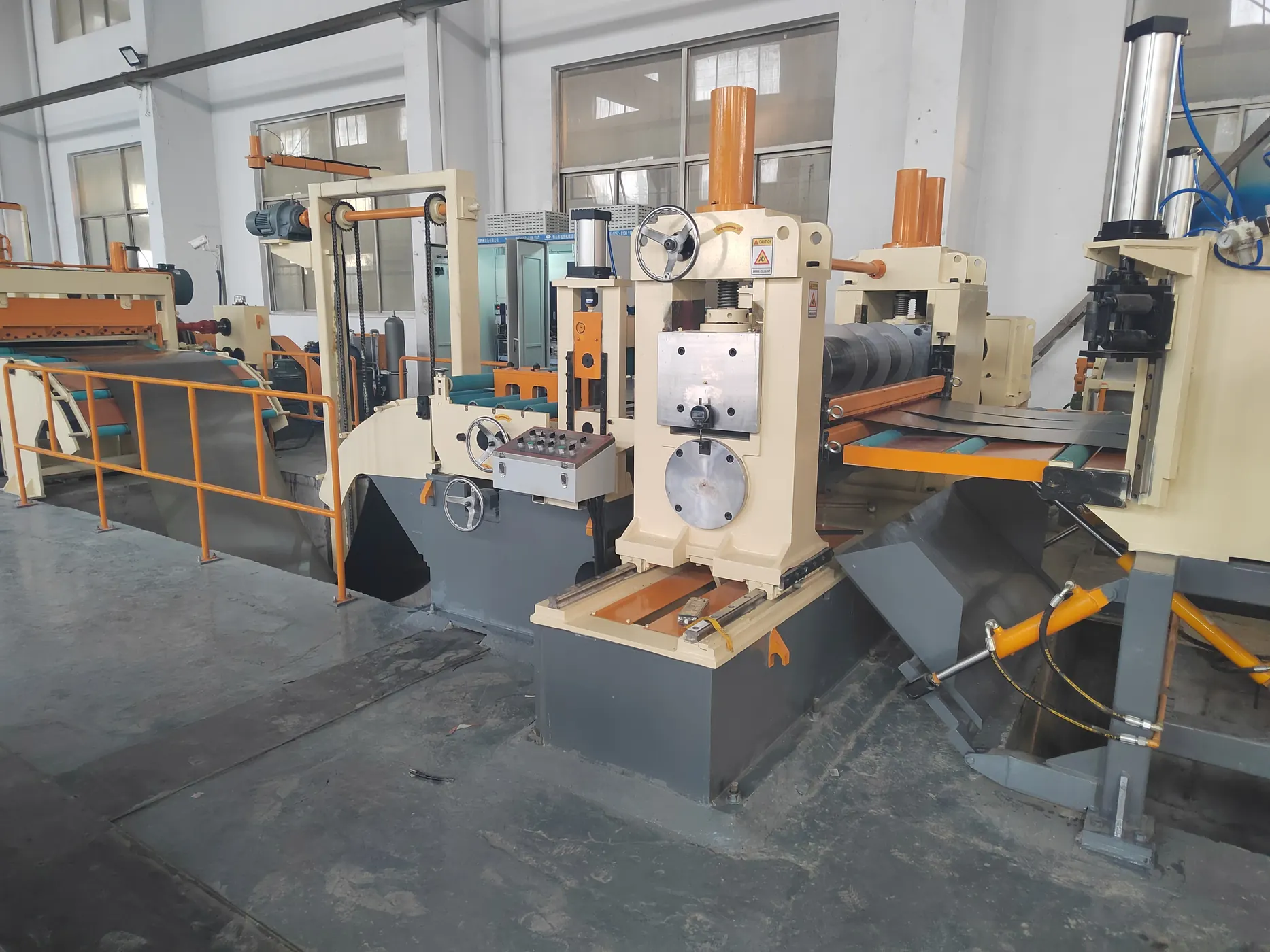
Slitting divides metal coil lengthwise into narrower strips. Blanking produces separate pieces, but the word has more than one meaning. In coil-processing discussions it can refer to rectangular blanks made by cross-cutting, sometimes after slitting. In presswork it can refer to cutting a defined shape with a die.
Before comparing equipment, name the finished product: narrow strip coil, rectangular sheet, multiple rectangular blanks, or a shaped blank. That description is more useful than asking for a “blanking machine” without a drawing.
Narrow strip coils from slitting
Choose a slitting process when the output remains continuous strip. Specify the slit widths and quantities, incoming coil material and dimensions, edge requirements and finished-coil handling. The strip can then feed later forming or other operations.
Cutting across the material is a different operation. A slitter’s ability to make narrow strips does not establish that it can produce separate sheets or shaped parts.
Rectangular sheets from cut-to-length
A cut-to-length line feeds and cross-cuts coil into separate sheets. Leveling and output handling are evaluated with sheet length, width, flatness and squareness requirements.
If an order needs several widths of rectangular blanks, explain both the width division and cross-cutting requirement. A multi-blanking configuration may combine those operations. Its line layout and equipment scope need specific confirmation rather than an assumption that every CTL line includes a slitter.
Shaped blanks from a press and die
A shaped blank introduces contour, tooling and press requirements that are not defined by a conventional slitting or CTL specification. Supply a part drawing and explain the intended process. Do not treat a coil-processing photograph as evidence of shaped-blank production capability.
| Required output | Process to discuss | Main dimensions to define |
|---|---|---|
| Narrow strip coils | Slitting and recoiling | Strip width and finished coil size |
| Rectangular sheets | Cut-to-length | Sheet width, length and geometry |
| Multiple rectangular blanks | Combined width division and cross-cutting | Width pattern, lengths and stacking |
| Shaped pieces | Press blanking or another contour-cutting process | Part drawing, material and tooling |
Avoiding an incomplete quotation request
Describe what enters the line, what leaves it and what happens next. Include material grade, thickness, coil dimensions, batch sizes and acceptance criteria. For rectangular products, specify whether the incoming width is retained or trimming is required.
If both strip coils and sheets are needed, request confirmation of whether separate lines, separate operating modes or a combined arrangement is appropriate. A shared input material does not establish a shared machine configuration.
MAXDO’s published process pages cover coil slitting and cut-to-length. The shaped-blank distinction here explains terminology; it is not a claim that MAXDO supplies a press-blanking system. For a direct strip-versus-sheet comparison, see slitting or cut-to-length selection.
Technical reference
Butech Bliss: Multi-Blanking Lines illustrates a manufacturer-specific combination of slitting and cross-cutting. That example supports the terminology distinction, not a MAXDO configuration or performance commitment.