


Metal Processing Glossary Routing Hub
A narrow metal processing glossary routing hub for defining slitting, CTL, gauge, tolerance, burr, flatness, FAT/SAT, and routing terms to deeper MaxDo support or product pages.
This page is a narrow vocabulary routing hub in the MaxDo topic network. It owns only the glossary function: define common slitting, CTL, gauge, tolerance, burr, flatness, FAT/SAT, and product-routing terms, then send the buyer to the deeper support page or product path. It is not a process core page, not a product page, and not an acceptance checklist.
For the slitting process trunk, use the metal slitting line core page. For CTL station sequence, use the cut-to-length process main page. For output-format routing, use the slitting vs blanking decision map. For equipment-family routing, use the metal slitting machine category or the metal cut-to-length line category.
Use this page when a term is unclear, then move to the deeper acceptance guide or product path. For a full slitting architecture, use the metal slitting line guide. For sheet output, use the cut-to-length process map. For output-format decisions, use the slitting vs blanking decision map and the slitting vs CTL ROI decision record.
How to Use This Glossary as a Buying Map
Do not treat glossary terms as isolated definitions. In coil processing projects, every term points to a decision: what material enters the line, what output is accepted, what tolerance is measured, what machine class fits, and what evidence closes FAT and SAT.
| Term family | Use it to decide | Next MaxDo path |
|---|---|---|
| Slitting terms | Strip width, knife setup, burr, camber, recoiling, scrap | Metal slitting machine category |
| CTL terms | Sheet length, flatness, leveler, shear, stacking | Metal cut-to-length line category |
| Quality terms | Gauge, tolerance, burr, camber, flatness, inspection records | Width tolerance protocol |
| Acceptance terms | FAT, SAT, sign-off, deviation owner, test material, sample count | Engineering handoff checklist |
Core Coil Processing Terms
Coil
A coil is flat-rolled metal wound around a central core or mandrel. A specification should record coil width, coil weight, inner diameter, outer diameter, grade, thickness, surface condition, and edge condition before any equipment decision is made.
Master Coil
A master coil is the incoming full-width coil from the mill or service center. It may be slit into narrow strips, cut into sheets, or processed through both paths depending on the downstream product.
Coil ID and Coil OD
Coil ID is the inside diameter of the wound coil. Coil OD is the outside diameter. These values decide uncoiler mandrel fit, coil car height, decoiler capacity, and handling safety.
Gauge
Gauge is a traditional sheet thickness label. Because gauge numbers vary by material family, RFQs should convert gauge into millimeters or inches. Use the gauge thickness chart before specifying a slitting or CTL line.
Yield Strength and Tensile Strength
Yield strength describes when material begins permanent deformation. Tensile strength describes the maximum stress before fracture. These values affect blade load, shear force, leveler penetration, drive torque, and model selection.
Slitting Line Terms
Corte
Slitting cuts a master coil lengthwise into narrower coils or strips. It is the right output path when the downstream process needs narrow coil stock for roll forming, tube making, stamping, appliance panels, HVAC parts, or service-center strip supply.
Arbor
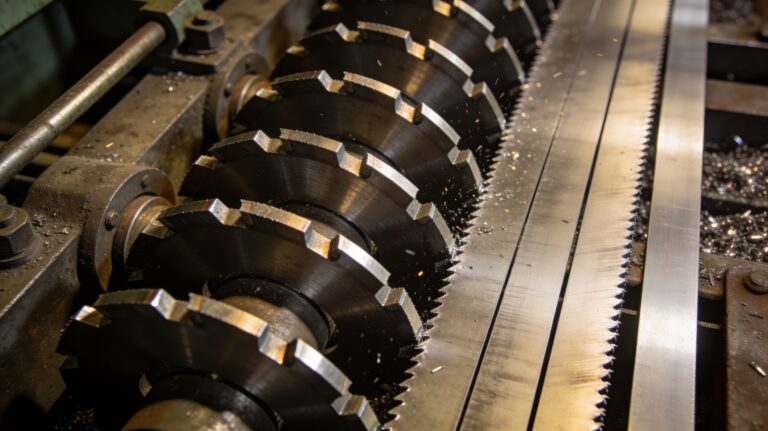
The arbor is the shaft that carries slitting knives and spacers. Arbor rigidity affects width consistency, knife runout, burr, camber, and repeatability. Larger or stronger arbors are needed as coil width, thickness, and strength increase.
Slitting Blade or Knife
A slitting blade is the circular knife that shears the strip edge. Blade material, sharpness, clearance, overlap, and spacer accuracy decide edge condition. For setup details, use the slitting line blade setup guide.
Blade Clearance
Blade clearance is the horizontal gap between the upper and lower knives, usually expressed as a percentage of material thickness. Too little clearance raises cutting force and blade wear. Too much clearance raises burr and rollover.
Burr
Burr is the raised edge left after cutting. In slitting acceptance, burr should be measured with width tolerance, camber, edge condition, and blade condition. Burr limits should be tied to the real material grade and thickness, not only to a generic machine claim.
Camber
Camber is side-to-side curvature of a slit strip. It can come from arbor alignment, blade clearance imbalance, strip tension, or material stress. If camber or shape defects are the main issue, use the slitting deformation control checklist.
Recoiler
The recoiler rewinds finished slit strips into coils. Recoiling quality depends on strip tension, separator setup, mandrel fit, coil build, surface protection, and unloading method.
Scrap Winder and Edge Trim
Edge trim is the narrow material removed from coil edges during slitting. The scrap winder collects that trim. To connect trim width, kerf, and process loss to payback, use the slitting scrap reduction map.
Cut-to-Length and Blanking Terms
CTL or Cut-to-Length
CTL converts coil into flat sheets with defined length, flatness, squareness, and stack quality. The key acceptance terms are leveler, feed length, shear, flatness, surface handling, and stacking.
Leveler
A leveler uses multiple rolls to remove coil set, crossbow, edge wave, and other shape defects. Leveler acceptance should be tied to material strength, thickness, incoming coil condition, target flatness, and test speed.
Servo Feed
A servo feed controls strip movement and length positioning. It appears in CTL lines, press feeds, and automated coil processing cells. For controller evidence, use the servo roll feed controller acceptance checklist.
Flying Shear and Guillotine Shear
A flying shear cuts while strip is moving and is used for faster light-gauge output. A guillotine shear cuts across the full width, usually after feed-stop positioning, and is common in medium or heavier CTL projects.
Stacker
The stacker collects finished sheets. Stack height, alignment, surface protection, pallet format, release method, and handling path should be part of CTL acceptance, especially for medium-gauge sheets.
Blanking
Blanking produces flat pieces or blanks from strip or sheet. Unlike slitting, it does not create narrow coils. Unlike standard CTL, it often targets a downstream part shape, die process, or formed component workflow.
Quality and Acceptance Terms
Tolerancia de anchura
Width tolerance is the allowed deviation between target strip width and measured strip width. It should state the measuring tool, sample count, sample location, material, speed, and action rule when drift appears.
Flatness
Flatness describes how closely a sheet or strip matches a flat plane. It may be measured in mm/m, I-units, or a buyer-defined inspection method. Flatness must be accepted under the actual material and speed conditions.
FAT and SAT
FAT is factory acceptance testing before shipment. SAT is site acceptance testing after installation. Each should include material, thickness, speed, tolerance, sample count, deviation owner, retest method, training, and final sign-off.
Tiempo de preparación
Setup time is the time needed to change from one job to another. It includes knife setup, spacer stack, threading, recipe loading, trial strip, correction loops, and first-good-output approval. For frequent job changes, use the slitting line setup time reduction checklist.
Route Terms to MaxDo Product Paths
When the key terms point toward narrow slit coils, start with the MA-850 compact slitting machine, MA-1350, MD-1650, and MD-2200. When the key terms point toward flat sheets, compare CT-850, CT-1350, and CT-1650.
To request a specification review, send MaxDo the glossary terms that are driving the decision: material grade, gauge or thickness, coil width, output format, tolerance, burr or flatness requirement, setup frequency, FAT/SAT evidence, and expected product route through the contact form.