
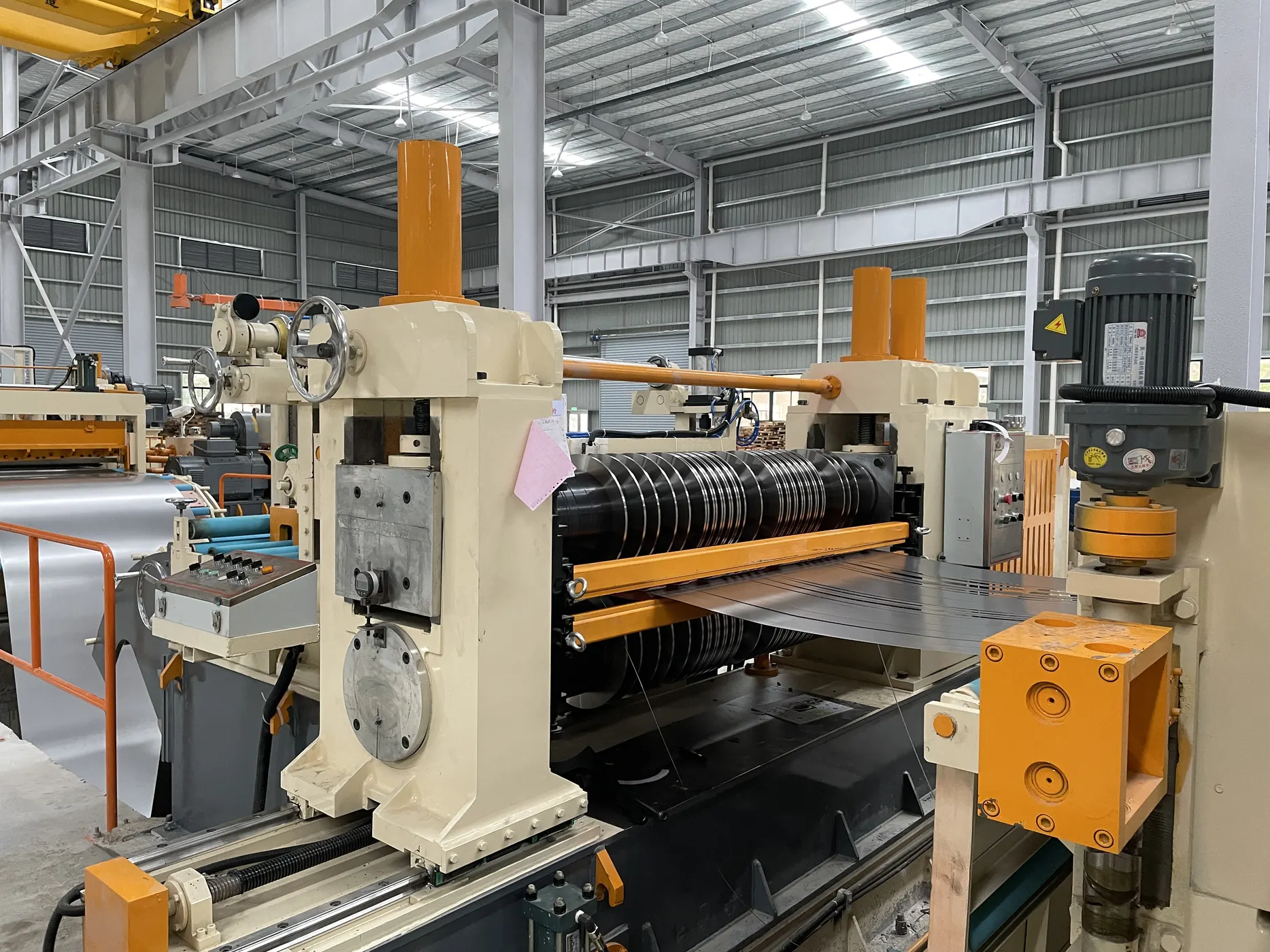
A coil slitting line cuts a wide metal strip lengthwise into several narrower strips. The finished strips are commonly rewound into coils for later forming, stamping or fabrication. Selecting the line requires both the incoming coil specification and the finished strip specification; maximum coil width alone is insufficient.
Entry coil and strip guidance
Start with material grade, thickness range, coil width, weight and inside and outside diameters. State whether the material is coated, filmed or sensitive to surface marks. The entry arrangement must handle that coil and guide its path through the cutting section.
List the regular production mix as well as the extremes. A line sized around one maximum-width job still needs an assessment for frequent narrow-strip or thin-material orders. Do not assume that a single maximum capacity applies to every grade and thickness combination.
Slitter head and cutting tools
Circular knives arranged on the slitter cut the strip into the requested widths. Tooling and setup must be reviewed against the material, edge requirements and strip pattern. A machine’s outside dimensions do not establish its finished-width tolerance.
Record the number of strips, their individual widths and the required edge condition. Identify strips that will enter a sensitive downstream process. Width tolerance and edge quality should be agreed as separate inspection requirements.
If an order gives thickness as a gauge number, check the material and named reference before using the sheet gauge chart. State the decimal thickness and permitted incoming range in the equipment request.
Strip separation, tension and recoiling
After cutting, the individual strips need a controlled path to the recoiler. Separation and tension arrangements are part of the line assessment. A request for “ten strips” should also identify the width pattern, thickness, finished coil size and handling requirements.
Ask how the finished coils will be removed, supported and transferred. A workable equipment layout includes entry loading, the processing path and finished-coil removal. It also allows access for tooling changes and approved maintenance.
Comparing equipment proposals
| Requirement | Information to supply | Confirmation to request |
|---|---|---|
| Input coil | Grade, thickness, width, weight and diameters | Permitted material and coil envelope |
| Slit pattern | Widths, strip counts and order mix | Tooling and line suitability |
| Product quality | Width, burr, shape and surface limits | Inspection and acceptance method |
| Finished coils | Required weight, diameters and handling | Recoiling and removal arrangement |
| Production | Batch sizes and changes per shift | Output for representative jobs |
Do not compare running speed as if it were accepted output. Coil loading, setup, threading, inspection and unloading also occupy production time. Record them separately when evaluating an existing line or planning a new one.
Relating slitting to later processing
If the required output is sheets, review cut-to-length processing instead. A combined slitting and cross-cutting arrangement is a distinct configuration and must be confirmed explicitly; it is not implied by a standard slitting inquiry.
For MAXDO coil slitting equipment, submit the input and output requirements together. Photos here illustrate equipment in the supplied collection; they do not establish a particular model’s numerical capacity.
Technical reference
Braner USA: Slitting Lines identifies tooling, tension, handling and configuration considerations. This article uses those process distinctions, not Braner’s performance claims or proprietary features.