

MaxDo Precision Stainless Steel Slitting Line Delivered to India: Coil Processing Service Center Case Study
The Pune/Chakan industrial corridor is one of India's densest manufacturing zones — home to a large cluster of automotive component manufacturers, tube mills, and roll forming operations that collectively represent one of the highest concentrations of stainless steel coil processing demand in South Asia.
| Detail | Information |
|---|---|
| Client Location | Pune, Maharashtra, India (Chakan MIDC Industrial Area) |
| Business Type | Independent stainless steel coil processing service center |
| Markets Served | Tube mills, roll forming manufacturers, stamping operations, and general fabricators in Maharashtra, Gujarat, and Karnataka |
| Products Processed | SS 304, SS 316L, SS 201 cold-rolled coil — slit to customer-specified strip widths |
| Coil Width Input | 600–1,250 mm master coil |
| Thickness Range | 0.4–3.0 mm |
| Equipment Supplied | MaxDo Precision Stainless Slitting Line (Servo Tension Control) |
| Minimum Slit Width | 12 mm |
| Maximum Cuts | 18 simultaneous |
| Slit Width Tolerance Required | ±0.10 mm on SS 304 |
| Daily Output Target | 12–18 tons/shift |
| Investment Driver | Replace aging manual-tension slitting line; achieve tube mill skelp tolerance of ±0.10 mm; expand customer base to precision roll forming and stamping OEMs |
India’s Stainless Steel Processing Market: Context
India has emerged as one of the world’s fastest-growing stainless steel markets, driven by strong demand from the automotive, kitchenware, construction, pharmaceutical, and food processing sectors. The country’s stainless steel service center sector has developed significantly — major players include Jindal Stainless Steelway (with service centers in Gurgaon, Mumbai, Chennai, and Vadodara) and dozens of independent processors serving regional fabricator clusters.
The Pune/Chakan industrial corridor is one of India’s densest manufacturing zones — home to a large cluster of automotive component manufacturers, tube mills, and roll forming operations that collectively represent one of the highest concentrations of stainless steel coil processing demand in South Asia. The Pune client identified that the corridor’s independent service center sector was underserved for precision slitting (±0.10 mm tolerance) — most existing service centers were operating first-generation slitting lines capable of ±0.20–0.30 mm at best.
The investment thesis: a precision slitting line capable of ±0.10 mm would allow the client to capture supply of tube mill skelp (previously a segment they could not serve due to tolerance limitations) and precision roll forming strip for the automotive stamping operations in Chakan — both higher-margin segments than the general fabrication strip they were currently producing.
Why MaxDo Was Selected
The Pune client’s evaluation process considered three suppliers: a domestic Indian machinery manufacturer, a Taiwanese slitting machine company, and MaxDo.
Indian domestic option: The lowest price; no CE certification; slit width tolerance specification of ±0.20 mm — inadequate for the ±0.10 mm requirement. The domestic supplier proposed ±0.15 mm as a “special configuration” upgrade but could not provide documented FAT data from an existing installation at this tolerance. Eliminated on technical grounds.
Taiwanese option: Capable specification with documented ±0.12 mm tolerance data. Price approximately 1.5× MaxDo’s quotation. The Taiwanese proposal specified a hydraulic tension control system (adequate for 0.8–3.0 mm material) but did not include closed-loop servo tension control for the 0.4–0.8 mm thin-gauge stainless that represented 30% of the client’s anticipated order book. The Taiwanese supplier offered servo tension as a further upgrade option at additional cost — increasing the price gap further.
MaxDo: Documented ±0.08–0.10 mm tolerance data from existing Indian-market customer reference (a tube mill in Gujarat); closed-loop servo tension control standard (not an upgrade); SKD11 blades standard; price producing a 2.6-year payback at the client’s projected throughput. Selected.
Reference visit: Before finalizing, the client visited the Gujarat tube mill reference — a MaxDo slitting line customer who had been operating for 14 months. The Gujarat customer’s production manager confirmed: strip width average deviation of 0.07–0.09 mm on SS 304, 0.8 mm material; coil telescoping zero incidents in 14 months; thin-gauge (0.5 mm) tension stability “noticeably better than our previous machine.” This reference visit was the final decision factor.
Equipment Configuration
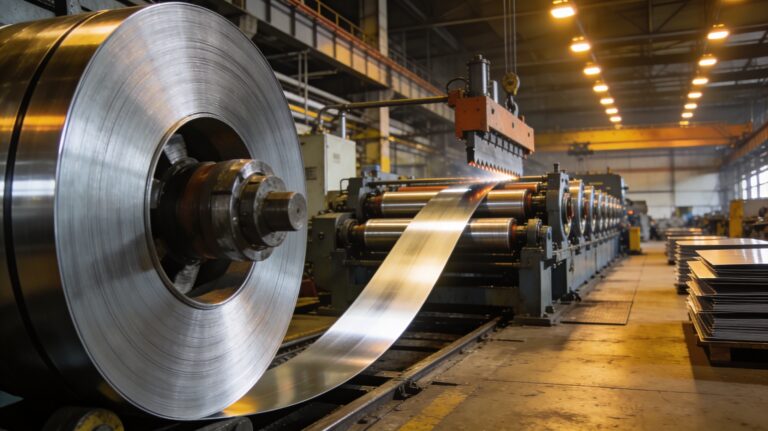
MaxDo Precision Stainless Slitting Line — Pune Configuration
Decoiler:
- Capacity: 8 tons; hydraulic expanding mandrel (508–610 mm ID coil)
- Powered uncoiler with brake-controlled tension at uncoiler
- Coil car: motorized; auto-centering to line centerline
Pre-straightener:
- 5-roll straightener; removes gross coil curvature before slitting head
- Roll diameter: 80 mm; adjustable gap
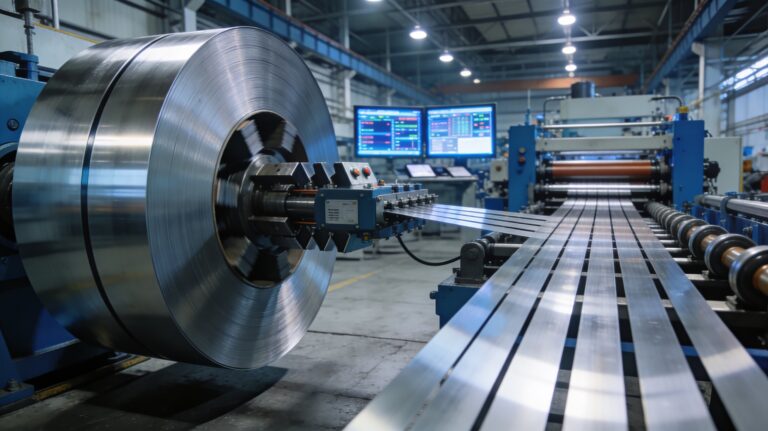
Slitting head:
- Arbor: 42CrMo heat-treated alloy steel, Ø100 mm; deflection at rated load: < 0.05 mm (certified at FAT)
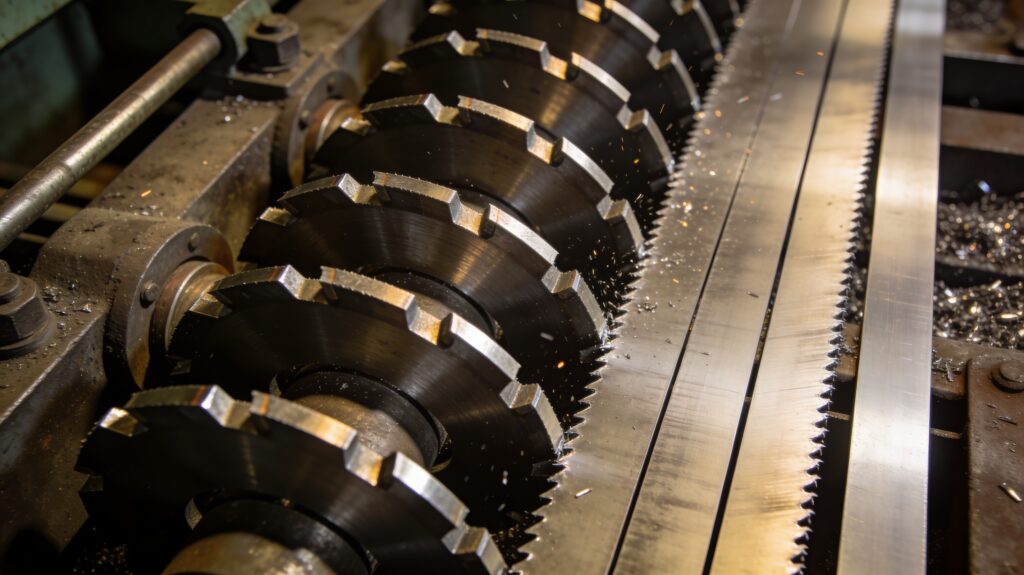
- Blades: SKD11, Ø180 mm; clearance micrometer-adjustable ±0.004 mm per spacer
- Maximum simultaneous cuts: 18
- Spacer set configuration: 12 pre-calculated spacer sets included (covering the client’s 12 most common slit widths: 12 mm to 610 mm)
Tension system:
- Closed-loop servo tension control with load cell on each recoiler arbor
- Thin-gauge mode (< 0.8 mm): reduced tension setpoint + tighter servo bandwidth for SS 304
- Normal mode (0.8–3.0 mm): standard tension curve
Recoiler:
- Dual-station; hydraulic expanding mandrel; independent speed servo per station
- Rubber-coated separation discs: Shore A 65 (softer than standard for SS 304 surface protection)
- Anti-telescoping laser sensor: optical sensor detects lateral strip migration > 3 mm, triggers tension correction
Control system:
- Siemens S7-1200; HMI in English (client preference — customer-facing interface for order entry)
- Recipe storage: 100 slit width programs
- Production counter: meters and kilograms per reel, per shift, per day
- Remote diagnostics: enabled via MaxDo’s cloud monitoring system
Installation and Commissioning in India
India-specific logistics notes:
- Sea freight: Foshan → Nhava Sheva (JNPT), Mumbai — 14 days transit
- India import: machinery HS 8462/8463; basic customs duty 7.5% (standard machinery category); GST 18% (recoverable ITC for registered manufacturers)
- Inland transport: Nhava Sheva to Pune Chakan MIDC: approximately 160 km; standard flatbed truck transport
- Total port-to-factory time: approximately 5 days (customs + inland)
Timeline:
| Phase | Duration |
|---|---|
| Engineering and manufacturing | 60 days |
| FAT at MaxDo (client’s technical manager attended) | 2 days |
| Sea freight to JNPT, Mumbai | 14 days |
| India customs clearance + inland to Pune | 6 days |
| Installation and commissioning | 7 days |
| Operator training (2 operators) | 2 days |
| Total: order to commercial production | ~91 days |
Commissioning highlights: Two items required attention during commissioning:
- Thin-gauge test (0.5 mm SS 304, 18 simultaneous cuts): initial run produced excessive inter-strip contact at the recoiler. MaxDo’s engineer adjusted the servo tension curve for thin-gauge mode (reduced ramp rate during acceleration). Second run: clean separation, no contact marking. Width measurement: ±0.09 mm across all 18 strips.
- Local power quality: the Pune industrial estate had measurable voltage variation (±8% vs the ±5% MaxDo specification). A power conditioner was added at the client’s electrical panel — resolved before production startup.
Production Results After 10 Months
Throughput: 14–17 tons/shift — within the 12–18 ton target. SS 304 at standard thickness (1.0–2.0 mm) achieves the upper range; thin-gauge (0.4–0.6 mm) at lower speed for tension stability achieves the lower range.
Slit width tolerance: Monthly QC sampling across production runs: average deviation 0.08 mm on SS 304, 1.0 mm material; 0.09 mm on SS 201, 0.8 mm. Both consistently within ±0.10 mm specification.
Tube mill skelp supply: The client has secured supply contracts with two Pune-area tube mills for SS 304 skelp at ±0.10 mm tolerance — a customer segment they could not serve before MaxDo installation. These two contracts represent approximately 35% of current slitting revenue.
Precision roll forming supply: A Chakan-based automotive stamping OEM qualified the client as an approved strip supplier for a seat bracket component requiring ±0.10 mm slit width tolerance. This OEM order has been running for 6 months with zero width-related rejections.
Investment payback tracking: At 10 months, the client’s management team estimates payback at approximately 28–30 months — slightly slower than the 2.6-year projection due to a 3-month ramp-up period while tube mill skelp contracts were being finalized. Current trajectory: on track for payback by month 32.
India Market Context for Slitting Line Investors
India’s stainless steel consumption has grown at approximately 8–10% annually over the past decade, driven by the infrastructure, automotive, consumer goods, and pharmaceutical sectors. The government’s “Make in India” manufacturing initiative and the PLI (Production Linked Incentive) scheme for specialty steel processing have added structural demand incentives for domestic stainless steel processing investment.
The gap between large integrated service centers (Jindal Stainless Steelway with 220,000+ MT/year slitting capacity in Gurgaon alone) and the fragmented small service center sector (200–2,000 MT/year capacity) creates a commercially attractive position for mid-size precision slitting operations: too large for small fabricators to economically operate in-house, yet smaller than the minimum order volumes of the large service centers for specialty slit widths.
Precision stainless slitting capability (±0.10 mm or better) remains genuinely differentiated in the Indian market — the majority of independent service centers operate general-purpose lines at ±0.20–0.30 mm tolerance, creating a captive premium market for operators who have invested in precision equipment.
Frequently Asked Questions from Indian Buyers
What import duty applies to MaxDo slitting lines in India?
Under India’s import tariff schedule (2025), coil slitting machinery classified under HS 8462.2100 or 8462.2900 attracts: Basic Customs Duty (BCD) 7.5%; Social Welfare Surcharge 10% of BCD (0.75%); IGST 18%. Total effective duty: approximately 27–28%. For manufacturers registered under MSME or holding IGST credit recovery ability, the IGST is fully recoverable as ITC against output GST.
Is MaxDo equipment eligible for PLI scheme benefits?
MaxDo equipment can be cited as capital investment under the PLI Scheme for Specialty Steel (Ministry of Steel) applications. MaxDo provides detailed technical specification documents and capital cost certification required for PLI applications. Eligibility determination is the applicant manufacturer’s responsibility in consultation with their PLI scheme advisor.
Does MaxDo have a local service presence in India?
MaxDo’s primary service delivery is remote (video call diagnostics via the remote access module) and periodic engineer visits (MaxDo engineers travel to India for major service; 1–3 business days notice for scheduling). MaxDo is developing an authorized service partner network in India — buyers can request the current status of local service availability in their region.
→ Contact MaxDo for a precision slitting line configuration for India market operations