

MaxDo Stainless Steel Tube Making Machine Delivered to India: Handrail Tube Factory Case Study
The Gujarat-based manufacturer had been purchasing finished stainless tubes from a trading house for resale to local fabricators and railing contractors.
| Detail | Information |
|---|---|
| Client Location | Gujarat, India |
| Factory Type | Stainless steel decorative tube manufacturer |
| Primary Products | Round tube for staircase handrail, balustrade, and window grille |
| Tube OD Range | 19 mm – 63.5 mm |
| Wall Thickness | 0.8 mm – 1.5 mm |
| Material Grade | SS 304, SS 201 |
| Equipment Supplied | TIG Stainless Steel Tube Mill + 4-Head Automatic Polishing Line |
| Surface Finish Required | No.4 and Mirror (BA) |
| Daily Output Target | 1,200 meters per day (single shift) |
The Client’s Challenge
The Gujarat-based manufacturer had been purchasing finished stainless tubes from a trading house for resale to local fabricators and railing contractors. As order volumes grew — driven by India’s expanding construction and real estate sector — the dependency on external tube suppliers was creating two compounding problems.
Supply inconsistency. Tube deliveries from the trading house were subject to lead times of 3–6 weeks, and surface finish quality varied between batches. For a customer base that specified No.4 brushed finish for indoor handrail, inconsistent scratch direction and grit depth was generating return claims.
Margin compression. With raw material (SS coil) prices rising and finished tube being purchased at a markup, the factory’s profitability on fabricated railing was under pressure. The decision to bring tube production in-house was driven primarily by a cost-per-meter calculation that showed an in-house tube mill would recover its investment within 18–24 months based on current volumes.
The factory owner’s core requirement: a compact, reliable tube mill and polishing system that could be operated by 3–4 workers with no prior tube manufacturing experience, producing consistent No.4 and mirror finish output from day one.
Why MaxDo Was Selected
The factory evaluated three machine suppliers: one from Foshan (MaxDo), one from Zhejiang, and one local Indian machine fabricator.
The MaxDo selection was driven by three factors:
1. Integrated supply. MaxDo offered both the tube mill and the downstream polishing line from a single source, with pre-matched infeed speeds between the two machines. The Zhejiang supplier offered only the tube mill and recommended sourcing a polishing machine separately — a coordination risk the factory wanted to avoid.
2. Factory visit reference. MaxDo arranged a video call visit to an operating customer line in Vietnam producing similar OD range and surface finish. Seeing actual production output — including mirror finish tube samples — on the same machine model removed uncertainty about whether the specified finish was achievable.
3. On-site commissioning included. The contract included MaxDo engineer on-site commissioning at the Gujarat factory, with the engineer remaining until the first production batch met the surface finish specification. The Indian fabricator’s quote did not include on-site commissioning support.
Equipment Configuration
Tube Mill (TIG Welding)
- OD range: 19–76 mm (current production: 19–63.5 mm)
- Wall thickness: 0.5–2.0 mm
- Production speed: 8–22 m/min (TIG welding mode)
- Forming passes: 14
- Sizing passes: 6
- Welding: Single-torch TIG with argon back-purge (for SS 304 weld zone integrity)
- Cut-off: Flying saw, automatic length setting
- OD tolerance achieved: ±0.15 mm after sizing
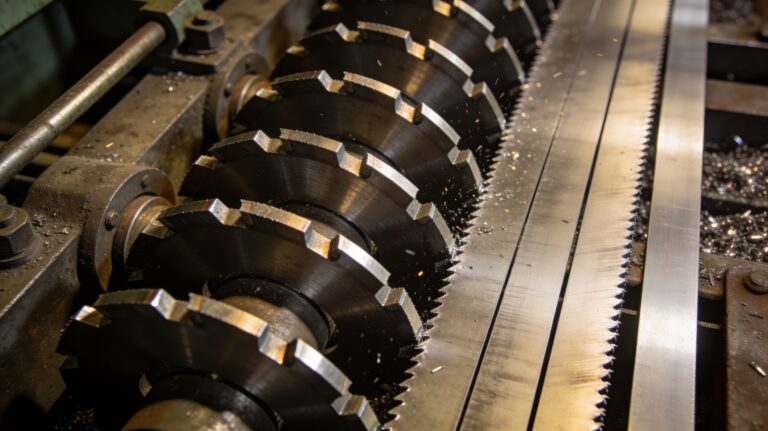
4-Head Automatic Polishing Machine
- Tube OD range: 19–76 mm
- Belt grit sequence: 120 → 180 → 240 → 320 (No.4 production); additional buffing compound head for mirror finish
- Infeed speed: 3–6 m/min
- Tube rotation: Motorized rotation rollers, auto-adjusting contact pressure
- In-feed/out-feed: Motorized roller conveyors (semi-automatic loading)
- Belt type: Zirconia alumina (120–240 grit stages), aluminum oxide (320 grit finish stage)
Installation and Commissioning
Civil works preparation (before machine arrival):
- Concrete floor foundation with machine anchor points (drawing provided by MaxDo 4 weeks before delivery)
- 3-phase 380V power supply, 120 kVA total load for mill + polishing line
- 3-ton overhead crane installed (for coil loading and roll changes)
- Argon gas supply lines run to tube mill welding station
Timeline:
| Phase | Duration |
|---|---|
| Manufacturing at MaxDo (Foshan) | 55 days |
| Factory Acceptance Test (FAT) at MaxDo | 3 days |
| Sea freight (Foshan → Mundra Port) | 22 days |
| Customs clearance and inland transport | 6 days |
| Machine installation and alignment | 6 days |
| Trial production and commissioning | 4 days |
| Total: order to first production batch | ~96 days |
The commissioning engineer resolved two issues during trial production: slight oval deformation on 19 mm OD thin-wall tube (corrected by adjusting the final sizing pass gap) and inconsistent polish depth on one abrasive head (corrected by belt tension calibration). Both were resolved within the 4-day commissioning window.
Production Results After 3 Months of Operation
The factory reported the following outcomes after 90 days of production:
Output achieved: 1,350–1,500 m/day average (exceeding the 1,200 m/day target) on standard No.4 finish production runs. Mirror finish runs achieve approximately 900–1,000 m/day due to the additional buffing stage.
Surface finish consistency: No customer returns for surface finish quality in the first 3 months of production. The factory’s key customer — a railing fabricator supplying residential apartment projects — confirmed that the in-house tube was passing their incoming inspection on OD tolerance and surface finish grade without exception.
Coil-to-tube cost per meter: The factory reported a coil-to-finished-tube cost reduction of approximately 28–32% versus purchasing finished tube from the trading house at equivalent surface finish grade. Exact figures depend on prevailing SS coil prices.
Staffing: The line is operated by 3 workers per shift — 1 on coil loading and tube mill monitoring, 2 on the polishing line (one loading, one unloading and bundling). No specialized tube manufacturing experience was required; MaxDo’s commissioning engineer provided on-site training covering standard operating procedures, belt change protocol, and basic roll alignment checks.
The India Market Context
India’s stainless steel market was valued at approximately USD 5.8 billion in 2025, with the pipes and tubes segment growing on the back of construction, infrastructure, and hospitality sector demand. The India stainless steel pipes and tubes market is projected to expand significantly through 2032, driven by increasing adoption of SS tube in architectural railings, interior design, and sanitary applications across residential and commercial construction.
For mid-size fabricators and tube traders in India looking to bring production in-house, the economics of a compact TIG tube mill + polishing line — at current SS coil prices and finished tube market rates — typically yield a payback period of 18–30 months depending on production volume and product mix.
Frequently Asked Questions from Indian Buyers
Is 3-phase 380V available in most Indian industrial estates?
Most industrial zones in Gujarat, Maharashtra, Tamil Nadu, and other manufacturing states supply 415V (which is within equipment operating range). MaxDo provides electrical panel configuration for Indian power supply standards on request.
What is the import duty on tube mill equipment into India?
Most capital goods machinery for manufacturing attract 0–5% Basic Customs Duty under India’s capital goods import scheme. Buyers are advised to verify current HS code classification with their customs broker, as duty rates can change. MaxDo provides HS code documentation for all equipment.
Can MaxDo supply spare forming rolls for Indian-sourced strip widths?
Yes. Forming roll sets are manufactured in-house at MaxDo’s Foshan facility. Non-standard OD or custom roll geometry for Indian strip widths can be machined within standard lead time.
Does MaxDo have experience shipping to other Indian ports?
MaxDo has shipped to Mundra, Nhava Sheva (JNPT), Chennai, and Kolkata. The logistics team coordinates with freight forwarders experienced in Indian port clearance procedures.
Next Steps
Factories in India evaluating stainless steel tube making equipment can request:
- A line configuration proposal based on their target OD range, wall thickness, daily output, and surface finish requirement
- Reference contacts at operating MaxDo line installations in South and Southeast Asia
- Cost-per-meter analysis template comparing in-house tube production versus purchased finished tube
→ Contact MaxDo for an India-specific configuration and pricing proposal