

MaxDo Stainless Steel Slitting Machine to Saudi Arabia: Coil Processing Factory Setup Case Study
The Dammam-based service center had been importing pre-slit stainless steel skelp from suppliers in the UAE and directly from Chinese mills to supply local tube manufacturers.
| Detail | Information |
|---|---|
| Client Location | Dammam, Saudi Arabia (1st Industrial City) |
| Business Type | Steel coil service center supplying tube mills and metal fabricators |
| Primary Products | Slit stainless and carbon steel coil strips (skelp) for downstream tube making and stamping |
| Materials Processed | SS 304, SS 201, carbon steel HR coil, galvanized coil |
| Coil Thickness Range | 0.5 mm – 4.0 mm |
| Coil Width Range | 800 mm – 1,500 mm |
| Equipment Supplied | Heavy-Duty Stainless and Carbon Steel Slitting Line |
| Slit Width Range | 20 mm – 750 mm |
| Slit Width Tolerance | ±0.10 mm (for stainless tube mill skelp); ±0.20 mm (for general fabrication) |
| Daily Output Target | 25–30 tons per shift |
The Client’s Challenge
The Dammam-based service center had been importing pre-slit stainless steel skelp from suppliers in the UAE and directly from Chinese mills to supply local tube manufacturers. As Saudi Arabia’s Vision 2030 industrial development program accelerated domestic manufacturing activity, demand for locally processed stainless skelp grew — both in volume and in quality requirements — faster than import supply chains could reliably meet.
Three operational pressures drove the decision to invest in in-house slitting capability:
Import lead time exposure. Pre-slit skelp from offshore suppliers carried 4–8 week lead times. Saudi tube mills operating on just-in-time production schedules were experiencing line stoppages when import shipments were delayed by Red Sea logistics disruptions — a risk that had materialized twice in the 18 months preceding the investment decision.
Strip width precision for tube mill customers. The service center’s highest-value customers — two local stainless steel tube manufacturers supplying decorative pipe for the construction and fit-out market — required skelp slit to ±0.10 mm width tolerance. Imported skelp from general-purpose Chinese slitting operations was delivering ±0.25–0.35 mm tolerance, causing weld quality complaints at the tube mills and OD variation that was failing the downstream fabricators’ fitting assembly process.
Material flexibility and mixed-grade processing. The service center needed to process both stainless steel (SS 304, SS 201) and carbon steel coil on the same line — as demand for each fluctuated with construction project cycles — without investing in two separate slitting lines.
The investment criterion: a slitting line capable of ±0.10 mm tolerance on stainless tube skelp, handling both stainless and carbon steel on the same setup, with a throughput sufficient to replace the import supply chain entirely.
Why MaxDo Was Selected
The service center’s technical director evaluated five slitting line suppliers: two from China (MaxDo and a Shanghai-based machine builder), one from India, one from South Korea, and one local Saudi machinery agent representing a European brand.
The European brand through the local agent offered the highest specified performance but at a price that extended the payback period beyond the 3-year target. The Indian supplier’s proposal did not address the ±0.10 mm tolerance requirement for stainless with adequate technical justification.
MaxDo’s selection was based on three differentiators:
Demonstrated stainless slitting tolerance. MaxDo provided a slitting test report from an existing installation processing SS 304, 1.0 mm thickness, showing measured slit width deviation of ±0.07–0.09 mm across a full coil run — within the ±0.10 mm requirement. No other supplier provided measured data; two provided specifications without supporting test evidence.
Blade clearance system design. MaxDo’s proposal specified ground and matched spacer sets with individual spacer tolerance of ±0.004 mm — the precision level required for consistent stainless slitting at thin gauge. The Shanghai-based competitor proposed standard shim spacers (±0.015 mm tolerance) with a note that “fine tuning on-site is required” — an indicator of insufficient precision in the tooling design.
Mixed-material capability documentation. MaxDo confirmed in writing — and demonstrated at FAT — that the line could switch between stainless and carbon steel processing with blade clearance adjustment only (changing the clearance setting between C = 0.07×t for stainless and C = 0.09×t for carbon steel), without blade replacement or arbor disassembly.
Equipment Configuration
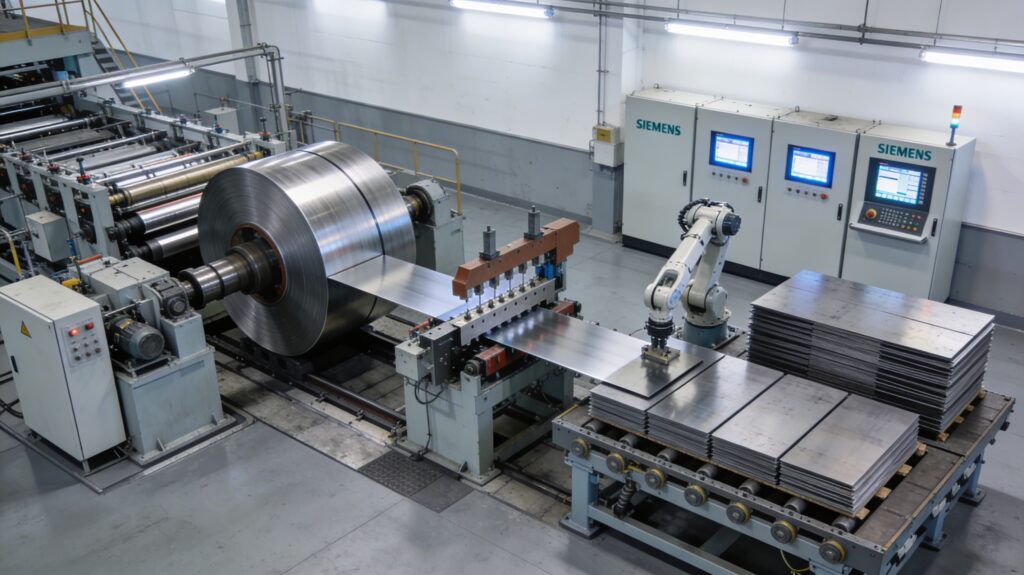
Heavy-Duty Combination Slitting Line (Stainless + Carbon Steel)
Uncoiling section:
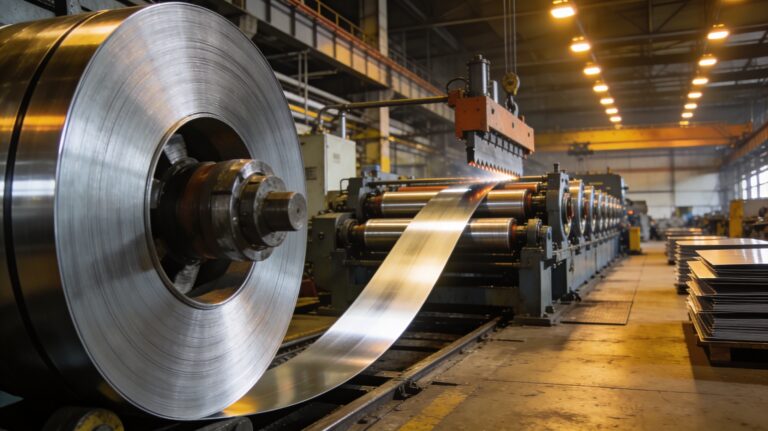
- Heavy-duty hydraulic uncoiler, 20-ton capacity
- Automatic peeler and strip guide system
- Edge position control (EPC) for strip centerline alignment
Straightening section:
- 7-roll straightener (pre-leveling before blade entry)
- Roll diameter: 100 mm (suitable for 0.5–4.0 mm material)
Slitting head:
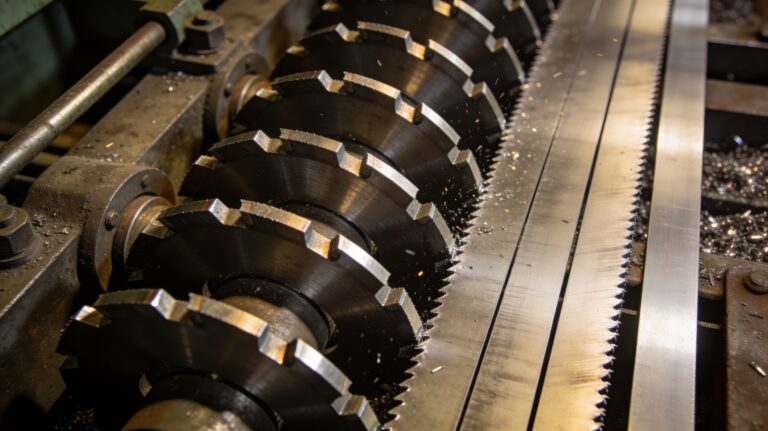
- Maximum 30 cuts (31 slit widths simultaneously)
- Blade material: SKD11, HRC 60–62
- Arbor diameter: 80 mm (heavy-duty specification for 4.0 mm carbon steel)
- Spacer system: Ground matched sets, individual spacer tolerance ±0.004 mm
- Blade clearance adjustment: Precision spacer exchange (two spacer sets supplied — one for stainless, one for carbon steel)
- Maximum slit strip count: 15 strips for stainless at full precision; up to 30 strips for carbon steel general-purpose slitting
Loop pit and tension section:
- 2.5 m deep loop pit between slitter head and recoiler
- Separator discs between slit strips to prevent lateral contact marking
Recoiling section:
- Double-head recoiler with individual tension arms per strip
- Hydraulic strip tension control (closed-loop, individual per strip group)
- Coil OD range: 400–1,600 mm
Control system:
- Siemens S7-1200 PLC
- HMI with Arabic-language interface (client requirement)
- Production logging: material grade, coil ID, slit widths, tonnage per shift
- Remote support module for MaxDo technical connection
Installation and Commissioning
Saudi Arabia logistics notes:
- Equipment shipped to Dammam Port (King Abdul Aziz Port) via sea freight
- Saudi Customs: CE documentation + commercial invoice + packing list sufficient for machinery clearance
- Installation site at Dammam 1st Industrial City had pre-installed 3-phase 380V supply and overhead crane (20-ton capacity) available
Timeline:
| Phase | Duration |
|---|---|
| Engineering and manufacturing | 58 days |
| Factory Acceptance Test at MaxDo | 3 days (client representative attended via video call; on-site FAT declined due to travel schedule) |
| Sea freight (Foshan → Dammam Port) | 24 days |
| Customs clearance and inland transport | 7 days |
| Installation and blade setup | 5 days |
| Trial production and commissioning | 4 days |
| Total: order to first production | ~101 days |
Commissioning outcomes: During the 4-day trial production, MaxDo’s commissioning engineer ran the following verification tests:
- SS 304, 1.0 mm, 8 slit widths (80 mm each) — measured width deviation: ±0.08 mm maximum across all strips, full coil length ✓
- SS 304, 0.5 mm, 5 slit widths (60 mm each) — measured: ±0.09 mm ✓
- Carbon steel HR, 3.0 mm, 15 slit widths (50 mm each) — measured: ±0.16 mm ✓
- Mixed run: SS 201, 1.2 mm, 10 slit widths — measured: ±0.08 mm ✓
Arabic-language HMI training was conducted over 2 days with the service center’s two designated operators, covering: coil loading, spacer changeover procedure, tension setting for different material grades, blade wear monitoring, and emergency stop protocol.
Production Results After 6 Months
Volume throughput: The service center is processing 28–32 tons per shift on standard carbon steel orders and 18–22 tons per shift on stainless precision skelp runs — within the 25–30 ton target for mixed operation.
Tube mill customer results: Both local tube manufacturers supplied by the service center reported elimination of OD variation complaints attributable to skelp width deviation. One customer — a 25.4 mm OD decorative tube manufacturer — reported that fitting assembly rejection rate dropped from approximately 8% (with imported skelp) to under 1% after switching to MaxDo-slit skelp from the Dammam service center.
Import substitution achieved: The service center has fully replaced imported pre-slit skelp for its two tube mill customers, eliminating the 4–8 week import lead time and the associated inventory holding cost. A third tube mill customer has been onboarded since the line started, representing new revenue that the service center’s management attributed directly to the reliability and precision of in-house slitting.
Blade life on stainless: SKD11 blades processing SS 304 at 0.5–1.5 mm are averaging 280–340 hours between resharpening — within the 200–400 hour range projected by MaxDo. Carbon steel at 2.0–4.0 mm is achieving 120–180 hours, also within projection. The service center has contracted with a local industrial tooling service in Dammam for blade resharpening, reducing downtime versus shipping blades to China for service.
The Saudi Arabia and Middle East Market Context
Saudi Arabia’s industrial manufacturing sector has expanded significantly under Vision 2030, with domestic steel consumption growing as construction and infrastructure investment accelerates. The Middle East steel service center market — encompassing Saudi Arabia, UAE, Kuwait, and Qatar — represents a growing base for coil processing equipment demand, driven by the need to reduce import dependency and improve supply chain resilience for the region’s expanding tube, sheet, and structural profile manufacturing sector.
For service centers and coil processors in the Gulf region, investment in in-house slitting capability — particularly for stainless steel precision skelp serving decorative tube mills — offers a clear commercial logic: domestic skelp supply at ±0.10 mm tolerance commands a premium over imported general-purpose slit coil, while eliminating the logistics risk that has made Red Sea-dependent supply chains increasingly expensive to rely on.
Frequently Asked Questions from Middle East Buyers
Does MaxDo provide Arabic-language HMI as standard?
Arabic-language HMI is available on request for all MaxDo slitting lines and CTL lines. It is not a standard default but is delivered at no additional cost when specified in the order.
What is the import duty on slitting lines in Saudi Arabia?
Most metalworking machinery imports into Saudi Arabia attract 5% customs duty under the GCC common external tariff. Buyers should verify current HS code classification with their Saudi customs broker. MaxDo provides a complete set of customs documentation (commercial invoice, packing list, CE Declaration, technical description) with every shipment.
Can MaxDo dispatch service engineers to Saudi Arabia?
Yes. MaxDo has dispatched commissioning and service engineers to Saudi Arabia, UAE, Egypt, and Turkey. Typical mobilization time after service request: 5–10 business days for planned visits; video call remote diagnosis within 24 hours for urgent operational issues.
Is local blade resharpening available in Saudi Arabia and the UAE?
Yes. Industrial tool and die service shops in Dammam, Riyadh, and Dubai are capable of resharpening SKD11 slitting blades to MaxDo’s required geometry specification. MaxDo provides a blade resharpening drawing with the machine documentation package.
Next Steps
Steel service centers and coil processors in Saudi Arabia and the wider Gulf and Middle East region can request:
- Slitting line configuration proposal for their specific coil dimensions, material grades, slit width range, and tonnage target
- Slit width tolerance test data from existing comparable stainless slitting installations
- Reference contacts at operating MaxDo installations in the MENA region
→ Contact MaxDo for a slitting line proposal for your Saudi Arabia or Middle East operation