
MD-850 Blade Setup: Complete Guide to Thin-Gauge Slitting 2026
Master MD-850 blade setup for 0.3–3.0 mm metal coils. Clearance tables, overlap specs, material-specific parameters, troubleshooting, and maintenance checklist.
Most blade setup failures on thin-gauge slitting lines happen before the first coil runs. Operators who treat a 0.5 mm aluminum strip the same way they’d set up a 3 mm carbon steel coil — adjusting overlap by feel and running a few test cuts until the burr looks acceptable — are leaving yield on the floor and accelerating blade wear every shift. The MD-850 is engineered for the demanding end of thin-gauge precision work: working widths from 20 to 820 mm, material thickness from 0.3 to 12 mm (with 0.3–3.0 mm as the primary operating range), and line speeds up to 250 m/min. But none of those capabilities are realized if blade clearance, overlap, cant angle, and material-specific parameters are not dialed in with the precision the machine is designed to deliver.
This guide covers every stage of the MD-850 precision slitting line blade setup process — from pre-run material assessment through fine-tuning and troubleshooting — with verified clearance tables, material-specific parameters, and a maintenance checklist built for production environments processing HVAC ductwork, appliance panels, EV battery enclosure components, and similar thin-gauge applications.
Why Thin-Gauge Slitting Demands a Different Setup Logic
The physics of shear slitting change significantly below 1.5 mm. Three factors drive this:
Structural rigidity drops non-linearly. A 0.5 mm strip deflects under the same cutting force that a 2.0 mm strip barely registers. This makes tension control — not just blade geometry — a primary quality variable.
Cutting forces are smaller but less forgiving. At thin gauges, even a 0.005 mm error in clearance changes the fracture geometry of the cut. The window between “clean shear” and “tearing” is narrow. Clearance that works perfectly at 1.0 mm can produce edge roll at 0.4 mm.
Heat generation affects edge microstructure. Stainless steel and AHSS grades used in EV battery enclosure components (e.g., 304 SS, DP780) work-harden at the cut face when heat is not managed. In 2026, as automotive OEMs push sub-1 mm AHSS for battery side sills and structural cross-members, precision heat management during slitting is no longer a secondary concern — it’s a quality gate.
Common mistake: Running the same blade overlap percentage across all gauges. Overlap is not a percentage of thickness — it’s an absolute measurement. For thin-gauge metallic coils, optimal overlap typically falls between 0.02 mm and 0.10 mm absolute, regardless of material thickness. (→ See the Overlap section below for grade-specific values.)
Understanding Blade Geometry: Clearance, Overlap, and Cant Angle
These three parameters interact. Setting one without accounting for the others produces inconsistent results.
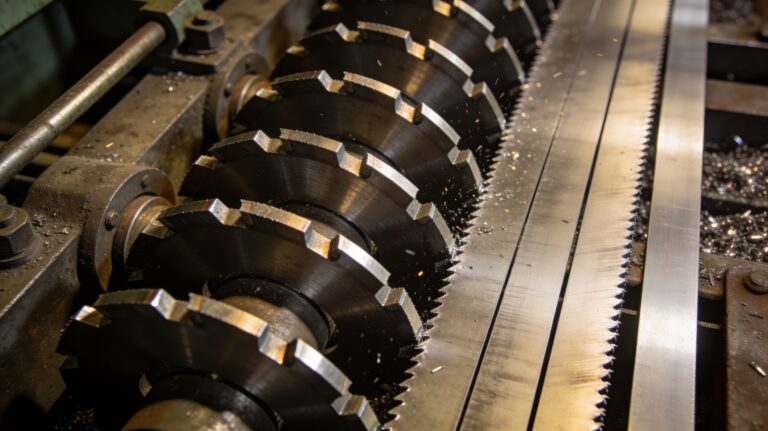
Clearance (Horizontal Gap Between Upper and Lower Blades)
Clearance is the horizontal gap between the cutting edge of the upper blade and the cutting edge of the lower blade. It controls fracture initiation. Too tight: metal-to-metal contact, heat spikes, chipping. Too loose: wire-drawing effect, burrs, edge roll.

Table 1: Recommended slitter blade clearance by material type (percentage of material thickness)
| Material Type | Tensile Strength (MPa) | Incision Depth (%) | Clearance as % of Thickness |
|---|---|---|---|
| Soft aluminum, copper, brass | ≤100 | 50 | 3–5% |
| Soft steel, copper alloy, hard aluminum | ≤240 | 25 | 10% |
| Carbon steel, soft stainless steel | 400–620 | 15 | 12–14% |
| Stainless steel, AHSS, high-alloy steel | 700–1350 | 5 | 14–30% |
Source: Industry-standard clearance chart; verified against Goodklife and Edgemills industry references.
Pro tip: Harder materials (stainless, AHSS) need wider clearance — up to 12% — to manage internal resistance to fracture. Aluminum needs tighter clearance (4–6%) to prevent the soft material from folding into the gap. These are not interchangeable settings.
Overlap (Vertical Penetration of Upper Blade Into Lower Blade)
Overlap depth controls how far the upper knife penetrates vertically into the lower knife’s cutting zone. For metallic coils on the MD-850:
- Optimal range: 0.02–0.10 mm absolute (not a ratio of thickness)
- Too deep (>0.10 mm): Excessive burr formation, accelerated blade wear
- Too shallow (<0.02 mm): Incomplete fracture, tearing, or torn edge
Adjust overlap in increments of 0.005 mm when fine-tuning. Document baseline settings per material grade for repeatable changeovers.
Cant Angle (Angular Offset Between Upper and Lower Blades)
The cant angle provides the scissoring motion necessary for clean shear. For thin metal coils:
- Recommended range: 0.25°–0.75°
- Steeper than 0.75°: Faster cutting but accelerated blade wear and potential distortion on thin gauges
- Less than 0.25°: Incomplete shear at the edge, especially at speeds above 150 m/min
Important: Always maintain a positive cant angle. A negative cant angle causes direct blade-to-blade contact and destroys cutting edges within minutes.
Material-Specific Blade Setup Parameters for the MD-850
Different metal grades require distinct blade geometry and material combinations. The following table provides a practical reference for common materials processed on the MD-850.

Table 2: MD-850 blade setup parameters by material grade
| Material Grade | Thickness Range | Recommended Blade Material | Clearance (% of t) | Overlap (mm) | Cutting Speed Guideline |
|---|---|---|---|---|---|
| Pure aluminum (1050, 3003) | 0.3–2.0 mm | Carbide or TiCN-coated HSS | 3–5% | 0.02–0.05 | Up to 200 m/min |
| Carbon steel (Q235B, DC01, SPCC) | 0.5–3.0 mm | M2 HSS or PM steel | 10–14% | 0.04–0.08 | Up to 250 m/min |
| Galvanized steel (SGCC, DX51D) | 0.5–2.5 mm | TiN-coated HSS or PM steel | 10–12% | 0.04–0.07 | Up to 220 m/min |
| Stainless steel (304, 316L) | 0.8–3.0 mm | Carbide-tipped or PM steel | 14–20% | 0.05–0.10 | 80–150 m/min |
| AHSS/DP grades (DP780, DP980) | 0.8–2.5 mm | Tungsten carbide | 18–25% | 0.06–0.10 | 60–120 m/min |
| Copper alloys | 0.3–2.0 mm | TiCN-coated HSS | 5–10% | 0.02–0.05 | Up to 180 m/min |
Pro tip: For stainless steel and AHSS grades, reduce line speed to the lower end of the guideline range during the first 15 minutes of a new blade set. This allows the cutting edge to establish a consistent fracture geometry before running at full speed.
Common mistake: Using the same M2 HSS blade for aluminum and stainless in a multi-material facility. Aluminum deposits on blade surfaces (cold-welding) degrade cutting performance on subsequent stainless runs. Maintain dedicated blade sets per material family and clean blades with appropriate solvents between changeovers.
Blade Selection: HSS, Carbide, and PM Steel in 2026
The MD-850 is compatible with three primary blade material families. Selection depends on production volume, material type, and acceptable cost-per-cut.
High-Speed Steel (HSS) — M2 / W18Cr4V Grade
M2 (or the Chinese-standard W18Cr4V equivalent) HSS blades are the general-purpose choice for facilities processing carbon steel, galvanized steel, and mixed-thickness applications at moderate volumes.
- HRC hardness: 62–65
- Best for: Materials up to 620 MPa tensile strength; thicknesses 0.5–3.0 mm
- Limitation: Requires more frequent resharpening than carbide; not recommended for stainless or AHSS at high production volumes
Carbide-Tipped Blades
Tungsten carbide tips bonded to a steel body. The benchmark for abrasion resistance — carbide maintains its cutting edge up to 10× longer than HSS when cutting non-ferrous or abrasive materials.
- Best for: High-volume stainless steel, AHSS, copper alloy processing
- Limitation: Brittleness under shock load; requires consistent blade pressure and stable arbor alignment
- 2026 note: Tungsten carbide remains the standard for automotive AHSS slitting, where DP780 and 22MnB5 press-hardened steel are increasingly used in EV battery frames
Powder Metallurgy (PM) Steel — Emerging Standard for 2026
PM steel blades feature a more uniform carbide phase distribution than conventional D2 tool steel, delivering superior edge retention and chipping resistance. PM grades are gaining adoption in facilities processing mixed high-strength and thin-gauge materials where carbide’s brittleness is a liability.
- Best for: Mixed-gauge facilities running stainless and carbon steel on the same line
- Edge retention: Outperforms D2 by approximately 30–40% in field applications [VERIFY: no independent published figure confirmed]
- 2026 relevance: BAUCOR’s 2026 circular slitter blade industry report identifies PM steel as an emerging standard for precision slitting lines
→ See: slitting line blade setup guide for a full comparison of blade regrinding intervals by material.
Step-by-Step MD-850 Blade Setup Procedure
Phase 1: Pre-Setup Verification (Do Not Skip)
- Implement lockout/tagout on all power sources. Verify emergency stops are functional.
- Confirm material specifications match the run order: grade, thickness (measure actual coil — nominal ≠ actual), width, tensile strength.
- Check blade holder runout. Maximum allowable runout for thin-gauge setups: 0.005 mm. Runout above this threshold causes periodic burr surges that appear to be random but correlate with arbor rotation frequency.
- Verify cutting fluid system: clean fluid, correct flow rate, nozzle direction aimed at the blade-material contact zone.
- Confirm all measurement tools are calibrated: feeler gauges, digital depth gauges, optical comparator or portable microscope for edge inspection.
Important: Never rely on visual blade inspection alone for alignment. A blade that looks aligned can still have 0.02 mm of twist across the arbor width that destroys edge consistency.
Phase 2: Initial Blade Positioning
Step 1 — Set baseline clearance.
Using Table 1 above, calculate the target clearance in millimeters for your specific material. Example: 1.0 mm 304 stainless → 14–20% → target clearance = 0.14–0.20 mm. Set to the midpoint of the range for initial positioning.
Step 2 — Set baseline overlap.
Position upper blade to 0.05 mm overlap as starting point for materials 0.5–2.0 mm. For sub-0.5 mm materials, start at 0.03 mm. Use a calibrated depth gauge — not a feeler gauge — for overlap measurement at this stage.
Step 3 — Set cant angle.
Set to 0.5° for initial positioning on carbon steel and stainless. Reduce to 0.35° for aluminum and copper to minimize deformation on soft materials.
Step 4 — Verify parallelism.
Check alignment across the full cutting width using precision measuring tools. A 0.01 mm parallelism error across an 800 mm cutting width produces a measurable camber in the finished strip.
Phase 3: Test Cut Validation and Fine-Tuning
Run a minimum 5-meter sample at 30% of target line speed before ramping to production speed.
Inspect edge quality using 10× magnification:
| Observation | Probable Cause | Correction |
|---|---|---|
| Burr on upper face only | Overlap too deep | Reduce overlap by 0.005 mm increments |
| Burr on lower face only | Clearance too tight | Increase clearance by 0.01 mm |
| Torn/ragged edge | Overlap insufficient OR dull blade | Increase overlap first; if no improvement, replace blade |
| Edge rolling (material curl) | Clearance too wide + overlap too shallow | Tighten clearance; verify blade sharpness |
| Inconsistent burr across width | Arbor misalignment or blade holder runout | Re-check Phase 1 runout measurement |
| Camber developing in strip | Uneven tension or blade tilt | Rebalance tension; check cant angle consistency |
Pro tip: On the MD-850’s variable speed drive, there is an inflection point between 80–120 m/min where vibration characteristics change. If edge quality is acceptable at low speed but degrades above 100 m/min, check blade holder tightness to specified torque — thermal expansion during warmup can slightly loosen holders that were set cold.
2026 Industry Context: Why Thin-Gauge Precision Slitting Is Accelerating
Two structural demand drivers are raising the stakes for MD-850 operators in 2026:
EV battery enclosure manufacturing. Battery packs add 180–320 kg to EV platforms, forcing OEMs to recover weight through structural lightweighting elsewhere. AHSS and UHSS grades — including press-hardened 22MnB5 and dual-phase DP980 — are now standard materials for battery side sills, cross-members, and underbody frames. These materials require slitting tolerances of ±0.1 mm or tighter, and blade setups that cannot manage the work-hardening behavior of DP grades at the cut face produce edge microcracks that fail in downstream roll-forming.
Solar and HVAC panel production. Thin aluminum and galvanized steel coils (0.3–0.8 mm) for solar panel frames and HVAC ductwork require clean, burr-free edges to maintain coating adhesion and forming accuracy. Facilities running the MD-850 on HVAC ductwork production have reported yield improvements exceeding 20% after adopting systematic setup protocols — eliminating trial-and-error overlap adjustment and replacing it with documented, material-specific parameter sheets [VERIFY: 20% figure from original article; no external source confirmed].
→ See: how slitting lines maximize material yield for a quantified breakdown of yield optimization by setup variable.
Troubleshooting: Four Common MD-850 Blade Setup Failures
Failure 1: Burr Height Variation Across Coil Width
Symptom: Burr height is consistent in the center but increases toward coil edges.
Root cause: Arbor deflection or blade holder wear causing non-uniform clearance across the cutting width. This is especially pronounced on wide-width setups (>600 mm) at speeds above 150 m/min.
Fix: Measure clearance at three points across the width (left, center, right). Adjust individual spacer thicknesses to equalize. If deflection is systemic, check arbor bearing condition.
Failure 2: Progressive Edge Deterioration During Production Run
Symptom: Edge quality is acceptable at run start but degrades over 2–3 hours.
Root cause: Thermal expansion of the arbor shifting blade clearance. This is common when facilities run long coils without monitoring blade temperature.
Fix: Log edge quality measurements every 30 minutes for the first production run with a new blade set. Establish the thermal stabilization point (typically 45–60 minutes into the run) and document the clearance shift required to compensate.
Failure 3: Stainless Steel Edge Work-Hardening at Cut Face
Symptom: Downstream forming operations report cracking at slit edge; edge microstructure shows hardening layer.
Root cause: Excessive heat at cut face from incorrect blade clearance (too tight) combined with insufficient cutting fluid. 304 SS work-hardens rapidly under heat and pressure.
Fix: Widen clearance to the upper end of the 14–20% range for 304 SS. Increase cutting fluid flow rate. Reduce line speed to 80–100 m/min until edge temperature is confirmed within acceptable range.
Failure 4: Width Variation Exceeding ±0.1 mm Tolerance
Symptom: Slit width measurements vary by 0.15–0.3 mm at random intervals along coil length.
Root cause: Tension fluctuation at the uncoiler causing periodic strip movement relative to the blade. Often misdiagnosed as a blade setup problem.
Fix: Before adjusting blade positions, instrument the uncoiler tension at 30-second intervals during a suspect run. If tension variation correlates with width variation timing, the problem is in the feed system, not the cutting head.
→ See: slitting line troubleshooting guide for a comprehensive fault tree covering 25 common slitting line defects.
Quality Control: Measurement Protocols and Acceptance Criteria
Edge Quality Measurement Standards
Establish quantified acceptance criteria before production begins — not after a defect is found.
| Quality Parameter | Measurement Method | Typical Acceptance Criterion |
|---|---|---|
| Burr height | Profilometer or optical comparator | ≤0.05 mm for thin gauge; ≤0.10 mm for 2–3 mm |
| Slit width tolerance | Calibrated digital calipers | ±0.1 mm (standard); ±0.05 mm (precision applications) |
| Edge straightness (camber) | Straightedge over 2 m length | ≤1.0 mm per 2 m for most applications |
| Surface scratch depth | Profilometer (Ra measurement) | Application-specific; typically Ra ≤ 0.8 µm |
Statistical Process Control Integration
For facilities running high-volume thin-gauge production (>500 kg/shift on the MD-850), implement SPC monitoring on slit width at minimum. Sample every 50 m of coil length. Control limits set at ±0.08 mm trigger an automatic blade position check before widths drift to the ±0.1 mm tolerance limit.
Pro tip: The most actionable early-warning indicator for blade wear is not burr height — it’s the rate of change of burr height over time. A blade that produces 0.03 mm burr at shift start and 0.07 mm at shift end is approaching the regrinding threshold faster than one producing stable 0.06 mm burr throughout. Log both values.
MD-850 Preventive Maintenance Checklist for Blade Systems
Consistent maintenance is the single highest-leverage action for extending blade life and protecting slit quality.
| Task | Daily | Weekly | Monthly |
|---|---|---|---|
| Visual blade inspection (chips, wear, deposits) | ☑ | ☑ | ☑ |
| Cutting fluid flow rate and cleanliness check | ☑ | ☑ | ☑ |
| Blade holder torque verification | — | ☑ | ☑ |
| Arbor runout measurement | — | ☑ | ☑ |
| Spacer ring thickness measurement and logging | — | ☑ | ☑ |
| Blade edge profilometer measurement | — | — | ☑ |
| Tension system calibration check | — | ☑ | ☑ |
| Full blade set pull, clean, measure, re-log | — | — | ☑ |
| Bearing inspection and lubrication | — | — | ☑ |
| Clearance vs. setup-sheet audit (all material types) | — | — | ☑ |
→ See: slitting line maintenance schedule for a full annual maintenance protocol including arbor reconditioning intervals.
MD-850 Model Comparison: When to Specify a Different Configuration
The MD-850’s working width range of 20–820 mm and 138.5 kW power system make it the right choice for precision thin-gauge applications up to 820 mm wide. For wider coils or higher production volumes, MaxDo’s MD Series offers scalable configurations:
Table 3: MaxDo MD Series slitting line — model selection by application
| Model | Working Width | Power | Primary Application |
|---|---|---|---|
| MD-850 | 20–820 mm | 138.5 kW | Precision thin-gauge (0.3–3.0 mm); HVAC, appliance, EV components |
| MD-1350 | 300–1300 mm | 318.5 kW | Mid-range production; automotive blanks and service center strip |
| MD-1650 | 300–1650 mm | 422.5 kW | High-volume processing; wide strip for construction and appliance |
| MD-2200 | 300–2150 mm | 422.5 kW | Maximum width capacity; coil service centers and flat-roll distribution |
Specify the MD-850 when: Your coil widths fall within 20–820 mm, gauge is consistently below 3 mm, and edge quality tolerance is ±0.1 mm or tighter.
Specify the MD-1350 when: Coil widths regularly exceed 900 mm or your production volume demands the higher power envelope for consistent throughput above 200 m/min on carbon steel.
→ Compare MD-850 vs. MD-1350 to evaluate which configuration fits your material mix and production targets.
Frequently Asked Questions: MD-850 Blade Setup
Q: What blade clearance should I use for 0.5 mm galvanized steel on the MD-850?
A: For DX51D or SGCC galvanized steel at 0.5 mm thickness, target clearance of 10–12% of material thickness — approximately 0.05–0.06 mm. Start at the midpoint (0.055 mm) and adjust based on edge inspection. Galvanized coating adds a small variable; inspect for coating delamination at the cut edge and tighten clearance slightly if delamination is visible.
Q: How often should blades be resharpened when processing 304 stainless steel at 1.0 mm on the MD-850?
A: At a typical production rate of 100–150 m/min on 304 SS, M2 HSS blades typically require resharpening every 8,000–12,000 meters of processed coil. Carbide-tipped blades extend this interval by 6–10×. Track burr height as your regrind trigger — when burr height at run-start exceeds 0.08 mm, resharpen before the next run.
Q: What is the maximum allowable arbor runout for thin-gauge setups on the MD-850?
A: Maximum allowable arbor runout for sub-1.5 mm material processing is 0.005 mm. Runout above this threshold produces periodic burr surges that are difficult to diagnose as a mechanical cause and are often incorrectly attributed to blade wear or clearance setting.
Q: Should I use cutting fluid when processing aluminum coils?
A: Yes. Aluminum cold-welds to blade surfaces without adequate lubrication, building up deposits that change effective clearance and produce inconsistent edge quality. Use a water-soluble cutting fluid with aluminum-compatible inhibitors. Inspect blade surfaces every 2–3 coils when processing aluminum and remove any aluminum pickup with an appropriate solvent before it hardens.
Q: Can the MD-850 process DP780 AHSS for automotive applications?
A: Yes. The MD-850 processes AHSS grades including DP780 within its 0.8–3.0 mm range, provided tungsten carbide blades are used and clearance is set to 18–22% of material thickness. Reduce line speed to 80–100 m/min on first-run setup. AHSS grades work-harden at the cut face — adequate cutting fluid flow and correct clearance are non-negotiable for acceptable edge microstructure.
Q: What causes slit width variation that appears at irregular intervals — not consistently at one point in the coil?
A: Random-interval width variation is almost always a tension control issue, not a blade setup issue. Check uncoiler tension stability during the suspect run by logging tension every 30 seconds. If tension spikes correlate with width deviation events, the root cause is in the feed system. → See: slitting line troubleshooting guide for a full diagnostic protocol.
Q: How do I set up the MD-850 for sub-0.5 mm ultra-thin aluminum foil applications?
A: Sub-0.5 mm aluminum requires: (1) clearance at the tight end of the 3–5% range (0.015–0.020 mm), (2) overlap of 0.02–0.03 mm, (3) cant angle reduced to 0.25°–0.35°, (4) line speed limited to 80–100 m/min until edge quality is confirmed, and (5) significantly reduced strip tension to prevent plastic deformation between blade stations. Crush slitting is not suitable for metal foil — maintain shear slitting geometry throughout.
Q: What is the blade setup difference between SPCC carbon steel and DC01 cold-rolled steel on the MD-850?
A: SPCC (JIS) and DC01 (EN 10130) are equivalent cold-rolled low-carbon steel grades with tensile strength typically 270–410 MPa. Use the same setup parameters: M2 HSS or PM steel blades, clearance 10–14% of thickness, overlap 0.04–0.08 mm, line speed up to 250 m/min. The practical difference on the MD-850 is surface finish sensitivity — DC01 is more commonly used for visible panels, so surface scratch criteria are tighter. Use fresh blades and ensure blade surfaces are clean and smooth (Ra ≤ 0.1 µm on the cutting face).
Ready to Optimize Your MD-850 Slitting Line?
- Request a custom blade setup consultation → Contact MaxDo engineering team
- Explore the full MD Series lineup → MD Series slitting lines
- Schedule a factory tour → MaxDo factory tour
Related Resources
- MD-850 precision slitting line — product page
- MD-850 vs. MD-1350: which slitting line is right?
- Ultimate guide to metal slitting lines
- Slitting line blade setup guide
- Slitting line troubleshooting guide
- Slitting line maintenance schedule
- How slitting lines maximize material yield
- Industry 4.0 in metal processing
- Slitting line control system upgrades
- Sheet metal gauge thickness chart
- Metal processing glossary (100+ terms)
- Advanced metal slitting lines guide
- Slitting line ROI calculator