

Slitting Line Control System Upgrades: Modern Automation Solutions for Metal Processing
Upgrade slitting line control systems with PLC, SCADA, and servo automation. Reduce scrap 40%, improve yield to 96%+, achieve ROI in 18-24 months.
Metal processing facilities running legacy slitting lines face mounting pressure to improve material yield, reduce changeover times, and compete in an increasingly automated manufacturing landscape. While the mechanical components of older slitting equipment may remain functional for years, outdated control systems create bottlenecks that directly impact profitability and operational efficiency.
Modern slitting line control upgrades** transform manual, relay-based operations into intelligent, self-optimizing production systems. Facilities that have upgraded from legacy controls to programmable logic controllers (PLCs) with servo-driven positioning report material waste reductions exceeding 40%, changeover time improvements of 90%, and energy savings reaching $65,000 annually. These performance gains stem from precision automation technologies that were unavailable when many existing slitting lines were originally installed.
This comprehensive guide examines the technical specifications, implementation strategies, and financial returns associated with modernizing slitting line control systems. Production managers and industrial engineers will find actionable insights for evaluating upgrade opportunities, selecting appropriate automation technologies, and executing migration projects that minimize production disruption while maximizing performance improvements.
Why Upgrade Your Slitting Line Control System
Legacy relay-based control systems that powered slitting lines installed before 2010 face fundamental limitations that modern manufacturing cannot accommodate. These older systems typically produce scrap rates between 15-20% due to inconsistent blade positioning, manual tension adjustments, and operator-dependent setup procedures. In contrast, contemporary PLC-based control architectures achieve material loss below 4% through closed-loop feedback systems that continuously monitor and correct processing parameters.

Manual setup and adjustment procedures represent another critical inefficiency in legacy systems. Traditional slitting lines require 45-60 minutes for changeovers as operators manually position blades, adjust tension settings, and verify strip widths through trial runs. Automated control systems complete identical changeovers in under 4 minutes by retrieving stored recipes and executing servo-driven positioning sequences with ±0.1mm repeatability.
Energy consumption constitutes a substantial operational cost that control system modernization directly addresses. Servo-driven motors with variable frequency drives reduce energy usage by 15-25% compared to constant-speed hydraulic systems. Optimized tension control algorithms eliminate unnecessary motor load during acceleration and deceleration cycles, while intelligent standby modes reduce power draw during production pauses.
Real-time monitoring capabilities fundamentally change maintenance approaches and quality management. Modern control systems detect developing issues—bearing wear, blade degradation, tension drift—before they cause defects or equipment failure. Facilities implementing predictive maintenance through upgraded controls report unplanned downtime reductions of 35-50%, translating to millions in preserved production capacity for high-volume operations.
Core Control System Components for Modern Slitting Lines
Programmable Logic Controllers (PLCs)
Programmable Logic Controllers serve as the central nervous system of modern slitting operations, providing millisecond-level coordination between uncoiling, slitting, and recoiling functions. Unlike the hard-wired relay logic of legacy systems, PLCs execute software-defined control sequences that can be modified, optimized, and expanded without physical rewiring. Industrial-grade PLCs suitable for slitting applications typically feature 32-64 digital inputs, 16-32 analog inputs for sensor integration, and processing speeds sufficient for motion control calculations at sub-millisecond intervals.
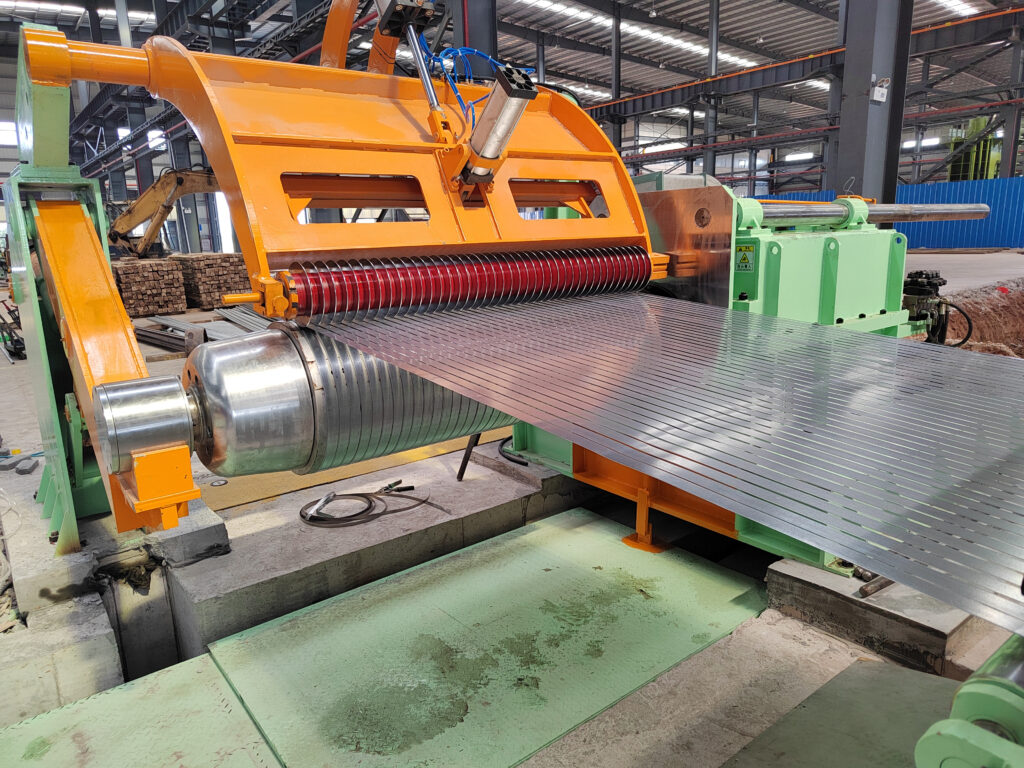
The centralized architecture of PLC systems eliminates the synchronization challenges inherent in distributed relay panels. Entry section uncoilers, slitting head positioning, and exit section recoilers receive coordinated commands that maintain precise material flow throughout speed changes, emergency stops, and normal operation. This coordination proves especially critical during acceleration and deceleration sequences where improper timing creates material wrinkles, edge damage, or coil telescoping.
Servo-Driven Blade Positioning Systems
Precision blade positioning represents the most impactful upgrade component for material yield improvement. Servo motor systems replace manual handwheels and pneumatic cylinders with electronically controlled actuators that maintain ±0.1mm positioning accuracy across the full working width of the slitting head. Closed-loop feedback from linear encoders continuously verifies blade positions, with automatic correction for any detected deviation.
Modern servo systems execute blade positioning moves in 2-5 seconds compared to the 3-5 minutes required for manual adjustments. Recipe-based operation recalls stored positions for each material specification, eliminating the operator skill dependency and setup variation that plague manual systems. The repeatability of servo positioning ensures consistent slit width across multiple production runs of identical material, critical for customers with tight dimensional specifications.
Multi-Zone Tension Control Architecture
Material tension directly affects edge quality, flatness, and dimensional consistency throughout the slitting process. Advanced control systems implement independent tension regulation for entry, processing, and exit zones using load cell feedback and PID control algorithms. Entry section dancers typically maintain 150-300 N/mm tension to remove coil set without inducing material yield, while processing zones adjust tension based on material properties—80-120 N/mm for thin gauges, 200-400 N/mm for thicker sections.
Load cells positioned at strategic points measure actual material tension in real-time, providing feedback to PID controllers that adjust motor torque or speed to maintain target values. This dynamic adjustment compensates for material property variations, coil diameter changes during unwinding, and speed fluctuations during operation. The result is consistent strip quality regardless of coil-to-coil variations that would cause defects in manually controlled systems.
Human-Machine Interfaces (HMI)
Contemporary HMI systems transform operator interaction from mechanical controls and analog gauges to intuitive touchscreen interfaces. Recipe management functionality enables storage of 500+ material specifications, each containing complete processing profiles including blade positions, tension maps, speed limitations, and quality control parameters. Operators select materials from searchable databases rather than consulting paper specifications and manually entering dozens of parameters.
Real-time process visualization displays material flow, tension levels, line speed, and quality metrics on centralized screens. Trend graphs show parameter stability over time, enabling operators to identify gradual degradation before it affects product quality. Alarm management systems prioritize notifications by severity, guiding operators through appropriate responses for each condition. This comprehensive visibility reduces the expertise required for effective operation while improving response times to developing issues.
Advanced Automation Technologies Transforming Slitting Operations
Servo Motor Integration and Electronic Synchronization
Servo motor technology replaces pneumatic cylinders, hydraulic motors, and mechanical gearboxes with electrically synchronized drive systems. Modern slitting lines employ servo drives for uncoiler tension, slitting head rotation, edge guide positioning, and recoiler torque control. Electronic cam profiles coordinate multiple axes with mathematical precision, maintaining exact speed relationships regardless of mechanical wear or temperature variations.
The elimination of mechanical power transmission components removes backlash, reduces maintenance requirements, and improves energy efficiency. Servo systems achieve positioning accuracies within 0.01° of rotation and respond to command changes within 10 milliseconds. This performance enables processing speeds exceeding 200 meters per minute while maintaining the precision required for high-strength automotive steels and aerospace aluminum alloys.
Digital communication between servo drives and the master PLC occurs via high-speed industrial networks such as EtherCAT or Profinet, with cycle times under 1 millisecond. This real-time data exchange enables coordinated motion profiles that compensate for material elasticity, coil diameter changes, and dynamic load variations. The result is material handling that adapts to actual conditions rather than relying on pre-calculated mechanical ratios.
Vision Systems and Intelligent Sensor Networks
Advanced vision systems monitor material quality at processing speeds that exceed human visual capability. Line-scan cameras capture surface images at resolutions sufficient to detect defects as small as 0.1mm—scratches, inclusions, edge cracks, surface rust—at line speeds over 200 meters per minute. Image processing algorithms classify defects by type and severity, automatically flagging or rejecting material that fails quality specifications.
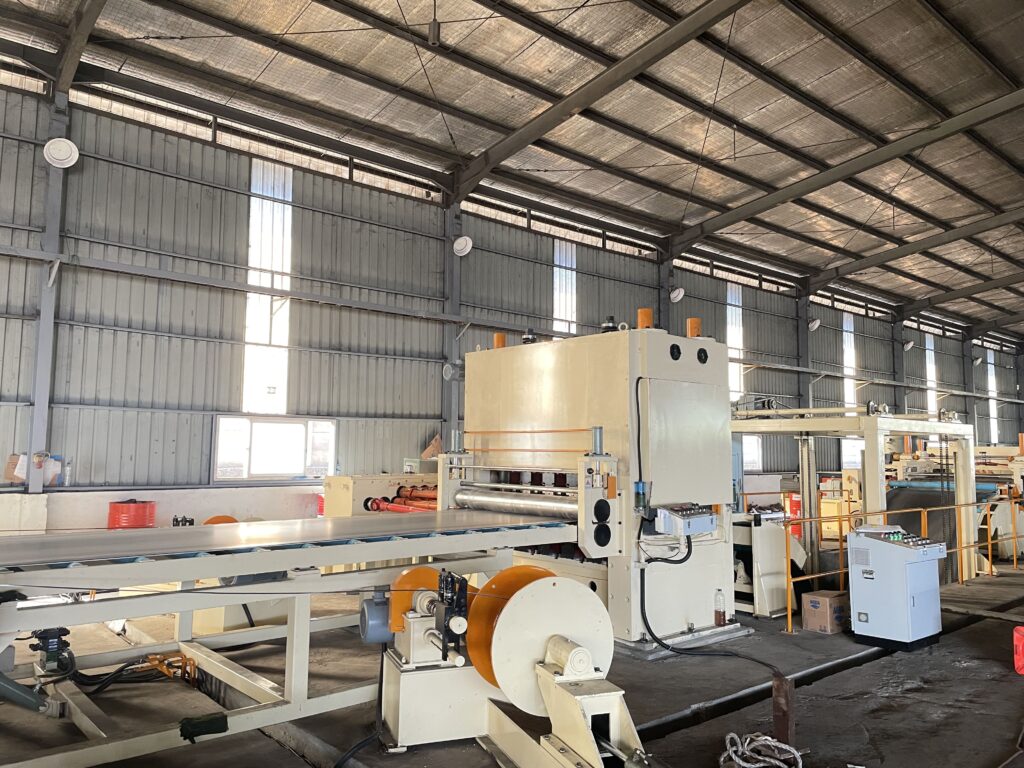
Edge detection sensors with laser or optical technology provide continuous feedback for steering correction systems. Dynamic algorithms analyze edge position data and command adjustments to centering actuators, maintaining material alignment within ±0.5mm throughout production runs. This active correction compensates for coil winding irregularities, material camber, and equipment wear that would cause edge damage or dimensional variation in manually guided systems.
Temperature monitoring via infrared sensors detects bearing problems, motor overheating, and abnormal friction conditions before they cause failures. Vibration sensors identify developing mechanical issues such as blade wear, bearing degradation, or coupling problems. This sensor network provides the data foundation for predictive maintenance programs that schedule component replacement based on actual condition rather than arbitrary time intervals.
Automated Threading and Robotic Tool Changing
Automated threading systems eliminate the manual process of feeding material through levelers, slitting heads, and into recoilers—historically one of the most time-consuming and hazardous aspects of slitting line operation. Powered pinch rollers, synchronized drive sections, and sensor-guided positioning move material through the line without operator handling. Threading sequences that required 15-20 minutes of manual work complete in 2-3 minutes with push-button operation.
Robotic tool changers automate blade and spacer positioning for width changes. Tool magazines store commonly used knife configurations, with robotic arms executing complete changeovers in under 4 minutes. This automation addresses the bottleneck that limits production flexibility in job-shop environments processing multiple widths daily. The elimination of manual knife handling also removes a significant safety hazard and reduces the skill level required for width changes.
Safety improvements extend beyond hazard removal to include comprehensive monitoring and interlocked guard systems. Light curtains, safety mats, and emergency stop circuits integrate with the control system to provide coordinated shutdown sequences that protect both personnel and equipment. Modern safety PLCs meet SIL 3 (Safety Integrity Level 3) requirements, providing certified protection for critical functions.
Industry 4.0 Integration and Digital Connectivity
SCADA Systems and Production Monitoring
Supervisory Control and Data Acquisition (SCADA) systems provide facility-wide visibility into slitting line performance, material flow, and quality metrics. Real-time dashboards display production rates, material yield, energy consumption, and equipment status across multiple lines from centralized control rooms. Historical data storage enables trend analysis, process optimization, and performance reporting for management review.
Ethernet connectivity using standardized protocols—OPC UA, MQTT, ModbusTCP—enables seamless communication between slitting line controls and enterprise systems. Production data flows automatically to inventory management, quality databases, and customer portals without manual data entry. This integration eliminates transcription errors, reduces administrative overhead, and provides real-time visibility for customer order tracking.
Alarm notification systems extend beyond local HMI displays to include email, SMS, and mobile app alerts. Maintenance personnel receive immediate notification of developing issues regardless of physical location. Remote access capabilities enable vendor support technicians to diagnose control system problems, adjust parameters, and verify performance without site visits—particularly valuable for facilities in remote locations or operating second and third shifts.
Manufacturing Execution Systems (MES)
MES platforms coordinate production scheduling, work order management, and material tracking across the slitting operation. Automated work order selection retrieves production specifications from ERP systems, populating control system recipes without manual transcription. Operators scan coil identification to verify material matches scheduled production, with automatic parameter loading based on material properties and customer requirements.
Process parameter optimization occurs through MES analysis of historical performance data. The system identifies optimal cutting speeds, tension settings, and blade configurations for each material type based on previous runs. This continuous learning approach improves performance over time as the database accumulates operational experience. New material processing benefits from similarity algorithms that recommend parameters based on comparable materials already in the system.
Quality management integration documents processing parameters, inspection results, and certifications for each coil produced. Certificate of conformance generation occurs automatically, pulling data from process monitoring systems, dimensional inspection equipment, and material property databases. This comprehensive documentation satisfies automotive and aerospace quality requirements while eliminating manual paperwork.
Data Analytics and Machine Learning
Advanced analytics platforms process the massive data streams generated by modern slitting line control systems—thousands of data points per second from sensors, drives, and quality systems. Pattern recognition algorithms identify correlations between processing parameters and quality outcomes that human analysis might miss. These insights guide optimization efforts and troubleshooting of intermittent quality issues.
Predictive models forecast equipment maintenance needs based on actual operating conditions rather than fixed schedules. Machine learning algorithms analyze vibration signatures, temperature trends, power consumption patterns, and other indicators to predict bearing failures, blade wear, and component degradation. Maintenance teams receive advance notice measured in days or weeks, enabling scheduled replacement during planned downtime rather than emergency repairs.
Energy optimization algorithms adjust motor speeds, acceleration profiles, and standby modes based on production schedules and utility rate structures. Time-of-day pricing, demand charges, and production priorities combine to minimize energy costs while maintaining output requirements. Facilities with multiple slitting lines benefit from load balancing that prevents simultaneous high-demand operations.
Cloud Connectivity and Remote Diagnostics
Cloud-based platforms enable equipment manufacturers to provide remote diagnostics, performance monitoring, and proactive support. Control system data uploads to secure cloud servers where vendor engineers analyze performance, identify optimization opportunities, and detect potential issues. This ongoing relationship extends beyond initial installation to continuous improvement throughout equipment life.
Remote software updates deliver new features, performance improvements, and security patches without requiring site visits. Control system parameters backup to cloud storage, providing disaster recovery capabilities and simplifying equipment duplication for multi-line facilities. Benchmark comparisons show how individual lines perform relative to similar installations, highlighting opportunities for improvement.
Cybersecurity considerations for connected systems require network segmentation, encrypted communications, and access controls. Industrial firewalls separate production networks from enterprise IT systems, while VPN access provides secure remote connectivity. Regular security audits and update protocols protect against evolving threats while maintaining the operational benefits of connectivity.
Upgrading Legacy Systems: Migration Strategies and Considerations
Phased Implementation Approaches
Production facilities cannot typically shut down slitting operations for extended periods required to replace entire control systems. Phased implementation strategies minimize disruption by upgrading subsystems during scheduled maintenance windows or slower production periods. Initial phases often focus on high-impact components such as servo blade positioning or tension control, demonstrating value before broader system replacement.
A typical three-phase approach begins with control panel replacement and PLC installation while retaining existing drives and sensors. This establishes the control architecture foundation and enables operator familiarization with new HMI systems. Phase two replaces motor drives with servo systems and adds feedback sensors for closed-loop control. The final phase implements advanced features such as vision systems, automated threading, and enterprise connectivity.
Weekend or holiday shutdowns provide opportunities for critical integration work that requires extended downtime. Careful planning ensures all components, software, and documentation arrive in advance. Pre-assembly and testing of control panels, cable harnesses, and sensor mounts reduces on-site installation time. Commissioning procedures validate each subsystem before proceeding to integrated operation.
Retrofit Compatibility Assessment
Successful upgrades require thorough evaluation of existing mechanical components to determine servo motor compatibility, sensor mounting requirements, and structural modifications needed for new equipment. Mechanical assessments examine shaft sizes, mounting patterns, space availability, and load capacities. Not all legacy equipment accepts direct servo motor replacement—some require adapter plates, coupling modifications, or gearbox changes.
Electrical infrastructure evaluation determines whether existing power supplies, motor control centers, and wiring infrastructure support upgraded components. Modern servo drives may require different voltage levels, regenerative braking capabilities, or enhanced ground systems. Control cabinet space, cooling capacity, and environmental protection may require upgrades to accommodate new electronics.
Safety system compliance with current standards often necessitates additional modifications beyond control system replacement. Guard interlocks, emergency stops, light curtains, and safety PLC integration must meet contemporary regulations even if legacy equipment operated legally under older codes. This compliance work represents a hidden cost that project planning must account for.
Operator Training Programs
Control system modernization fundamentally changes operator roles from manual adjustment and mechanical setup to recipe selection and monitoring. Training programs transition personnel from hands-on blade positioning to parameter verification and exception handling. The 4-6 week training period typically includes classroom instruction on control system operation, hands-on practice with HMI interfaces, and supervised production runs.
Skill requirements shift from mechanical aptitude and manual dexterity to process understanding and problem-solving. Operators learn to interpret real-time data displays, recognize abnormal parameter trends, and execute troubleshooting procedures guided by diagnostic systems. This transition can challenge experienced operators accustomed to tactile feedback and visual inspection, requiring patience and comprehensive training support.
Documentation development provides reference materials for daily operation, routine maintenance, and common troubleshooting scenarios. Laminated quick-reference cards at operator stations, detailed procedure manuals in control rooms, and video training libraries support ongoing skill development. Regular refresher sessions reinforce best practices and introduce new features as control systems evolve.
Data Migration Protocols
Legacy slitting lines accumulate decades of accumulated knowledge in setup sheets, material specifications, and operator notebooks. Control system upgrades must capture this tribal knowledge and translate it into digital recipe formats. Data migration teams interview experienced operators, review historical production records, and conduct trial runs to document optimal parameters for common materials.
Recipe databases organize materials by type, gauge, width, and customer specifications. Each entry includes blade positions, tension settings, speed limitations, and quality control parameters. The comprehensiveness of initial recipe creation determines how quickly upgraded systems achieve full productivity—inadequate recipes force operators into trial-and-error mode that negates automation benefits.
Continuous improvement processes add new materials, refine existing recipes based on performance data, and remove obsolete specifications. Recipe management protocols define approval authorities for parameter changes, version control for tracking modifications, and backup procedures for disaster recovery. This systematic approach transforms recipes from static references to living documents that improve with operational experience.
Performance Improvements and ROI Analysis
Material Yield Optimization
Material yield improvements represent the most significant financial return from slitting line control upgrades. Facilities processing $5 million annually in raw materials can realize $600,000-$800,000 in annual savings by reducing scrap from 15% to 4%. These savings result from multiple improvement mechanisms working together—precision blade positioning eliminates edge trim waste, optimized tension control prevents camber-induced rejections, and consistent processing reduces downstream quality issues.
Specific yield improvements depend on material types and original system condition. Thin-gauge aluminum and stainless steel—materials particularly sensitive to tension variations—show the most dramatic improvement, often 12-15 percentage points. Carbon steel and heavier gauges typically improve 6-8 percentage points. High-value materials such as titanium alloys, copper, and aerospace aluminum deliver rapid payback on upgrade investments due to raw material costs.
Edge quality improvements expand marketable product capabilities. Materials that previously required secondary edge conditioning operations emerge from upgraded slitting lines ready for direct use. This capability opens new customer opportunities, commands premium pricing, and reduces overall processing costs by eliminating downstream operations.
Production Capacity Gains
Changeover time reductions from 45 minutes to under 4 minutes translate directly to production capacity in facilities processing multiple materials daily. A line executing eight changeovers per shift recovers nearly six hours of production time weekly—equivalent to 15% capacity increase without additional equipment investment. This capacity gain accommodates business growth, improves delivery performance, and enhances scheduling flexibility.
Higher processing speeds enabled by servo control and automated tension management provide additional capacity. Lines originally rated at 150 meters per minute often achieve 200-250 meters per minute after control upgrades, representing 30-65% throughput improvement. Not all materials process at maximum speeds—thin gauges and high-strength alloys may require reduced speeds—but average throughput across typical product mixes improves substantially.
Reduced downtime from predictive maintenance and improved reliability contributes to effective capacity gains. Facilities report overall equipment effectiveness (OEE) improvements from 65-75% to 85-92% following comprehensive control upgrades. These gains accumulate to substantial annual capacity increases—a 15-point OEE improvement on a line operating 6,000 hours annually adds 900 hours of productive time worth $450,000-$750,000 in processing revenue.
Energy Cost Reductions
Energy savings from servo drives and optimized motor operation range from $35,000-$65,000 annually for typical slitting lines operating 6,000 hours yearly. Servo systems consume power proportional to actual loads rather than running at full capacity continuously. Regenerative braking during deceleration returns energy to electrical systems rather than dissipating it as heat in resistor banks.
Intelligent standby modes reduce power consumption during production pauses, coil changes, and minor stoppages. Legacy hydraulic systems maintain full pressure continuously, consuming 60-80% of rated power even when idle. Modern servo systems drop to 5-10% of rated consumption within seconds of stopping. For facilities with frequent short interruptions, these savings accumulate substantially over annual operation.
Facility-level energy management integration optimizes power consumption based on utility rate structures. Time-of-day pricing, demand charge management, and power factor correction opportunities become visible when control systems provide real-time energy data. Some facilities achieve an additional 10-15% energy cost reduction beyond direct equipment efficiency through strategic load scheduling.
Comprehensive ROI Calculations
Typical payback periods for comprehensive slitting line control upgrades range from 18-24 months based on material cost savings, throughput improvements, and energy reductions. Facilities processing high-value materials or operating multiple shifts achieve faster payback—12-18 months—while single-shift operations with lower-value materials may require 24-30 months.
Total cost of ownership analysis extends beyond initial investment to include maintenance costs, spare parts inventory, and operational labor. Modern control systems reduce maintenance requirements by 30-40% through reduced mechanical wear, predictive maintenance capabilities, and longer component life. Spare parts inventory consolidates around standardized industrial components rather than obsolete proprietary parts with limited supply.
Operational labor costs decrease through reduced setup time, simplified operation, and lower skill requirements for routine production. Some facilities reduce staffing requirements from 2-3 operators per line to single-operator supervision. Others maintain staffing levels but reallocate personnel to quality inspection, material handling, or additional production equipment. The labor flexibility gained through automation provides options for operational optimization.
MaxDo MD Series Control System Capabilities
Integrated Servo Control Architecture
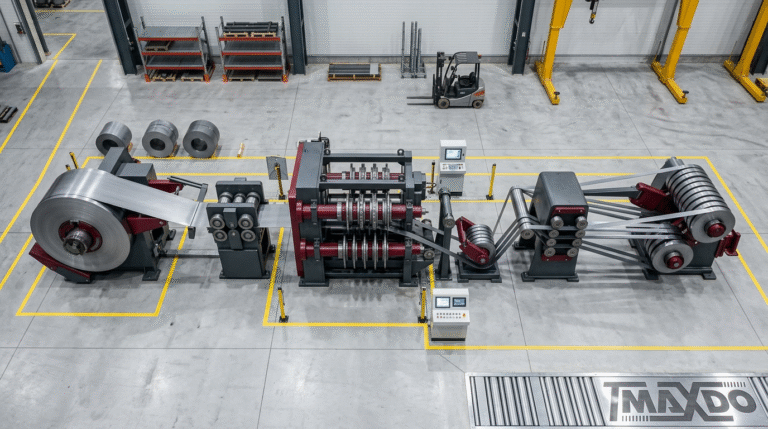
MaxDo’s MD-850, MD-1350, MD-1650, and MD-2200 slitting line models incorporate factory-integrated servo control systems designed specifically for precision metal processing. The control architecture coordinates uncoiling, leveling, slitting, and recoiling functions through centralized PLC systems with distributed servo drives. Processing speeds up to 250 meters per minute maintain ±0.1mm precision across the full width range from 300mm to 2150mm depending on model.
Servo motor selection for each axis considers torque requirements, speed ranges, and positioning accuracy needs. Uncoiler and recoiler drives provide constant tension control through coil diameter changes using dancer feedback and calculated compensation. Slitting head drives maintain synchronous rotation with material feed speed, while blade positioning servos execute rapid width changes between production runs.
The scalability of MD series control systems accommodates future expansion and capability additions. Modular software architecture enables feature activation—vision system integration, automated threading, MES connectivity—without replacing base control hardware. This design protects initial investment while providing growth paths as operational requirements evolve.
Recipe Management and Material Database
Comprehensive recipe management systems store material-specific parameters including tension maps, blade clearances, speed ramping sequences, and quality control limits. Operators select materials from touchscreen interfaces that display coil specifications, customer requirements, and processing history. Recipe recall executes complete line setup in 2-3 minutes including blade positioning, tension presets, and speed limit configuration.
Material databases organize recipes by alloy designation, gauge range, width specifications, and customer identity. Search functions locate appropriate recipes using multiple criteria—material type, thickness, surface finish, mechanical properties. New material entries benefit from similarity algorithms that suggest starting parameters based on comparable materials in the database.
Process optimization capabilities analyze production data to refine recipes over time. The system tracks yield, quality metrics, and processing speeds for each material run, identifying parameter combinations that optimize performance. Continuous improvement occurs automatically as operational experience accumulates, enhancing recipes without manual engineering analysis.
Real-Time Quality Monitoring
Advanced sensor packages continuously monitor critical quality parameters throughout production. Strip width measurement systems verify slit dimensions at multiple points along the line using laser micrometers or optical edge detection. Thickness gauges confirm material gauge consistency, while surface inspection cameras detect scratches, stains, and coating defects.
Automatic parameter adjustment maintains consistent output as material properties vary within coils. The control system responds to thickness variations by adjusting blade clearances, compensates for hardness changes by modifying cutting speeds, and corrects tension settings when elasticity varies. This adaptive control prevents quality drift that occurs in manually operated systems when operators cannot respond quickly to changing conditions.
Statistical process control integration provides real-time capability analysis and trend monitoring. Control charts display process stability, highlight parameters approaching specification limits, and trigger alerts when quality risks develop. Historical quality data supports root cause analysis for customer complaints and continuous improvement initiatives.
Enterprise System Integration
Standardized communication protocols enable seamless integration with warehouse management systems (WMS), enterprise resource planning (ERP) platforms, and customer portals. OPC UA connectivity provides real-time data exchange for production status, inventory levels, and order completion. Material tracking follows coils from receiving through processing to shipping with automatic data capture at each stage.
Automated reporting generates production summaries, quality documentation, and performance metrics without manual data compilation. Daily production reports, weekly performance analyses, and monthly trend summaries distribute automatically to relevant stakeholders. Certificate generation pulls processing parameters, inspection results, and material certifications for each coil, satisfying quality system requirements.
Remote monitoring capabilities enable MaxDo support engineers to review system performance, diagnose issues, and recommend optimizations. Secure VPN connections provide access to control system data without compromising facility network security. This ongoing support relationship extends equipment life, maintains optimal performance, and provides rapid response to operational questions.
Conclusion
Slitting line control system upgrades represent strategic investments that transform aging equipment into competitive production assets. The combination of PLC coordination, servo-driven precision, intelligent sensors, and digital connectivity delivers performance improvements that were unattainable with mechanical control systems. Material yield gains exceeding 12 percentage points, changeover time reductions of 90%, and energy savings reaching $65,000 annually demonstrate the financial impact of modernization.
Implementation success depends on systematic planning that addresses technical compatibility, operator training, and phased deployment strategies. Facilities that conduct thorough assessments, select appropriate automation levels, and execute structured migration programs achieve rapid returns while minimizing production disruption. The 18-24 month payback periods typical for comprehensive upgrades make these projects attractive even for equipment approaching end-of-life replacement decisions.
Production managers evaluating control system modernization should consider not only immediate performance gains but also strategic positioning for Industry 4.0 manufacturing. Digital connectivity, data analytics, and predictive maintenance capabilities prepare operations for evolving customer requirements around transparency, sustainability, and quality documentation. The control systems implemented today establish foundations for autonomous operation, artificial intelligence optimization, and advanced manufacturing capabilities emerging over the next decade.
MaxDo’s MD series slitting lines demonstrate how integrated control system design delivers turnkey automation solutions. Facilities considering equipment upgrades or new installations benefit from consulting with experienced automation specialists who understand both the technical requirements and operational realities of metal processing environments. The combination of proven mechanical design and advanced control technology positions operations for sustained competitive advantage in dynamic global markets.
FAQ
What is the typical ROI timeline for slitting line control system upgrades?
Most facilities achieve payback within 18-24 months through combined material savings, throughput improvements, and energy reductions. The exact timeline depends on operational factors including annual material volume, number of shifts, product mix complexity, and raw material costs. Facilities processing high-value materials such as stainless steel, aluminum, or titanium often achieve 12-18 month payback due to substantial scrap reduction from improved precision control.
A steel service center processing $5 million annually in coils with 15% scrap can realize $550,000 in annual material savings by reducing waste to 4% through precision control. Combined with $120,000 in energy savings and $200,000 in additional revenue from recovered capacity, the facility achieves $870,000 in annual benefits. Against a typical upgrade investment of $400,000-$600,000, payback occurs within 8-12 months for this scenario. Lower-volume facilities or single-shift operations may require 24-30 months for full payback but still achieve attractive returns over equipment life.
Can legacy slitting lines be retrofitted with modern PLC control systems?
Yes, most slitting lines installed after 1990 accept control system retrofits with varying degrees of mechanical modification. Successful retrofits require compatibility assessment covering electrical infrastructure, mechanical interfaces, and space availability. Lines with standard motor mounting patterns, adequate control cabinet space, and suitable structural supports typically accommodate servo motor integration and sensor additions with minimal mechanical changes.
Phased retrofit approaches minimize production disruption by upgrading subsystems during scheduled maintenance windows. Initial phases often replace control panels and install PLCs while retaining existing motors and drives. Subsequent phases add servo positioning for critical functions such as blade positioning and tension control. Final phases implement advanced features including vision systems and automated threading. This staged approach allows continued production during most of the upgrade process, typically requiring only 2-3 days of complete shutdown for final integration.
Facilities should engage automation specialists experienced with slitting line retrofits to conduct detailed compatibility assessments. These evaluations identify mechanical modifications required, estimate total project costs, and establish realistic implementation timelines. Some older lines with proprietary components or limited space may prove more economical to replace than retrofit, particularly if mechanical components approach end-of-life.
How do servo-driven systems improve slitting precision compared to hydraulic controls?
Servo systems deliver superior precision through closed-loop feedback, faster response times, and elimination of mechanical compliance. Hydraulic positioning systems typically achieve ±0.5mm repeatability limited by valve response, pressure variations, and mechanical backlash. Servo motors with linear encoder feedback maintain ±0.1mm positioning accuracy through continuous position monitoring and immediate correction of any deviation.
Response time differences significantly impact precision during dynamic operations. Hydraulic systems require 2-5 seconds to stabilize at new positions due to fluid compression, valve response delays, and damping characteristics. Servo drives achieve stable positioning within 0.1-0.2 seconds, enabling rapid width changes and maintaining precision during speed variations. This responsiveness proves critical for thin-gauge materials and high-strength alloys where minor position errors cause quality defects.
Temperature stability represents another precision advantage for servo systems. Hydraulic fluid viscosity changes with temperature affect positioning accuracy and response characteristics throughout production shifts. Electrical servo systems maintain consistent performance regardless of ambient temperature or duty cycle. This stability ensures identical part quality from first-shift startup through third-shift operation without compensation adjustments.
What training is required for operators transitioning to automated control systems?
Comprehensive training programs typically span 4-6 weeks combining classroom instruction, hands-on practice, and supervised production runs. Initial classroom sessions cover control system architecture, HMI operation, recipe management, and basic troubleshooting procedures. Operators learn to interpret real-time displays, recognize abnormal parameter trends, and execute diagnostic procedures guided by the control system.
Hands-on training emphasizes recipe selection, production startup procedures, width changeovers, and routine maintenance tasks. Operators practice on the actual equipment during non-production hours or slow periods, building confidence with touchscreen interfaces and automated sequences. Common scenarios—emergency stops, material breaks, minor jams—receive particular attention to ensure operators respond appropriately under pressure.
The skill transition from manual adjustment to recipe-based operation challenges experienced operators accustomed to tactile feedback and mechanical controls. Training programs acknowledge this challenge by relating new procedures to familiar concepts, explaining the control logic behind automated sequences, and building understanding of why systems operate as they do. Some operators adapt quickly while others require additional support—successful programs provide flexible timelines accommodating individual learning speeds.
Ongoing training occurs through regular refresher sessions, introduction of new features, and continuous improvement initiatives. Video training libraries, laminated quick-reference guides, and online resources support day-to-day operation. Facilities that invest in comprehensive training realize automation benefits more quickly and experience fewer operational issues during the transition period.
How long does a complete control system upgrade take from planning to full operation?
Complete slitting line control system upgrades typically require 6-12 months from initial assessment through full production operation. The timeline breaks into distinct phases: assessment and planning (4-8 weeks), detailed engineering and procurement (8-12 weeks), installation and commissioning (2-4 weeks), and operator training and optimization (4-8 weeks). Facilities pursuing phased implementations extend total timelines to 12-18 months but minimize production disruption by spreading work across multiple scheduled shutdowns.
Assessment and planning phases establish project scope, evaluate mechanical compatibility, define automation levels, and develop detailed specifications. Engineering teams create electrical schematics, program PLC software, configure HMI screens, and specify all components. Procurement lead times for industrial control equipment typically range from 6-10 weeks for standard components, longer for customized panels or specialized sensors.
Installation and commissioning work occurs during planned shutdowns ranging from 1-3 weeks depending on upgrade scope. Phased approaches break this work into multiple shorter shutdowns—weekend or holiday periods—minimizing lost production. Post-installation optimization continues for 4-8 weeks as operators gain experience, recipes undergo refinement, and engineers fine-tune parameters for optimal performance. Facilities typically achieve 80-90% of potential performance improvements within the first month, with continued refinement capturing remaining benefits over subsequent months.