


Sheet Metal Gauge Thickness Chart: Complete Conversion Table
Sheet metal gauge to mm & inch conversion table. Covers 7-30 gauge for steel, stainless, aluminum & galvanized. Free printable reference chart.
Not sure what “16 gauge” actually means in millimeters? You’re not alone.
The gauge system is a legacy measurement standard that can be confusing because gauge numbers differ between steel, stainless steel, and aluminum. This reference page provides the definitive conversion tables used by metal service centers, fabrication shops, and equipment procurement professionals. Values are based on the Manufacturers’ Standard Gauge for Steel Sheet and Brown & Sharpe (B&S) gauge for non-ferrous metals.
Bookmark this page — you’ll come back to it.
Steel (Carbon Steel / Mild Steel) Gauge Chart
The most commonly referenced gauge table. Based on the Manufacturers’ Standard Gauge for Steel Sheet.
| Gauge | Thickness (mm) | Thickness (inch) | Weight (kg/m²) |
|---|---|---|---|
| 7 | 4.554 | 0.1793 | 35.73 |
| 8 | 4.176 | 0.1644 | 32.76 |
| 9 | 3.797 | 0.1495 | 29.80 |
| 10 | 3.416 | 0.1345 | 26.80 |
| 11 | 3.038 | 0.1196 | 23.83 |
| 12 | 2.657 | 0.1046 | 20.85 |
| 13 | 2.278 | 0.0897 | 17.87 |
| 14 | 1.897 | 0.0747 | 14.88 |
| 15 | 1.709 | 0.0673 | 13.41 |
| 16 | 1.519 | 0.0598 | 11.92 |
| 17 | 1.367 | 0.0538 | 10.72 |
| 18 | 1.214 | 0.0478 | 9.53 |
| 19 | 1.062 | 0.0418 | 8.33 |
| 20 | 0.912 | 0.0359 | 7.16 |
| 21 | 0.836 | 0.0329 | 6.56 |
| 22 | 0.759 | 0.0299 | 5.96 |
| 23 | 0.683 | 0.0269 | 5.36 |
| 24 | 0.607 | 0.0239 | 4.76 |
| 25 | 0.531 | 0.0209 | 4.17 |
| 26 | 0.455 | 0.0179 | 3.57 |
| 27 | 0.417 | 0.0164 | 3.27 |
| 28 | 0.378 | 0.0149 | 2.97 |
| 29 | 0.343 | 0.0135 | 2.69 |
| 30 | 0.305 | 0.0120 | 2.39 |
Density used: 7,850 kg/m³ (standard carbon steel)
Stainless Steel Gauge Chart
Stainless steel uses a different gauge standard than carbon steel. A “16 gauge” stainless sheet is thinner than a “16 gauge” carbon steel sheet.
| Gauge | Thickness (mm) | Thickness (inch) | Weight (kg/m²) |
|---|---|---|---|
| 7 | 4.369 | 0.1720 | 34.97 |
| 8 | 4.166 | 0.1640 | 33.35 |
| 9 | 3.759 | 0.1480 | 30.09 |
| 10 | 3.404 | 0.1340 | 27.25 |
| 11 | 3.048 | 0.1200 | 24.40 |
| 12 | 2.657 | 0.1046 | 21.27 |
| 13 | 2.311 | 0.0910 | 18.50 |
| 14 | 1.984 | 0.0781 | 15.88 |
| 15 | 1.829 | 0.0720 | 14.64 |
| 16 | 1.588 | 0.0625 | 12.71 |
| 17 | 1.424 | 0.0561 | 11.40 |
| 18 | 1.270 | 0.0500 | 10.17 |
| 19 | 1.067 | 0.0420 | 8.54 |
| 20 | 0.889 | 0.0350 | 7.12 |
| 21 | 0.813 | 0.0320 | 6.51 |
| 22 | 0.711 | 0.0280 | 5.69 |
| 23 | 0.635 | 0.0250 | 5.08 |
| 24 | 0.559 | 0.0220 | 4.48 |
| 25 | 0.508 | 0.0200 | 4.06 |
| 26 | 0.457 | 0.0180 | 3.66 |
| 27 | 0.406 | 0.0160 | 3.25 |
| 28 | 0.356 | 0.0140 | 2.85 |
| 29 | 0.330 | 0.0130 | 2.64 |
| 30 | 0.305 | 0.0120 | 2.44 |
Density used: 8,000 kg/m³ (304 stainless steel)
Aluminum Gauge Chart
Aluminum uses the Brown & Sharpe (B&S) / AWG gauge system, which is significantly different from steel gauges. A “16 gauge” aluminum sheet is approximately 1.29 mm — different from both steel and stainless.
| Gauge | Thickness (mm) | Thickness (inch) | Weight (kg/m²) |
|---|---|---|---|
| 7 | 3.665 | 0.1443 | 9.90 |
| 8 | 3.264 | 0.1285 | 8.81 |
| 9 | 2.906 | 0.1144 | 7.85 |
| 10 | 2.588 | 0.1019 | 6.99 |
| 11 | 2.304 | 0.0907 | 6.22 |
| 12 | 2.053 | 0.0808 | 5.54 |
| 13 | 1.828 | 0.0720 | 4.94 |
| 14 | 1.628 | 0.0641 | 4.40 |
| 15 | 1.450 | 0.0571 | 3.92 |
| 16 | 1.291 | 0.0508 | 3.49 |
| 17 | 1.150 | 0.0453 | 3.11 |
| 18 | 1.024 | 0.0403 | 2.76 |
| 19 | 0.912 | 0.0359 | 2.46 |
| 20 | 0.812 | 0.0320 | 2.19 |
| 22 | 0.644 | 0.0254 | 1.74 |
| 24 | 0.511 | 0.0201 | 1.38 |
| 26 | 0.405 | 0.0159 | 1.09 |
| 28 | 0.321 | 0.0126 | 0.87 |
| 30 | 0.255 | 0.0100 | 0.69 |
Density used: 2,700 kg/m³ (6061 aluminum)
Galvanized Steel Gauge Chart
Galvanized steel gauge numbers refer to the base metal thickness before the zinc coating is applied. The total thickness (base + zinc coating) is slightly higher.
| Gauge | Base Metal (mm) | Base Metal (inch) | With Coating (mm) | Weight (kg/m²) |
|---|---|---|---|---|
| 10 | 3.416 | 0.1345 | 3.51 | 27.56 |
| 12 | 2.657 | 0.1046 | 2.75 | 21.58 |
| 14 | 1.897 | 0.0747 | 1.99 | 15.63 |
| 16 | 1.519 | 0.0598 | 1.61 | 12.64 |
| 18 | 1.214 | 0.0478 | 1.31 | 10.28 |
| 20 | 0.912 | 0.0359 | 1.00 | 7.86 |
| 22 | 0.759 | 0.0299 | 0.85 | 6.67 |
| 24 | 0.607 | 0.0239 | 0.70 | 5.49 |
| 26 | 0.455 | 0.0179 | 0.55 | 4.31 |
| 28 | 0.378 | 0.0149 | 0.47 | 3.71 |
Note: Coating thickness varies by specification. G90 (0.09 oz/ft²) adds approximately ~0.04 mm per side.
Quick Reference: Same Gauge, Different Thickness
This is where most confusion happens. Here’s a quick comparison at the most common gauges:
| Gauge | Carbon Steel (mm) | Stainless Steel (mm) | Aluminum (mm) |
|---|---|---|---|
| 10 | 3.416 | 3.404 | 2.588 |
| 12 | 2.657 | 2.657 | 2.053 |
| 14 | 1.897 | 1.984 | 1.628 |
| 16 | 1.519 | 1.588 | 1.291 |
| 18 | 1.214 | 1.270 | 1.024 |
| 20 | 0.912 | 0.889 | 0.812 |
| 22 | 0.759 | 0.711 | 0.644 |
| 24 | 0.607 | 0.559 | 0.511 |
Takeaway: Always specify thickness in mm or inches — never rely on gauge number alone, especially when ordering from international suppliers who may use different gauge standards.
How to Specify Thickness for Coil Processing Equipment
When requesting quotes for slitting lines or CTL lines, always use:
- ✅ Millimeters (mm):
0.5–6.0 mm thickness range - ✅ Inches:
0.020"–0.250" thickness range - ❌ Gauge only:
18–10 gauge— ambiguous without specifying material type
Pro tip: When providing your requirements to equipment manufacturers, include:
| Parameter | Example |
|---|---|
| Material type | Cold-rolled mild steel, 304 stainless, 5052 aluminum |
| Thickness range (mm) | 0.5–3.0 mm |
| Coil width range (mm) | 200–1,350 mm |
| Tensile strength (MPa) | 270–450 MPa |
| Coil weight (tons) | Up to 15 tons |
This eliminates gauge ambiguity and ensures you receive equipment specified for your exact material range.
→ Need equipment specs? Compare our MD Series slitting line models or CT Series CTL line models.
Frequently Asked Questions
What gauge is 1.5 mm steel?
1.5 mm carbon steel is approximately 16 gauge (actual 16 gauge = 1.519 mm).
What gauge is 3 mm steel?
3 mm carbon steel is approximately 11 gauge (actual 11 gauge = 3.038 mm).
Why are aluminum gauges different from steel?
Steel uses the Manufacturers’ Standard Gauge system (developed for the steel industry). Aluminum uses the Brown & Sharpe / American Wire Gauge system (originally developed for wire). The two systems evolved independently, so the same gauge number represents different thicknesses.
Is a higher gauge number thicker or thinner?
Thinner. Higher gauge numbers = thinner material. 10 gauge (3.4 mm) is much thicker than 24 gauge (0.6 mm).
What gauge of steel can a slitting line process?
Light-gauge slitting lines (like the ) handle 0.3–6.0 mm (approximately 30–7 gauge steel). Heavy-gauge lines (like the ) process up to 25 mm — well beyond the gauge system’s range.
Do I need to convert gauges when ordering equipment from overseas?
Yes — always specify in mm. Gauge standards vary by country and material type. When requesting quotes for slitting lines or CTL lines, specify your thickness range in millimeters to eliminate ambiguity.
Need Equipment for Your Gauge Range?
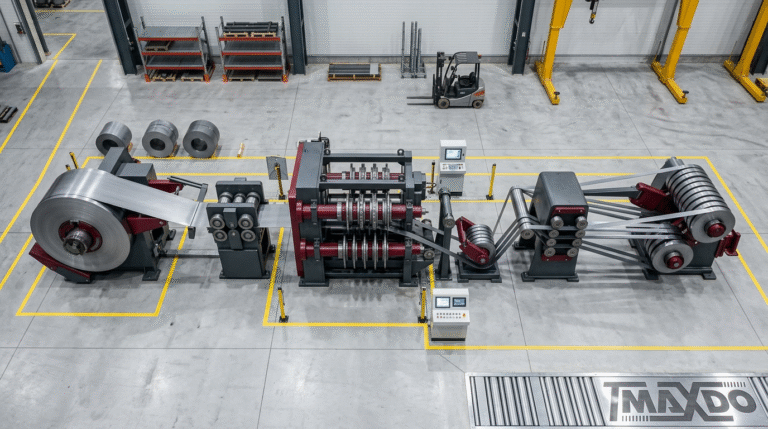
MaxDo slitting lines and CTL lines cover the full gauge spectrum from 0.3 mm (30 ga) to 25 mm.
- Light gauge (0.3–3.0 mm) — MD-850 Precision Slitting Line
- Mid gauge (1.0–8.0 mm) — MD-1350 Slitting Line
- Heavy gauge (3.0–25 mm) — MD-1650 / MD-2200 Heavy Gauge Lines
- Request a quote for your gauge range