
MD-850 Precision Slitting Line: HVAC & Appliance Guide 2026
The MaxDo MD-850 slitting line delivers ±0.1 mm width tolerance for HVAC ductwork and appliance panel production. Specs, material guides, and ROI data for 2026.
Most slitting line failures in HVAC and appliance manufacturing trace back to the same root cause: specifying a machine to your average gauge, not your maximum gauge. If your HVAC runs reach 1.5 mm galvanized steel or your appliance panels push to 2.5 mm stainless on peak shifts, you need a line engineered for that ceiling — not one straining at its design limit every third coil.
This guide is for production managers and plant engineers evaluating precision slitting equipment for light-to-medium gauge applications: specifically galvanized steel HVAC ductwork (24G–18G / 0.60–1.20 mm per SMACNA) and pre-painted or stainless steel appliance panels (0.6–3.0 mm). It covers the MaxDo MD-850 slitting line in full technical depth — specifications, material processing parameters, blade selection, maintenance protocols, and ROI calculation.
What the MD-850 Is Engineered For
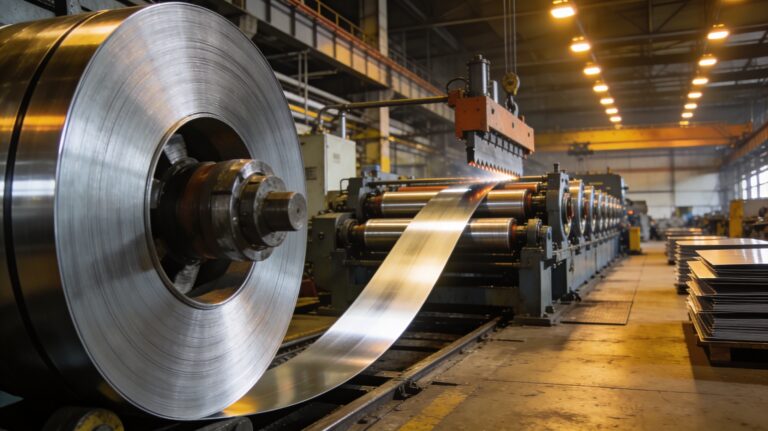
The MaxDo MD-850 slitting line is a light-to-medium gauge precision slitting system designed for widths up to 850 mm and material thicknesses from 0.3 to 3.0 mm. It runs at speeds up to 120 m/min and handles coils up to 10 tons, with a Siemens PLC control system and AC servo drive train throughout.

MD-850 core specification summary:
| Specification | Value |
|---|---|
| Gauge range | 0.3 – 3.0 mm |
| Maximum coil width | 850 mm |
| Maximum coil weight | 10 tons |
| Maximum line speed | 120 m/min |
| Width tolerance | ±0.1 mm (±0.05 mm precision option) |
| Maximum slitting cuts | Up to 20 |
| Drive system | AC servo |
| Control system | Siemens PLC |
| Coil inner diameter | 508 / 610 mm |
| Coil outer diameter | Max 1,500 mm |
| Certification | ISO 9001:2015, CE marked |
The MD-850’s 850 mm coil width ceiling covers the full dimensional range of standard HVAC duct strip and the majority of residential appliance panel applications. Operations regularly processing widths above 850 mm or gauges above 3.0 mm should evaluate the MD-1350 mid-range slitting line instead.
Common mistake: Ordering an MD-850 to process carbon steel above 2.5 mm with hardness exceeding 30 HRC. Blade wear accelerates 3–4× at that combination. Size up to the MD-1350 for harder material approaching the 3.0 mm ceiling.
HVAC Ductwork: Gauge Requirements and Processing Standards
SMACNA Gauge Standards for Galvanized Steel Ductwork
SMACNA (Sheet Metal and Air Conditioning Contractors’ National Association) defines minimum galvanized steel gauges by duct size and pressure class. The following table reflects SMACNA HVAC Duct Construction Standards and ASTM A653 G90-coated galvanized material — the standard coating specification for ductwork in commercial and industrial applications.
SMACNA minimum galvanized steel gauge by duct dimension (low-pressure systems):
| Maximum Duct Dimension | Gauge | Thickness (mm) | ASTM A653 Designation |
|---|---|---|---|
| Up to 750 mm | 24G | 0.60–0.63 mm | G90, lock-forming grade |
| 751–1,500 mm | 22G | 0.75–0.80 mm | G90, lock-forming grade |
| 1,501–2,250 mm | 20G | 0.90–1.00 mm | G90 |
| Above 2,250 mm | 18G | 1.20 mm | G90 + structural reinforcement |
The MD-850 processes all four gauge ranges within specification. At 24G (0.60 mm), the machine runs at full-speed operation (up to 120 m/min). At 18G (1.20 mm) commercial duct applications, reduce to 80–90 m/min to maintain edge quality and protect galvanized coating integrity.
Pro tip: ASTM A653 G90 coating — 90 g/m² total zinc — is the minimum for exposed ductwork. If your customer specifies G60 (60 g/m²) for interior concealed applications, blade clearance requirements remain the same, but pre-painted and film-protected coils require reduced cutting force to prevent coating delamination at the slit edge.
Dimensional Tolerances for Duct Assembly

Rectangular ductwork fitting tolerances vary by application class:
- Residential low-pressure duct: ±0.5 mm acceptable per SMACNA standard practice
- Commercial low-pressure: ±0.25 mm for Pittsburgh seam lock-forming compatibility
- High-pressure commercial (≥ 2 in. wg static): ±0.1 mm for leak-free seam integrity
The MD-850’s standard ±0.1 mm width tolerance satisfies all three classes without any process adjustment — commercial and high-pressure specs are met as a baseline, not as a precision option.
Appliance Panel Processing: Materials and Edge Quality Requirements
Pre-Painted Steel and Protective Film Handling
Appliance panels — refrigerator side panels, washing machine drums, oven fascias — arrive at the slitter as pre-painted or film-protected coils. The slit edge itself is not visible in most final assemblies, but burr height and edge straightness determine whether the panel aligns correctly in automated assembly fixtures.
Typical appliance panel material specifications:
- Pre-painted steel (SPCC base): 0.6–1.2 mm, yield strength 140–280 MPa
- Stainless 304 (2B or brushed finish): 0.8–2.5 mm, yield strength 205–310 MPa
- Stainless 316 (for wet appliances): 1.0–3.0 mm, higher chromium-molybdenum content
Pro tip: For protective film-covered pre-painted coils, run the MD-850 at no more than 60–70% of rated speed. Film adhesion varies by supplier and temperature. At high speeds, film tension can cause micro-tears at the slit edge that are invisible until the protective layer is peeled in assembly — creating costly downstream rejection.
Stainless Steel Processing: Grade-Specific Parameters
304 and 316 stainless steel require tighter blade clearances than mild or galvanized steel of equivalent thickness, because austenitic stainless work-hardens at the shear zone. A clearance that produces clean edges in DC01 mild steel will generate a rough, work-hardened edge in 304 SS of the same gauge.
Blade clearance recommendations by material type (as % of material thickness):
| Material | Grade Example | Typical Clearance | Notes |
|---|---|---|---|
| Mild steel (low carbon) | DC01, SPCC, Q235B | 5–8% | Standard setup |
| Galvanized steel | ASTM A653 G90, G60 | 6–9% | Protect zinc layer; reduce speed near upper gauge |
| Pre-painted steel | SPCC-painted, 0.6–1.2 mm | 5–7% | Use polyurethane stripper rings |
| Stainless 304 | AISI 304, EN 1.4301 | 8–12% | Carbide-tipped blades recommended above 1.5 mm |
| Stainless 316 | AISI 316, EN 1.4401 | 9–13% | Higher yield; specify carbide blades at order |
Reference: Blade clearance recommendations derived from AHSS Insights (WorldAutoSteel) shear clearance guidelines and Consolidated Metal Service industry practice documentation.
Common mistake: Using the same blade setup for 304 SS as for galvanized steel because both fall within the 0.8–1.2 mm range. Stainless work-hardens at the cut face, producing micro-cracks that cause assembly alignment failures. Run a dedicated blade set for stainless grades and track clearance separately from the mild steel setup log.
MD-850 vs. MD Series: Selecting the Right Configuration
Use the decision matrix below to confirm the MD-850 is the correct model for your operation before committing to a purchase.
MaxDo MD Series slitting line selection matrix:
| Specification | MD-850 | MD-1350 | MD-1650 | MD-2200 |
|---|---|---|---|---|
| Min gauge (mm) | 0.3 | 0.5 | 1.0 | 3.0 |
| Max gauge (mm) | 3.0 | 6.0 | 12.0 | 25.0 |
| Max width (mm) | 850 | 1,350 | 1,650 | 2,200 |
| Max coil weight (t) | 10 | 20 | 35 | 60 |
| Max speed (m/min) | 120 | 100 | 80 | 60 |
| Drive | AC servo | AC servo | AC servo | AC servo + hydraulic |
| Typical applications | HVAC, electronics, light appliances | Automotive, roll forming | Energy sector, structural | Heavy plate, shipbuilding |
For the MD-850 to be the correct choice, all three conditions must hold:
- Maximum material gauge ≤ 3.0 mm
- Maximum coil width ≤ 850 mm
- Maximum single coil weight ≤ 10 tons
If any condition fails, step up one model. → Compare the full MD Series lineup
Pro tip: Always size for your maximum gauge, not your average. If 30% or more of your volume is at or near the 3.0 mm ceiling, the MD-850’s blade and bearing wear will accelerate noticeably. The MD-1350 handles that range with headroom to spare.
Blade System Engineering and Tension Control
Rotary Blade Setup for Burr-Free Edges
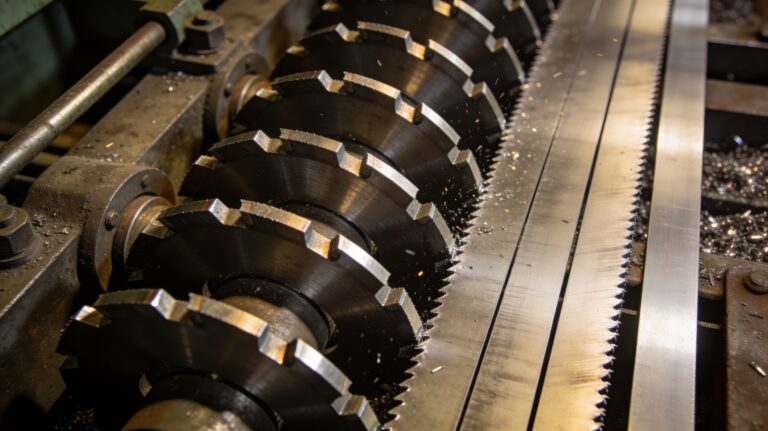
The MD-850 uses a precision rotary blade arbor system with servo-driven blade gap adjustment. A correctly set slit edge has four distinct zones visible under 20× magnification: rollover, burnish (bright zone), fracture (dark zone), and burr. When blade clearance and sharpness are correct, the burr zone is negligible — typically below 5–8% of material thickness for mild and galvanized steel.
Burr height diagnosis:
- Uniform oversized burrs on all strips: Blade clearance too large — reduce clearance by 1–2% of material thickness
- Irregular, fragmented burrs: Clearance too small, or blade is worn — check sharpness first, then adjust clearance upward
- Burrs alternating between odd/even strips: Arbor runout or shaft shoulder offset — run mechanical accuracy check before adjusting clearance
- Periodic burr variation along strip length: Spindle runout or spacer accuracy issue — inspect tooling, not clearance
→ See the complete slitting line blade setup guide for step-by-step arbor assembly procedures.
Servo Tension Control System
The MD-850’s AC servo tension control maintains consistent strip tension throughout the loop pit between the slitting head and recoiler. This prevents two common defects:
- Edge wave: Caused by inconsistent tension allowing strip to buckle laterally. In HVAC duct strip, edge wave exceeding 1–2 mm per meter affects Pittsburgh seam formation and lock-forming yield.
- Coil set amplification: Residual coil curvature from the original master coil is amplified by uneven tension, creating dimensional errors in downstream forming.
The servo system adjusts tension in real time based on material speed and strip weight — no manual tension stand settings required during production.
IIoT Integration and Industry 4.0 Readiness (2026)
Metal service centers and HVAC duct fabricators are accelerating IIoT adoption in 2026, driven by pressure to reduce unplanned downtime and improve coil-to-coil traceability. The MD-850’s Siemens PLC control system supports integration with manufacturing execution systems (MES) via standard OPC-UA protocols.
Practical IIoT applications for MD-850 installations:
- Real-time blade wear monitoring: Track cumulative running meters per blade set and trigger re-sharpening alerts before edge quality degrades
- Coil genealogy tracking: Link each slit coil ID to original master coil heat number, material grade, and processing parameters — essential for appliance OEM quality audits
- Speed-quality correlation logging: Automatically flag coils processed above material-specific speed thresholds for downstream QC sampling
- Predictive maintenance triggers: Monitor servo motor current draw; abnormal current at a given speed indicates bearing wear or arbor misalignment before a failure occurs
→ See how other metal service centers are implementing Industry 4.0 in metal processing
Facility Requirements and Installation Planning
Power Infrastructure
The MD-850 requires three-phase electrical supply. [VERIFY: Exact kW rating — original article cited 138.5 kW; not confirmed in official MD Series spec reference.] Confirm total connected load with MaxDo engineering during site survey. Install dedicated voltage regulation if facility supply fluctuates more than ±5% — Siemens PLC systems are sensitive to voltage instability, and irregular supply causes false alarm trips that interrupt production.
Floor Space and Material Handling
Plan the MD-850 installation layout to include:
- Overhead crane access for coil loading (minimum 3-ton hook capacity for 10-ton coils with crane safety factor)
- Upstream coil car or pallet jack access lane
- Downstream slit coil removal path — allow minimum 3 meters clear of the recoiler
- Maintenance access on both sides of the slitting head (blade changes require front and back access)
- Safety guarding perimeter per CE/OSHA machine guarding requirements
Operator Training Scope
Successful MD-850 deployment requires trained operators across three competency areas:
- Material handling: Coil loading, core sizing, and inner/outer diameter verification before threading
- Blade setup: Blade clearance calculation by material type and thickness, arbor assembly sequence, clearance verification with feeler gauge
- Quality control: Edge inspection protocol, burr height measurement, width verification with calibrated digital calipers (minimum resolution 0.01 mm)
Maintenance Schedule
Preventive maintenance intervals for the MD-850 operating on a single-shift (8-hour/day) basis:
| Frequency | Task | Notes |
|---|---|---|
| Daily | Blade edge inspection (visual + tactile) | Replace or re-sharpen when burr height exceeds 8% of material thickness |
| Daily | Loop pit strip tension verification | Check for edge wave on first coil of shift |
| Weekly | Lubrication of arbor bearings and blade spacers | Use manufacturer-specified grease grade; over-lubrication contaminates blade faces |
| Weekly | Servo drive feedback check | Verify encoder counts match actual strip speed; log any discrepancy |
| Monthly | Width tolerance verification | Measure 10 random strips per slit coil; compare against setup parameters |
| Monthly | Coil car and reel hydraulic system inspection | Check for fluid leaks at seals; replace seals at first sign of seepage |
| Quarterly | Full mechanical accuracy audit | Arbor runout, spindle parallelism, shaft shoulder offset — use dial indicator to 0.005 mm resolution |
| Annual | Siemens PLC firmware update check | Coordinate with MaxDo service team; do not update firmware without engineering approval |
→ Download the full slitting line maintenance schedule
ROI Calculation Framework
Capital Investment Payback Model
The following framework uses representative figures for a mid-volume HVAC ductwork or appliance panel operation. Insert your own production data for an accurate payback estimate.
Assumptions (adjust to your operation):
| Parameter | Example Value |
|---|---|
| Annual coil throughput | 2,400 tons/year |
| Average coil width processed | 650 mm |
| Current manual/outsourced slitting cost per ton | USD 45/ton |
| MD-850 target in-house slitting cost per ton | USD 18/ton (power + labor + blades) |
| Annual cost savings | USD 64,800/year |
| MD-850 equipment investment (indicative) | [VERIFY with MaxDo quote] |
| Estimated payback period | 18–24 months at stated throughput |
The 18–24 month payback range cited in industry references for equipment in this class is achievable when:
- Utilization exceeds 1.5 shifts/day (≥ 12 operational hours)
- Scrap rate from dimensional miscuts is reduced below 0.8%
- Outsourced slitting premium (transport + service center markup) exceeds USD 25/ton
Use the slitting line ROI calculator to model your specific volumes and cost structure.
Quality Cost Reduction
Consistent ±0.1 mm width tolerance eliminates two recurring quality costs in HVAC and appliance manufacturing:
- Pittsburgh seam rework: Duct strip out of ±0.25 mm tolerance fails at the lock-former, requiring manual trimming or rejection. At 2,400 tons/year throughput, even a 1.5% rework rate represents 36 tons of rework labor annually.
- Appliance fixture misalignment: Panels outside ±0.2 mm width tolerance cause automated assembly fixture jams. Each jam in a continuous assembly line costs 8–15 minutes of lost line time — at 5–10 jams per shift attributable to incoming material, the production time losses exceed the cost of equipment within the first operating year.
FAQ
Q: What is the maximum material thickness the MD-850 can process?
A: The MaxDo MD-850 slitting line handles material from 0.3 mm (thin precision strip) up to 3.0 mm thickness. For material above 3.0 mm, the MD-1350 (up to 6.0 mm) is the correct specification. Running the MD-850 regularly at its 3.0 mm ceiling with high-hardness steel (> 30 HRC) accelerates blade and bearing wear; contact MaxDo engineering to discuss blade specification options if your mix includes borderline thicknesses.
Q: Can the MD-850 process galvanized steel without damaging the zinc coating?
A: Yes — with correct blade clearance and cutting speed. For ASTM A653 G90 galvanized steel at 0.6–1.2 mm, use 6–9% clearance and reduce speed to 80–90 m/min at the upper gauge range. Sharp blades are critical: dull blades increase cutting force and cause micro-cracking of the zinc layer at the slit edge, exposing base steel to corrosion.
Q: What is the MD-850’s width tolerance, and is a tighter option available?
A: Standard width tolerance is ±0.1 mm across the full gauge and width range. A precision option of ±0.05 mm is available — specify at order. The precision option requires more frequent blade inspection and reduced maximum speed to approximately 80 m/min for consistent performance.
Q: How many slit strips can the MD-850 produce in a single pass?
A: Up to 20 simultaneous cuts. Actual maximum cuts in production depend on material gauge, strip width uniformity requirements, and blade arbor loading. For very narrow strips (< 15 mm), consult MaxDo engineering for arbor configuration guidance — narrow strip tension distribution is critical to preventing edge wave at high strip counts.
Q: What blade material should I use for 304 and 316 stainless steel?
A: For 304 stainless up to 1.5 mm, HSS (High-Speed Steel) blades with carbide coating are acceptable. For 304 SS above 1.5 mm and all 316 SS grades, specify solid carbide-tipped blades at order. Stainless austenitic grades work-harden at the shear zone; under-specified blades produce rough edges and fail prematurely. → See also slitting line blade setup guide
Q: What is the lead time and installation process for the MD-850?
A: [VERIFY: Lead time with MaxDo sales team — varies by configuration and market conditions.] MaxDo provides on-site installation, machine commissioning, and operator training as part of the delivery package. Contact the MaxDo engineering team for current lead time and installation scope documentation.
Q: How does the MD-850 compare to the MD-1350 for HVAC applications?
A: For HVAC ductwork within 850 mm coil width and 3.0 mm maximum gauge, the MD-850 delivers equivalent ±0.1 mm width tolerance at a lower capital cost and higher line speed (120 m/min vs. 100 m/min for MD-1350). The MD-1350 is the correct choice when coil widths exceed 850 mm, gauges exceed 3.0 mm, or coil weights exceed 10 tons per load. → MD-850 vs. MD-1350 comparison
Q: Does the MD-850 carry ISO and CE certification?
A: Yes. The MaxDo MD-850 is manufactured under ISO 9001:2015 quality management standards and carries CE marking for European export compliance. Documentation is available upon request through the MaxDo contact page.
Ready to Specify the MD-850 for Your Operation?
- Request a custom quote → Contact MaxDo Engineering
- Explore the full MD Series slitting line lineup → MD Series Product Pages
- Schedule a factory visit → MaxDo Factory Tour
Related Resources
- MD-850 precision slitting line product page
- MD-1350 mid-range slitting line
- MD-850 vs. MD-1350: which slitting line is right?
- Ultimate guide to metal slitting lines
- How slitting lines maximize material yield and reduce scrap
- Slitting line blade setup guide
- Slitting line maintenance schedule
- Slitting line troubleshooting guide
- Industry 4.0 in metal processing
- Metal production line automation ROI
- Slitting line ROI calculator
- Sheet metal gauge thickness chart
- Metal processing glossary (100+ terms)