


Slitting Line Setup Time Reduction: Complete 40-60% Improvement Guide
Reduce slitting line setup time by 40-60% with automated knife positioning, recipe management, and quick changeover systems. Proven strategies from 500+ installations.
Production managers face a persistent challenge: traditional slitting line changeovers consume 30-90 minutes of valuable production time, directly impacting overall equipment effectiveness and profitability. Manual blade positioning, tension adjustments, and calibration runs create bottlenecks that limit manufacturing flexibility and generate excessive setup scrap. Modern automation technologies now enable facilities to reduce changeover time by 40-60% through integrated systems combining automated knife positioning, recipe management slitting, and standardized procedures. This comprehensive guide presents proven strategies from over 500 installations worldwide, delivering actionable implementation roadmaps that production managers can deploy immediately to recover lost capacity and improve operational efficiency.
Why Setup Time Reduction Matters for Slitting Operations
Downtime costs steel processing facilities $2,000-$5,000 per hour in lost production capacity and fixed overhead absorption. Traditional slitting line changeovers generate 5-15 hours of downtime weekly for facilities processing ten different strip width configurations daily—equivalent to nearly two full shifts lost each week. This unplanned capacity loss directly reduces OEE by 15-25% and limits the ability to respond to rush orders or high-mix production requirements.
Every minute spent on changeovers represents lost production capacity that directly impacts your facility’s bottom line. Traditional slitting line changeovers consuming 30-90 minutes severely limit production flexibility and daily output capacity. For facilities processing ten different strip width configurations daily, this translates to 5-15 hours of non-productive time—nearly two full shifts lost each week.
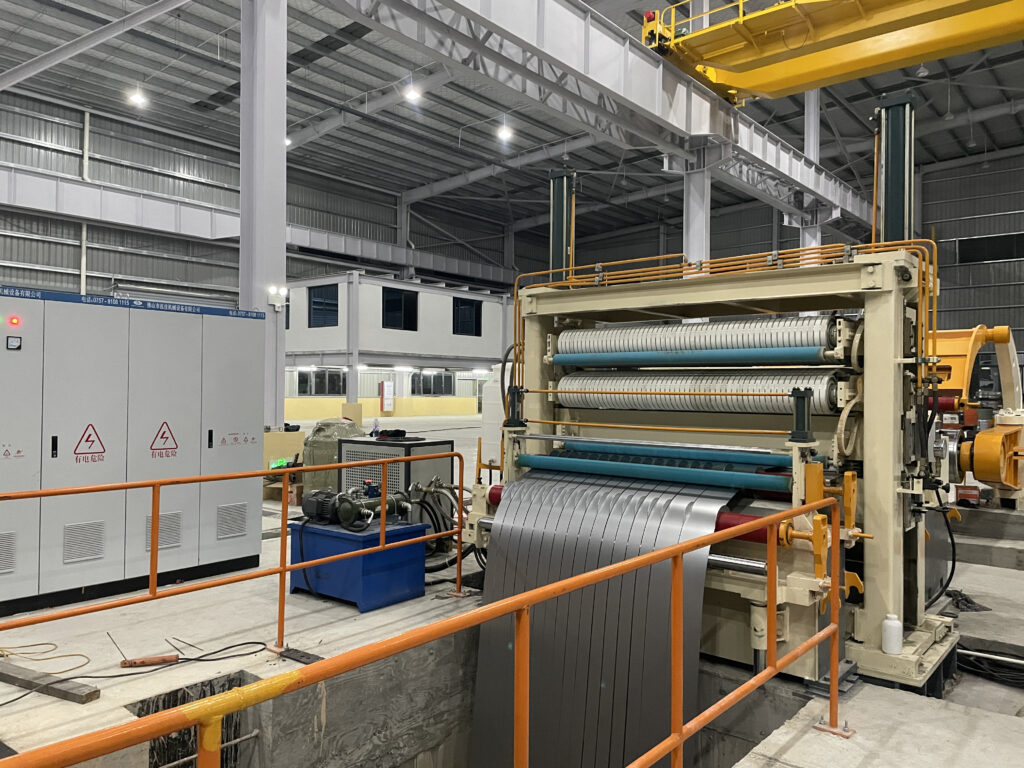
Manual knife positioning accounts for 60% of setup-related quality issues and generates excessive setup scrap during calibration runs. Operators measuring and adjusting blade positions by hand introduce measurement errors that require multiple test runs to achieve specification. Downtime extends by 10-15 minutes per changeover during each calibration cycle as operators verify edge quality and dimensional accuracy, consuming material and production capacity.
Manufacturers processing multiple strip widths lose 15-25% of available machine hours to changeover activities, directly impacting OEE. Staffing challenges compound this capacity loss, with skilled operator shortages adding 15-20% to average changeover times in facilities relying on manual blade positioning expertise. This dual constraint becomes particularly costly when customer demand fluctuates or order mix changes frequently. Facilities unable to respond quickly to rush orders miss revenue opportunities or carry excessive inventory to buffer against setup constraints.
Quick changeover capability enables smaller lot sizes and faster response to customer orders without inventory buildup. Modern automated metal processing systems transform economics of small-batch production, allowing facilities to accept orders previously considered uneconomical due to setup time overhead.
Automated Knife Positioning Systems: Core Technology
The foundation of rapid changeover lies in eliminating manual blade adjustment through precision automation. Servo-driven blade positioning maintains accuracy within ±0.02mm to ±0.1mm across the entire width range, eliminating measurement errors that plague manual systems. This precision prevents the trial-and-error cycles that consume setup time and generate scrap during calibration.
Automated knife positioning system reduces changeover time from 20-30 minutes to 8-12 minutes by removing manual adjustment steps. Operators simply input desired strip widths into the control interface, and servo motors drive each knife holder to precise positions verified through digital encoders. This automated movement occurs simultaneously across all blade positions rather than sequentially as with manual adjustment.
Ball screw drive mechanisms with precision linear guides compensate for blade wear through automatic position correction. The system monitors cutting forces and blade condition, adjusting positions incrementally to maintain edge quality as blades gradually wear. This self-compensation extends blade life while maintaining consistent strip width throughout production runs.
CNC-controlled slitter heads use laser-guided positioning that cuts setup time from 40 minutes to under 10 minutes. Advanced systems from manufacturers like MaxDo incorporate absolute position encoding, eliminating the need for home positioning cycles after power interruptions. The MD series machines maintain positioning accuracy within ±0.1mm while processing materials from 0.3mm to 12mm thickness at speeds up to 250 m/min.
Digital positioning interfaces allow operators to input specifications and execute movements from touchscreen controls rather than manual measurement. Real-time monitoring through modern HMI systems displays current blade positions, target positions, and movement status continuously, enabling operators to detect positioning errors within milliseconds. This immediate visibility ensures that operators can verify completion and correct any deviations from a single control station before they impact production quality.
Recipe Management Systems for Rapid Job Changeover
Real-time monitoring systems integrated with recipe management provide continuous visibility into changeover performance and blade positioning accuracy. These systems track actual setup times against target benchmarks, automatically alerting supervisors when deviations exceed 20% thresholds. Real-time monitoring prevents the 143-minute staffing delays documented in industry studies by triggering immediate notifications when equipment sits idle, enabling rapid response before lost capacity compounds across shifts.
Recipe management slitting transforms changeover operations from manual procedures requiring skilled operators into automated sequences executable by any trained personnel. Pre-programmed job recipes store 200+ blade setup configurations with material specifications, tension curves, and cutting parameters. Each recipe captures the complete knowledge required to process a specific material and strip width combination, codifying expert operator experience into repeatable digital instructions.
Recipe management slitting systems enable operators to recall complete setup configurations in under 30 seconds via touchscreen selection. Instead of consulting paper work orders and manually calculating blade positions, operators simply select the appropriate recipe from a dropdown menu or scan a barcode associated with the incoming coil. The system then automatically configures all processing parameters without manual intervention.
Stored recipes include knife positions, blade clearances, tension settings, recoiling parameters, and line speed profiles for each material type. This comprehensive parameter set ensures consistent processing regardless of which shift performs the changeover. Advanced systems also store blade wear compensation factors, automatically adjusting positions based on cumulative cutting time since last blade change.
Barcode or QR code scanning automatically retrieves the correct recipe for incoming coil specifications, eliminating manual lookup errors. Facilities can print specification labels directly from their ERP systems, creating seamless integration between production planning and equipment setup. This automation eliminates the common error of operators selecting incorrect recipes for similar-appearing materials.
Recipe systems improve shift-to-shift consistency by standardizing setup parameters regardless of operator experience level. Staffing flexibility increases dramatically as new operators achieve the same setup quality as experienced personnel—the system captures and applies expert knowledge automatically, eliminating the 6-12 month skill development curve required with manual changeover methods. This consistency reduces quality variability and eliminates the production disruptions caused by operator learning curves, enabling facilities to maintain production schedules despite workforce turnover or shift rotation constraints.
For more information on servo control integration, see our guide on precision in metal processing with servo roll feeder systems.
SMED Quick Changeover Methodology for Slitting Lines
Single-Minute Exchange of Die principles convert internal setup tasks to external activities performed while the previous job is running. This fundamental methodology distinction separates activities that must occur with the machine stopped (internal tasks) from those performable during production (external tasks). Systematic analysis typically reveals that 50-70% of traditional changeover activities can be converted to external tasks.
Quick changeover slitting line implementation focuses on separating external preparation from internal machine adjustment time. Preparation activities—retrieving tooling, staging spacers, reviewing job specifications, and pre-assembling blade cartridges—occur during the final minutes of the current production run. When the last coil completes processing, all materials and information are immediately available at the machine, eliminating search and retrieval delays.
Pre-staging tooling, spacers, and documentation for the next job while current production runs eliminates search and retrieval delays. Dedicated changeover carts organize all required components in sequence of use, with visual guides showing proper arrangement. Operators prepare these carts 15-20 minutes before the current job completes, ensuring zero time wasted locating components after machine stops.
Standardized work procedures with visual guides ensure repeatable changeover sequences and reduce dependency on operator memory. Photographic work instructions posted at operator stations show each step with expected completion times. This standardization enables facilities to measure changeover performance objectively and identify specific steps requiring improvement.
Modular tooling systems with quick-change knife holders enable blade assembly preparation offline for swap-in installation. Pre-assembled blade cartridges containing complete knife and spacer sets for specific strip width patterns can be installed in minutes, compared to 20-30 minutes for individual blade positioning. Facilities processing recurring strip patterns achieve dramatic setup time reduction through this approach.
Understanding the differences between processing methods is crucial—learn more in our slitting vs CTL lines comparison.
Slitting Line Setup Automation Technologies
Modern automation extends beyond blade positioning to encompass the entire changeover sequence. Automatic coil threading systems reduce material loading time by 50% through motorized entry and alignment mechanisms. These systems use powered pinch rolls to draw the coil leading edge through the processing line, eliminating manual threading that requires operators to walk material through multiple stations.
Servo-controlled tension management adjusts entry, slitting, and exit zone tensions automatically based on material specifications. Multi-zone tension control prevents the camber and telescoping defects that create quality issues and material waste. The system maintains optimal tension throughout the changeover process, automatically compensating for different material properties and strip widths.
Automated edge detection and web guiding systems eliminate manual alignment adjustments during setup. Vision systems monitor coil edge position continuously, providing feedback to servo-controlled guide rolls that maintain centerline alignment. This automation prevents the misalignment issues that generate edge quality defects and require extended setup time to correct.
Hydraulic or pneumatic quick-clamp systems replace manual bolt tightening for knife holder securing, reducing tool change time by 40%. Toggle clamps or cam-lock mechanisms enable single-motion securing and release, compared to multiple wrench operations with traditional bolt fastening. This mechanical simplification reduces both changeover time and the risk of improper torque application.
Integrated PLC controls synchronize all setup functions from a single interface, coordinating multiple actuators simultaneously. Rather than operators sequencing individual movements, the control system executes complex motion profiles that optimize total changeover time. This orchestration ensures that activities occur in optimal sequence without operator intervention.
For a comprehensive overview of slitting technology, explore our ultimate guide to slitting lines.
Setup Time Optimization Checklist
Maintenance requirements decrease by 30-40% when automated positioning systems eliminate manual adjustment-related wear on blade holders and guide mechanisms. Predictive maintenance enabled by recipe system runtime tracking replaces calendar-based schedules, reducing unnecessary service interventions while preventing unexpected breakdowns. Maintenance windows align with natural production breaks rather than interrupting active runs, improving overall capacity utilization and reducing emergency repair costs by 50-70%.
Implementing systematic improvement requires structured evaluation of current practices and targeted technology deployment. Use this checklist to identify high-impact opportunities:
- Implement digital knife positioning with memory storage for repeat jobs to eliminate manual measurement steps. Evaluate servo positioning systems with absolute encoders for maximum accuracy and repeatability.
- Deploy recipe management system with touch-screen selection for one-button changeover initiation. Ensure the system captures all critical parameters including tensions, speeds, and blade clearances.
- Convert setup tasks to external activities: prepare tooling, stage materials, review job specifications before current job completes. Document which activities can occur during production and establish standard procedures.
- Standardize spacer and arbor organization using shadow boards and color-coding for rapid identification and retrieval. Implement visual management that makes correct component selection obvious.
- Install quick-change knife holders with standardized mounting interfaces to enable swap-in blade assemblies. Consider modular cartridge systems for recurring strip width patterns.
- Create visual setup guides with photos and measurements posted at operator stations for reference. Include expected completion times for each step to enable performance tracking.
- Establish setup time tracking system to identify bottlenecks and measure improvement initiatives. Use simple stopwatch studies initially, progressing to automated tracking through machine controls.
- Conduct regular operator training on changeover procedures and equipment capabilities to maintain consistency. Include both technical operation and continuous improvement mindset development.
For facilities processing both slit and blanked products, review our professional guide to precision cut-to-length systems for complementary processing strategies.
Changeover Standard Operating Procedure Template
Establishing standardized procedures ensures consistent performance regardless of operator or shift. This template provides a framework adaptable to specific equipment configurations:
Pre-changeover preparation (5-10 minutes, external): Review next job specifications in detail, retrieve the appropriate recipe from the system, stage all required tooling and spacers near the machine, and prepare documentation including work orders and quality specifications. This preparation occurs while the current job continues running.
Equipment shutdown and safety (2-3 minutes, internal): Complete lockout/tagout procedures per facility safety protocols, verify emergency stops remain functional through test activation, clear the work area of debris and obstacles, and confirm that all personnel are clear of pinch points and moving components before proceeding.
Knife removal and installation (5-8 minutes, internal): Use quick-change systems or standardized removal sequences to extract current blade configuration, inspect each blade for wear or damage requiring replacement, verify replacement blade sharpness meets specification, and install new blade configuration following documented torque and alignment procedures.
Automated positioning (3-5 minutes, internal): Load the selected recipe into the control system, initiate the automatic knife positioning sequence, monitor the movement progress on the HMI, and verify final positions through digital readout display. Modern systems complete this step in under 5 minutes compared to 20-30 minutes for manual positioning.
Tension and alignment setup (3-4 minutes, internal): Input material parameters including thickness, width, and yield strength, allow the system to automatically configure multi-zone tensions based on recipe specifications, verify edge guide alignment through sensor feedback or visual inspection, and confirm that all tension zones display expected values.
Test run and verification (4-6 minutes, internal): Process 2-3 meters of material at reduced speed, measure strip widths using calibrated instruments at multiple locations, check edge quality for burrs or deformation, examine surface finish for scratches or marking, and make minor adjustments if measurements fall outside specification.
Production start (2-3 minutes, internal): Clear setup scrap from the line and collection systems, begin production at programmed operating speed, monitor the first 50 meters for quality consistency, and verify that all strips maintain specification before leaving the machine unattended.
Documentation (1-2 minutes, external): Record actual setup time achieved for performance tracking, note any issues or deviations from standard procedure, update the recipe if parameter adjustments were required during verification, and communicate any equipment concerns to maintenance personnel.
Total elapsed time for optimized changeover: 15-25 minutes compared to 45-90 minutes with manual procedures.
ROI Analysis: Setup Time Reduction Investment
Understanding the financial impact of setup time reduction enables informed investment decisions. Calculate recovered production hours first: reducing 45-minute changeover to 15 minutes recovers 5+ hours weekly for facilities with 10 daily changeovers. At typical processing speeds of 100-200 m/min, this represents 30,000-60,000 meters of additional processing capacity weekly.
Material savings from setup scrap elimination deliver immediate cost reduction. Automated positioning reduces calibration scrap by 60-80%, saving $15,000-$40,000 annually for facilities processing 5,000-10,000 tons. Manual setup typically requires 2-5 test runs to achieve specification, wasting 10-25 meters per changeover. Automated systems achieve specification on the first or second test run consistently.
Labor cost reduction through simplified procedures and reduced skilled operator dependency during setup activities compounds these savings. Facilities can reassign premium-skilled operators from setup duties to value-added activities like quality inspection or process optimization. Maintenance schedules optimize automatically when recipe systems track actual runtime hours rather than calendar days, preventing both over-maintenance waste and the 6.8% breakdown rate caused by under-maintenance. The standardization enabled by recipe management also reduces training time for new operators from weeks to days.
Increased production flexibility enables smaller lot sizes and faster customer response without economic penalty. The ability to process orders economically down to single-coil quantities opens new market opportunities and enables just-in-time delivery strategies. Customers increasingly value rapid turnaround over price alone, creating competitive advantage beyond direct cost savings.
Typical payback period of 12-18 months for automated positioning systems based on material savings and capacity gains alone. When flexibility benefits and labor savings are included, many facilities achieve payback in under 12 months. MaxDo’s MD series installations across 500+ facilities demonstrate consistent achievement of these financial targets.
Implementation Roadmap for Setup Time Improvement
Systematic implementation maximizes success probability and ensures sustainable improvement. Phase 1 focuses on establishing baseline performance: document current setup times for all product configurations, identify major time consumers through direct observation and timing studies, establish a measurement system for ongoing tracking, and secure management commitment through data-driven business case presentation. Allocate 4-6 weeks for thorough baseline establishment.
Phase 2 implements SMED quick-win improvements using existing equipment through procedure optimization and external task conversion. Focus on converting 50% of current internal tasks to external execution, standardizing tooling organization and retrieval, developing visual work instructions, and training operators on new procedures. These low-investment improvements typically achieve 20-30% setup time reduction within 8-12 weeks.
Phase 3 deploys automated knife positioning system with recipe management for primary production lines processing the highest changeover volume. Select equipment based on accuracy requirements, material range, and integration with existing controls. MaxDo’s MD series offers configurations from 850mm to 2200mm width, processing materials from 0.3mm to 12mm thickness. Equipment installation and commissioning typically requires 12-16 weeks including operator training.
Phase 4 installs supporting automation such as automatic threading, quick-change tooling, and integrated tension control. These complementary systems eliminate remaining manual bottlenecks and achieve full automation potential. Priority should align with remaining time consumption identified during baseline measurement. Implementation occurs over 8-12 weeks concurrent with Phase 3 optimization.
Phase 5 establishes continuous improvement through operator feedback, recipe refinement, and periodic time studies to sustain gains. Form cross-functional improvement teams meeting monthly to review performance data, identify emerging opportunities, and share best practices across shifts. Mature facilities achieve ongoing incremental improvements of 5-10% annually through this structured approach.
For more information on MaxDo’s proven track record and capabilities, visit our about us page.
Conclusion
Slitting line setup time reduction from 45-90 minutes down to 15-25 minutes delivers measurable competitive advantage through increased capacity utilization, reduced operating costs, and improved customer responsiveness. The integration of automated knife positioning systems, recipe management slitting, and SMED methodology creates a comprehensive solution that addresses both technical and procedural improvement opportunities.
Production managers implementing these strategies report consistent achievement of 40-60% setup time reduction with payback periods of 12-18 months. The combination of recovered production hours, material savings, and operational flexibility justifies investment even for facilities facing capital constraints.
MaxDo’s MD series slitting lines incorporate these technologies based on over 20 years of R&D experience and 500+ installations across 30+ countries. The systems deliver 96%+ material yield with ±0.1mm accuracy while maintaining the automation capabilities required for rapid changeover.
Begin your implementation journey by establishing accurate baseline measurements of current setup performance, then systematically deploy the technologies and procedures outlined in this guide. Contact MaxDo for facility-specific assessments and implementation support tailored to your production requirements.
FAQ
How much can automated knife positioning systems reduce setup time?
Automated knife positioning reduces changeover time from 20-30 minutes to 8-12 minutes, representing 40-60% improvement. Systems with recipe management can complete width changes in under 10 minutes compared to 40+ minutes with manual adjustment. The time savings result from eliminating manual measurement, reducing test runs required for calibration, and enabling simultaneous blade positioning rather than sequential adjustment.
What is recipe management in slitting line operations?
Recipe management stores pre-programmed setup configurations including knife positions, tension settings, and processing parameters. Operators select saved recipes via touchscreen to automatically configure equipment for specific jobs, eliminating manual measurement and reducing setup errors. Advanced systems store 200+ recipes with complete parameter sets including blade clearances, tension curves, line speeds, and material specifications. Barcode scanning enables automatic recipe retrieval for incoming coils.
How do SMED principles apply to slitting line changeovers?
SMED converts internal setup tasks to external activities performed while production runs. Preparing tooling, staging materials, and reviewing specifications before the current job ends dramatically reduces machine downtime during actual changeover execution. Facilities implementing SMED typically convert 50-70% of changeover activities to external execution, reducing internal downtime by 40-60% without equipment investment.
What positioning accuracy do automated knife systems achieve?
Modern servo-driven knife positioning systems maintain accuracy within ±0.02mm to ±0.1mm across the full width range. Digital measurement systems provide ±0.10mm accuracy for widths under 508mm and ±0.18mm for longer widths, eliminating manual measurement errors. Ball screw drive mechanisms with precision linear guides enable repeatable positioning across thousands of changeover cycles. MaxDo MD series systems maintain ±0.1mm accuracy while processing materials from 300mm to 2200mm width.
What is typical ROI for setup time reduction investments?
Facilities typically achieve 12-18 month payback through material savings from reduced setup scrap, recovered production hours, and labor efficiency. High-changeover operations with 10+ daily setups can recover 5+ hours weekly of production capacity, representing $75,000-$150,000 annual value at typical processing rates. Material savings from 60-80% scrap reduction add $15,000-$40,000 annually. Combined benefits often enable payback in under 12 months for facilities processing diverse product mixes.
Can recipe management systems work with existing slitting lines?
Recipe management can be retrofitted to existing lines equipped with servo-driven positioning systems. Older mechanical positioning systems require servo conversion before recipe functionality can be added, but modular upgrades enable phased implementation. The control system integration typically requires 4-6 weeks including recipe development and operator training. Retrofit projects achieve similar performance improvements as new equipment installations when properly executed.