

Top 10 High-Speed Metal Processing Machine Suppliers 2025
The pursuit of higher processing speeds isn't simply about running existing equipment faster. It requires a complete rethinking of mechanical design, control systems, and material handling approaches.
Why Most “Top 10” Lists Get the Category Wrong
A buyer searching for a high-speed metal processing machine supplier is not searching for a single product. “Metal processing” spans at least four fundamentally distinct process families — each with its own physics, precision requirements, supplier ecosystem, and total cost structure:
| Process Family | What it does | Representative machine types |
|---|---|---|
| Coil slitting & CTL lines | Uncoils, slits, or cuts metal coil to strip or sheet | Slitting lines, cut-to-length lines, combined CTL/slitting lines |
| Stamping & forming | High-force deformation of sheet or strip | Mechanical presses, servo presses, transfer presses |
| Laser & thermal cutting | Material removal via focused energy | Fiber laser flatbed, tube laser, plasma cutting |
| Sheet metal fabrication | Punching, bending, folding flat sheet | Turret punch presses, press brakes, panel benders |
A slitting line and a stamping press share virtually nothing in their engineering, their buyers, their maintenance requirements, or their total cost of ownership. Listing them in the same “top 10” comparison table and assigning numeric scores produces results that are at best meaningless and at worst actively misleading to procurement teams.
This guide covers coil slitting lines and cut-to-length equipment — the category in which MaxDo operates and for which factory-verified specifications are available. For the remaining nine suppliers, it identifies what they actually manufacture and why they cannot be benchmarked on a shared scoring scale with slitting-line manufacturers.
What “High-Speed” Actually Means in Coil Slitting & CTL Processing
Defining Speed in Slitting Line Context
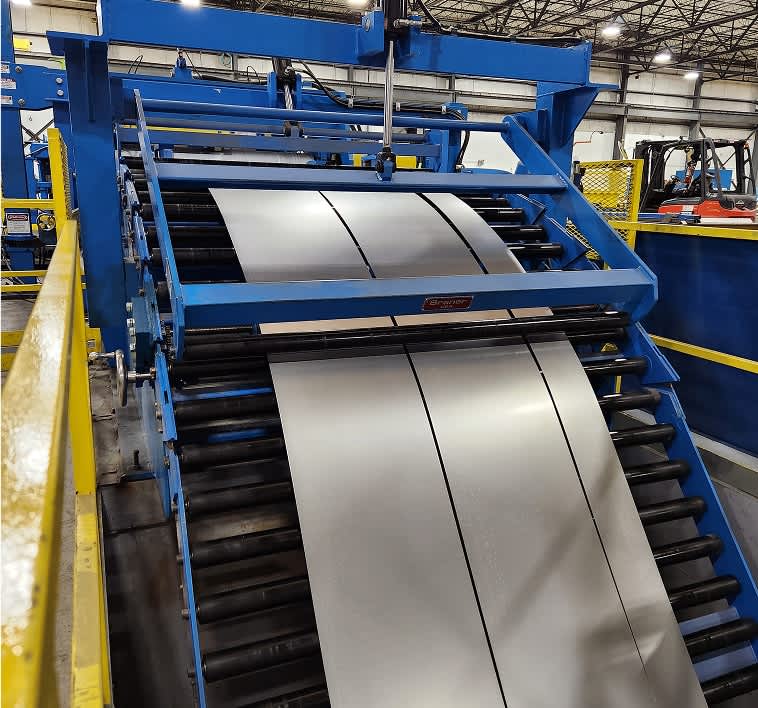
In coil processing, “high-speed” is defined differently depending on material thickness — a detail absent from most supplier comparison charts:
| Material thickness range | Typical processing speed range | Application context |
|---|---|---|
| 0.3 mm – 1.5 mm (thin gauge) | 150–250 m/min | Automotive body panels, electronics enclosures, appliance skins |
| 1.5 mm – 3.0 mm (light gauge) | 80–150 m/min | HVAC components, general fabrication, tube stock |
| 3.0 mm – 6.0 mm (medium gauge) | 30–80 m/min | Structural sections, heavy appliances, agricultural equipment |
| 6.0 mm – 12.0 mm (heavy gauge) | 10–30 m/min | Construction, heavy plate processing, industrial base stock |
The MaxDo MD series is rated 1–250 m/min across all four models. This speed range is physically limited by material thickness: thicker coil requires slower speed to maintain edge quality, dimensional tolerance, and consistent tension. A supplier claiming 250 m/min for 10 mm steel should be asked to substantiate that figure under production conditions.
The Speed–Precision–Tension Triangle
High-speed coil processing operates within a three-variable constraint that no single figure adequately captures:
1. Speed determines throughput and heat generation at the blade-material interface. Higher speed increases vibration amplitude and demands tighter dynamic damping throughout the machine frame.
2. Precision (slit width tolerance) degrades at higher speeds unless closed-loop servo positioning continuously corrects for blade deflection, bearing wear, and thermal expansion. MaxDo’s engineering documentation specifies ±0.1 mm slit width tolerance at speeds up to 200 m/min on the MD-2200 — a figure validated through deployment documentation published by MaxDoMachine.com, not a theoretical maximum.
3. Tension control holds the strip geometry stable between uncoiler and recoiler. In modern servo-controlled lines, entry section tension typically operates at 150–300 N/mm, processing-zone tension varies from 80–400 N/mm depending on material grade and thickness, and exit recoil tension is maintained at 60–150 N/mm. Maintaining these profiles dynamically — while speed ramps, material properties shift across a coil, and diameter changes continuously — is the central engineering challenge of high-speed slitting.
An effective slitting line must optimise all three simultaneously. A machine rated for 250 m/min that runs at 180 m/min in production because tension instability creates edge wave is not a 250 m/min machine for that material.
The Real Cost of Inadequate Tension Control
Raw material typically accounts for up to 75% of total production costs in metal processing operations (MaxDoMachine.com, Advanced Slitting Lines documentation). This single fact makes yield optimisation — not machine speed alone — the dominant return-on-investment driver.
Traditional slitting operations with manual tension control generate material loss across multiple mechanisms:
- Edge trim waste: Manual positioning requires conservative 10–15 mm margins per side to account for operator variability. On a 1,500 mm wide coil, this conservatism alone consumes 2–4% of available material width.
- Setup scrap: Each changeover generates test strips during manual blade adjustment. Multiple passes are required before achieving specification, particularly when transitioning between dissimilar materials.
- Quality rejects: Inconsistent tension creates edge wave that renders strips unsuitable for precision stamping. Worn blades produce burr conditions requiring secondary deburring or full material rejection.
- Coil-end losses: Poor recoil control during the final metres generates telescoped coils and loose outer wraps, especially damaging on high-value materials like stainless steel or aluminium alloy.
Modern servo-driven systems reduce total material loss to below 4% — versus a conventional baseline of 12–15% — by addressing each mechanism systematically. This 8–11 percentage-point yield improvement, applied to annual material spend, drives the financial case for capital investment.
MaxDo MD Series — Factory-Verified Specifications
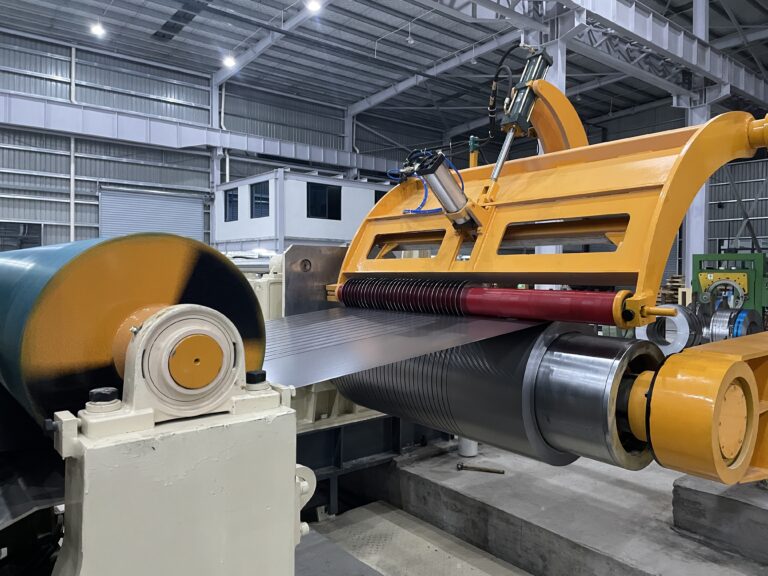
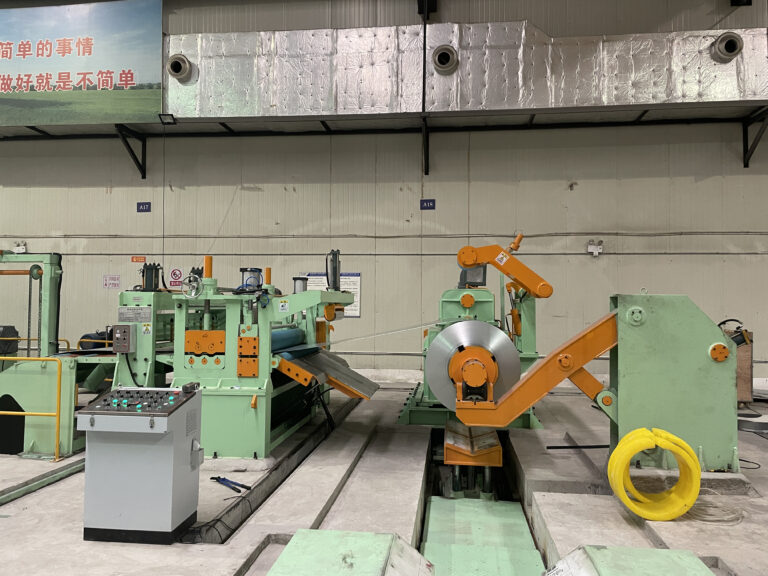
MaxDo (Foshan, Guangdong, China) manufactures high-speed metal slitting lines and cut-to-length processing equipment. The MD series currently comprises four models spanning compact strip processing to wide-format heavy industrial production. All specifications below are drawn from factory documentation files.
MD Series Full Specification Table
| Specification | MD-850 | MD-1350 | MD-1650 | MD-2200 |
|---|---|---|---|---|
| Working width range | 20–820 mm | 300–1,300 mm | 300–1,600 mm | 300–2,150 mm |
| Thickness: thin gauge | 0.3–3.0 mm | 0.3–3.0 mm | 0.3–3.0 mm | 0.3–3.0 mm |
| Thickness: light gauge | 1.5–6 mm | 1.5–6 mm | 1.5–6 mm | 1.5–6 mm |
| Thickness: medium gauge | 2–8 mm | 2–8 mm | 2–8 mm | 2–8 mm |
| Thickness: heavy gauge | 4–12 mm | 4–12 mm | 4–12 mm | 4–12 mm |
| Processing speed | 1–250 m/min* | 1–250 m/min* | 1–250 m/min* | 1–250 m/min* |
| Machine weight | 10–35 t (customisable) | 10–35 t (customisable) | 10–35 t (customisable) | 10–35 t (customisable) |
| Total installed power | ~138.5 kW | ~318.5 kW | ~422.5 kW | ~422.5 kW |
| Slit width tolerance | ±0.1 mm (verified at ≤200 m/min on MD-2200) | ±0.1 mm | ±0.1 mm | ±0.1 mm at 200 m/min |
| Material yield | 96%+ | 96%+ | 96%+ | 96%+ |
| Certification | ISO 9001 | ISO 9001 | ISO 9001 | ISO 9001 |
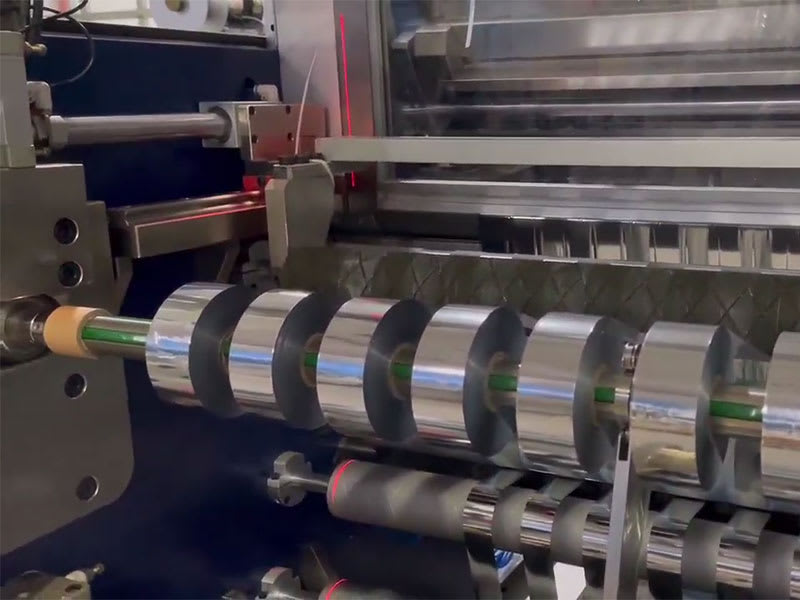
*Speed decreases with material thickness. 250 m/min applies to thin-gauge materials (0.3–1.5 mm). Actual production speed for each material configuration should be confirmed with MaxDo application engineering.
Compatible Materials
All MD series models support:
- Mild steel (MS) — including SPCC, SPCD, Q235, Q345
- Stainless steel (SS) — including 201, 304, 316 series
- Aluminium alloys — including 1xxx, 3xxx, 5xxx series
- Copper and copper alloys
Material-specific processing parameters (blade clearance, tension profile, speed limits) are stored in the onboard recipe management system.
Core Engineering Features
Servo-driven precision positioning: Blade positioning achieves ±0.02 mm repeatability across the full working width via closed-loop feedback. This eliminates the iterative test-cut cycles of manual systems.
Recipe-based changeover: The control system stores 500+ material-specification recipes. Changeover from one material specification to another is reduced from the 45–60 minutes typical of manual systems to 8–12 minutes for standard transitions — a verified figure from MaxDo’s deployment documentation.
Multi-zone tension control: PID algorithms continuously adjust tension actuators across entry, processing, and exit zones, compensating for speed changes, coil diameter variation, and material property shifts within a single coil.
Touchscreen PLC interface: Full digital parameter entry and status monitoring. No manual dial or mechanical adjustment required during production.
Automatic coil feeding and recoiling: Integrated material handling reduces floor labour and eliminates operator-introduced variability in coil entry and exit quality.
Blade-engagement millisecond control: Blade engagement timing is tuned at millisecond resolution to minimise shock loads, extend blade service life, and prevent edge micro-cracking on hardened materials.
Investment Range and Deployment Timeline
Based on MaxDo’s published engineering documentation:
- MD-850 system (entry configuration): from approximately USD 400,000
- MD-2200 fully automated configuration: USD 1,500,000+
- Installation and commissioning: typically adds 15–25% to equipment cost, depending on facility modifications required (electrical infrastructure, foundations, safety systems)
- Deployment timeline: 16–24 weeks from order to production-ready, varying with system complexity and facility readiness
- Ramp to full efficiency: 6–12 months post-installation to achieve optimised OEE
- Documented payback: under 18 months in case studies where MD series replaced manual or semi-automated slitting operations
These figures are sourced from MaxDo’s ROI documentation and represent scenarios where yield improvement was the primary value driver. Site-specific results depend on material mix, operating hours, and material cost.
📎 Related: MD-850 Product Page | MD-1350 Product Page | MD-1650 Product Page | MD-2200 Product Page
The Global Supplier Landscape — Categorised Accurately
The following section covers all ten suppliers originally referenced in this article. Each is categorised by actual product type, with its correct headquarters listed and a clear description of the market it serves. Direct benchmarking against MaxDo on slitting-line metrics is not applicable where product categories do not overlap.
#1 — MaxDo | Coil Slitting Lines & CTL Equipment
Headquarters: Foshan, Guangdong, China
Product category: High-speed metal slitting lines, cut-to-length lines, combined processing systems
Market served: Steel service centres, automotive stamping feedstock, appliance manufacturers, HVAC producers, precision strip processors globally
MaxDo is the only supplier in this list that manufactures coil slitting lines and CTL equipment as its core product. Full specifications are covered in Part 2. ISO 9001 certified.
📎 See also: Advanced Metal Slitting Lines: 96%+ Yield Guide | What Is the Cut-to-Length Process?
#2 — Schuler Group | High-Speed Stamping Presses
Headquarters: Göppingen, Baden-Württemberg, Germany
Product category: Mechanical and servo-electric stamping presses, transfer presses, die-cushion systems
Market served: Automotive body and structural components, coin and currency manufacturing, household appliances
Schuler is one of Europe’s largest press manufacturers. Its high-speed servo presses are used primarily for automotive body panel stamping and multi-die transfer operations. Schuler does not manufacture coil slitting lines or CTL equipment. Buyers needing feedstock preparation equipment (coil handling, straightening, feeding) for Schuler press lines typically source those sub-systems separately — from coil processing specialists.
Specifications for Schuler equipment should be sourced directly from Schuler Group (schulergroup.com). No Schuler specifications are reproduced here.
#3 — Aida Engineering | Stamping & Forging Presses
Headquarters: Sagamihara, Kanagawa, Japan (Note: Aida’s North American operations are based in Dayton, Ohio, USA — this is a regional subsidiary, not the corporate headquarters)
Product category: Mechanical presses, servo presses, transfer presses, forging presses
Market served: Automotive, electronics, precision metal components
Aida is a major Japanese press builder with a global installed base in automotive and precision stamping. Its servo press technology is widely adopted for complex forming operations requiring programmable ram motion profiles. Aida does not manufacture coil slitting lines. Coil processing equipment used alongside Aida presses (straighteners, feeders, reels) is typically third-party supplied.
Specifications for Aida equipment should be verified at aida-global.com.
#4 — Komatsu Industries | Hydraulic & Mechanical Stamping Presses
Headquarters: Komatsu City, Ishikawa Prefecture, Japan
Product category: Hydraulic presses, mechanical presses, servo presses, automation systems
Market served: Automotive, general metal fabrication, die casting post-processing
Komatsu Industries (not to be confused with Komatsu Ltd., the construction equipment company) is a specialised press manufacturer. Its product portfolio is focused on force-application processes — blanking, drawing, forming — not on coil slitting or continuous strip processing.
Specifications should be verified at komatsu-industries.co.jp.
#5 — Trumpf | Laser Cutting & Laser Processing Systems
Headquarters: Ditzingen, Baden-Württemberg, Germany
Product category: Fibre laser flatbed cutting, tube laser cutting, laser welding, bending (TruBend series), additive manufacturing
Market served: Sheet metal fabrication shops, automotive Tier 1/2, aerospace, medical devices, electronics enclosures
Trumpf is the world’s largest manufacturer of industrial laser cutting machines by revenue (as of most recent available reports — this figure requires verification against current Trumpf annual report). Its TruLaser series cuts flat sheet and tube; its TruBend series handles press braking. Trumpf does not manufacture coil slitting lines. A metal fabricator that buys pre-slit strip or sheet from a steel service centre to feed into a Trumpf laser cell is using products from two completely different supply chains.
Specifications should be verified at trumpf.com.
#6 — Amada | Laser Cutting, Punching & Bending
Headquarters: Isehara, Kanagawa, Japan
Product category: Fibre laser cutting, punch presses, press brakes, automation systems
Market served: Contract sheet metal fabrication, electronics enclosures, HVAC components, building products
Amada is one of the world’s largest sheet metal fabrication machine builders. It operates across the punch/laser/bend triad and has significant automation system capability for lights-out production. Amada does not manufacture coil slitting lines. It is a consumer of pre-processed slit strip and cut sheet, not a supplier of coil processing equipment.
Specifications should be verified at amada.com.
#7 — Bystronic | Laser Cutting & Bending
Headquarters: Niederönz, Canton of Bern, Switzerland
Product category: Fibre laser flatbed cutting, automated sorting, press brakes, software
Market served: General sheet metal fabrication, architectural metalwork, automotive subcontractors
Bystronic competes primarily in the precision laser cutting and bending segment. Its ByStar Fiber series is a widely referenced benchmark for fibre laser performance in the 3–30 kW power range. Bystronic does not manufacture coil processing equipment.
Specifications should be verified at bystronic.com.
#8 — Salvagnini | Flexible Panel Manufacturing Systems
Headquarters: Sarego, Province of Vicenza, Italy
Product category: Panel benders, punching systems, fibre laser flatbed cutting, integrated flexible manufacturing cells
Market served: Enclosure and cabinet manufacturers, HVAC, elevators, automotive subcontractors
Salvagnini’s P-series panel benders are used in high-volume enclosure production and represent a distinct technology from press braking. Salvagnini does not manufacture coil slitting lines. Its systems process pre-cut flat sheet.
Specifications should be verified at salvagnini.com.
#9 — Prima Power | Laser, Punch & Bending Systems
Headquarters: Collegno, Turin, Italy (Prima Industrie Group)
Product category: Fibre laser cutting, punch-laser combination machines, press brakes, automated cells
Market served: Sheet metal fabrication, automotive, aerospace, energy
Prima Power is part of the Prima Industrie Group and offers an integrated range of sheet metal processing machines. Its Laser Genius+ series and punch-laser combination systems compete with Trumpf and Amada in precision sheet processing. Prima Power does not manufacture coil slitting lines or CTL equipment.
Specifications should be verified at primapower.com.
#10 — LVD | Laser Cutting, Punching & Press Brakes
Headquarters: Gullegem, West Flanders, Belgium
Product category: Fibre laser cutting, punch presses, press brakes, automated bending cells, software (CADMAN suite)
Market served: General fabrication, energy, rail, automotive subcontractors
LVD is a Belgian machine tool manufacturer with particular strength in automation integration for bending cells. Its CADMAN software suite provides parametric bend programming and production management. LVD does not manufacture coil slitting lines.
Specifications should be verified at lvdgroup.com.
Category Summary: What Buyers Should Take From This
| Supplier | Actual product category | Competes with MaxDo in slitting/CTL? |
|---|---|---|
| MaxDo | Coil slitting lines, CTL lines | — (reference supplier) |
| Schuler | Stamping presses | No |
| Aida Engineering | Stamping / forging presses | No |
| Komatsu Industries | Hydraulic / mechanical presses | No |
| Trumpf | Fibre laser cutting, bending | No |
| Amada | Laser, punching, bending | No |
| Bystronic | Fibre laser cutting, bending | No |
| Salvagnini | Panel bending, punching, laser | No |
| Prima Power | Laser, punch-laser, bending | No |
| LVD | Laser, punching, press brakes | No |
None of the nine non-MaxDo suppliers in this list manufacture high-speed coil slitting lines or CTL equipment. A buyer sourcing coil processing equipment should evaluate MaxDo and other coil processing specialists directly — not laser cutting or stamping press manufacturers. If you need slitting line competitors to MaxDo for comparative tendering, contact MaxDo’s sales team to request a competitive evaluation framework, or search specifically for “coil slitting line manufacturers” and “cut-to-length line suppliers” in your target region.
How to Evaluate a High-Speed Slitting Line or CTL Supplier
Whether evaluating MaxDo or any alternative, the following ten-point framework covers the technical and commercial dimensions that determine whether a supplier can actually deliver on speed, yield, and precision claims.
10-Point Supplier Evaluation Checklist
1. Speed claims — ask for material-specific test data, not nameplate ratings
Maximum rated speed is meaningless without knowing the material grade, thickness, and width at which it was measured. Request processing speed specifications for the specific material configuration you will run most frequently.
2. Tolerance verification — specify the measurement method
±0.1 mm under what conditions? At what speed, on what material, measured how (manual gauge, laser micrometer, statistical sample)? Reputable suppliers provide validated tolerance data from production deployments, not theoretical calculations.
3. Tension control architecture — servo or hydraulic?
Servo-electric systems offer precise, repeatable tension profiling with faster response times. Hydraulic systems are more common in heavy-gauge applications but offer less precision at thin-gauge speeds. Ask for the control architecture and PID response specifications.
4. Changeover time — test with your material mix
Published changeover times should be verified with your specific product mix. A supplier claiming 8–12 minute changeovers on a standard carbon steel–to–stainless transition should demonstrate that on materials representative of your production schedule.
5. Recipe management capacity and flexibility
How many recipes can the system store? Can recipes be imported/exported programmatically? Does the system log actual vs. programmed parameters for each run? This determines how the machine integrates with your ERP and quality management systems.
6. Yield loss documentation — not marketing claims
Ask for documented yield improvement data from comparable installations. What was the baseline yield, what was achieved after stabilisation, and over what time period? Verified yield data (not “up to” claims) is the most reliable predictor of ROI.
7. After-sales support infrastructure
What is the supplier’s service response time in your region? Is there a local parts inventory? Are remote diagnostic and firmware update capabilities included? For a machine accounting for a significant share of production throughput, support response time is a financial variable.
8. Blade and consumable supply chain
What is the blade service interval for your material configuration? What is the cost per kilometre processed? Is the supplier the sole source for blades, or can you qualify alternatives? Consumable costs are often underestimated in TCO analysis.
9. Installation and commissioning scope
What does the quoted price include? Foundation requirements, electrical installation, operator training, commissioning to specification — these add 15–25% to equipment cost and should be scoped explicitly before contract signature.
10. Financial references and reference site visits
Request contact with three current customers running comparable material specifications at comparable volumes. A site visit to a reference installation is the most reliable evaluation tool available.
Red Flags in Supplier Evaluation
- Speed claims without material-specific context
- Precision claims without measurement method disclosure
- Yield claims prefaced with “up to” without baseline documentation
- Comparison tables that benchmark slitting lines against stamping presses or laser cutters
- Founding year or certification claims with internal “requires verification” notes
- Comparison data (OEE, uptime %) that contradicts the supplier’s own product specification sheets
Application-Specific Guidance
Automotive Supply Chain
Automotive applications demand the most stringent combination of speed, precision, and surface quality. Typical requirements for automotive strip feedstock:
- Slit width tolerance: ±0.1 mm maximum, with many tier-1 stampers specifying ±0.05 mm
- Edge burr height: below 10% of material thickness
- Surface: no oil contamination from cooling systems, no handling marks
- Traceability: coil ID linked to heat/lot number throughout processing
The MD-2200 is sized for the 300–2,150 mm width range that covers the majority of automotive body panel feedstock widths. Its verified ±0.1 mm tolerance at 200 m/min addresses standard automotive specifications.
📎 Related: Metal Slitting vs. Cut-to-Length Lines: Equipment Selection Guide
Steel Service Centres
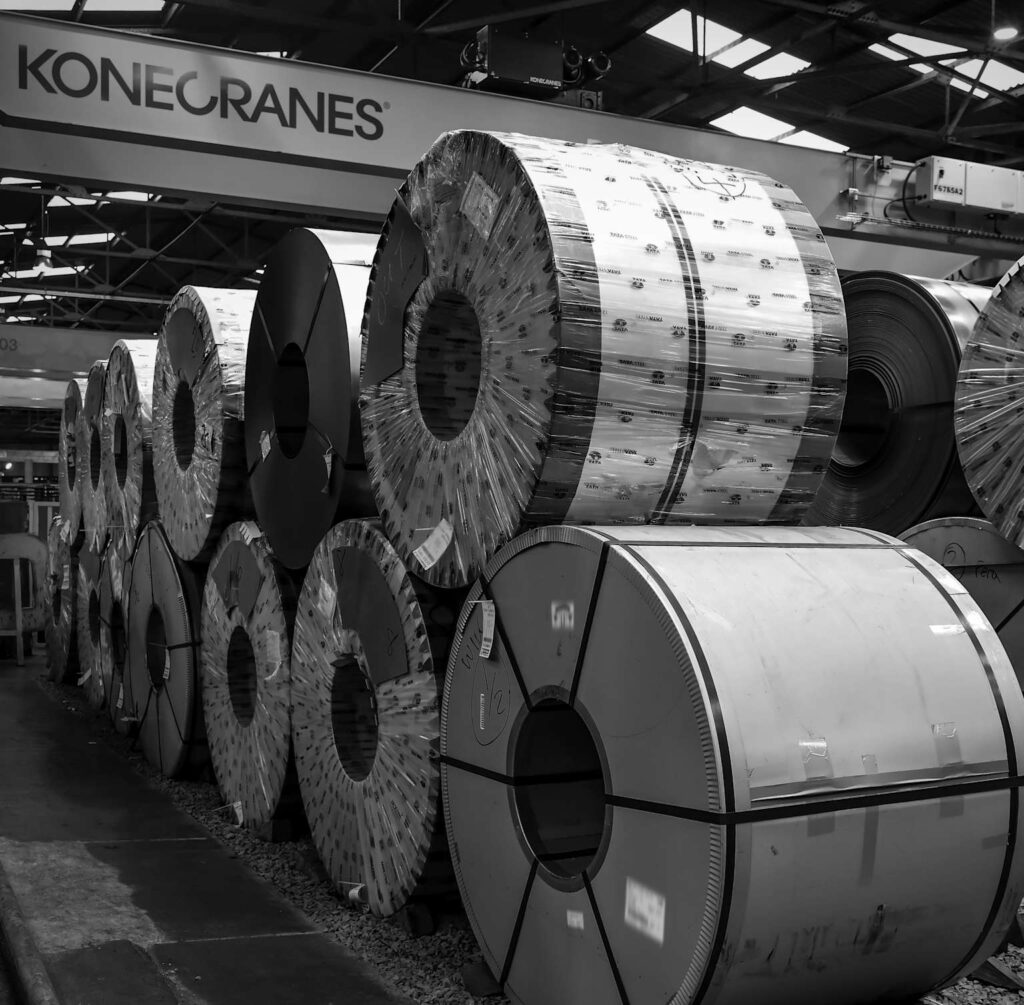
Service centre operations require maximum changeover agility — the ability to process dozens of material specifications across a single shift with minimal setup loss. Key requirements:
- Recipe-based changeover under 15 minutes for standard transitions
- Mixed material capability (MS, SS, aluminium) without blade system changes
- Coil weight flexibility up to machine capacity
- Yield tracking per coil for customer reporting and internal cost accounting
The 500+ recipe capacity in MaxDo’s control system and the 8–12 minute standard changeover time directly address service centre economics.
HVAC & Construction Products
HVAC and light construction applications typically process coil in the 0.3–2.0 mm range with less stringent tolerance requirements than automotive, but with high volume and thin margins. Speed and yield are the primary drivers:
- Material: galvanised steel, aluminium, pre-painted steel
- Width range: typically 80–1,500 mm depending on product
- Tolerance: ±0.2–0.5 mm typically acceptable
- Throughput: maximising m/min within tolerance envelope
The MD-850 (20–820 mm) and MD-1350 (300–1,300 mm) are well-matched for HVAC strip processing. The power-to-width ratio of the MD-850 (~138.5 kW for widths up to 820 mm) makes it energy-efficient for high-volume narrow-strip applications.
📎 Related: Sheet Metal Coil Processing: Material Types & Applications
Electronics & Precision Components
Electronics strip processing requires:
- Very tight tolerances (±0.1 mm or better) on small widths
- Surface-critical handling (no scratching of copper, aluminium, or coated materials)
- Compatibility with thin-gauge, soft materials (copper strip down to 0.3 mm)
- Clean-room-adjacent operating environment in some facilities
The MD-850’s 20 mm minimum working width covers narrow copper strip applications. Surface protection measures (felt guides, tension-controlled soft handling) should be discussed with MaxDo application engineering for critical surface specifications.
Investment Framework & Total Cost of Ownership
Capital Cost Structure
MaxDo published investment ranges based on system configuration:
| Configuration | Approximate capital cost (USD) |
|---|---|
| MD-850 entry system | From ~$400,000 |
| MD-1350 production system | Range to be confirmed with MaxDo application engineering |
| MD-1650 heavy industrial | Range to be confirmed with MaxDo application engineering |
| MD-2200 full automation | $1,500,000+ |
| Installation & commissioning | +15–25% of equipment cost |
Note: Pricing varies with automation level, material handling options, and facility requirements. The ranges above are published reference figures; contact MaxDo for configuration-specific quotes.
Operating Cost Factors
Energy: Servo-electric drive systems typically consume 20–30% less energy per unit processed than hydraulic-drive predecessors (MaxDo engineering documentation). At 422.5 kW total installed power (MD-1650 / MD-2200), actual consumption varies with load factor and speed profile.
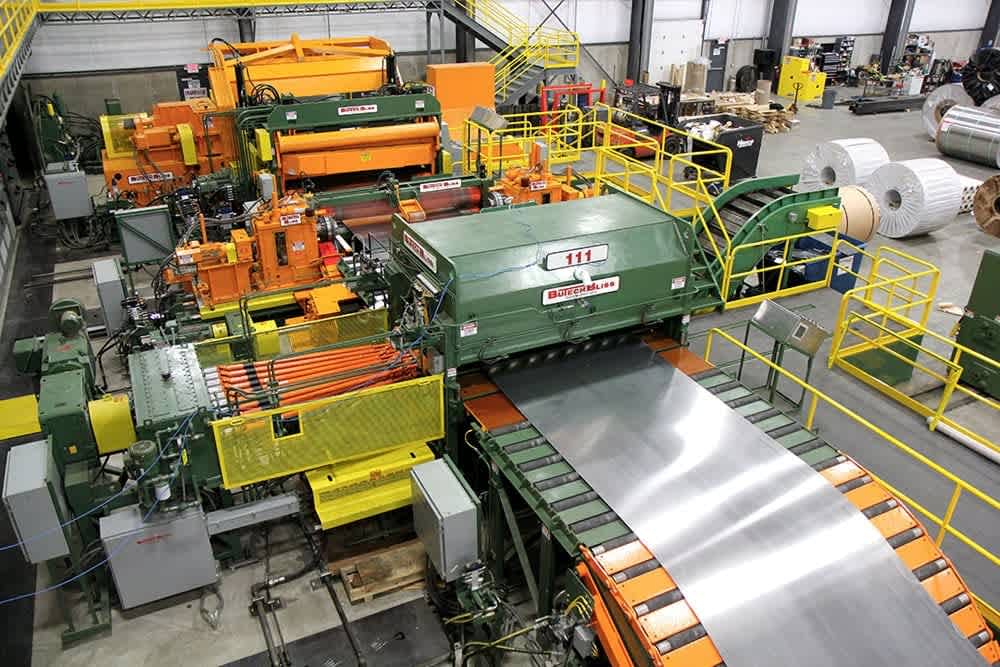
Blades and consumables: Blade service interval depends on material grade, thickness, and cutting clearance. Proper clearance maintenance (5–8% of material thickness for steel, 3–5% for aluminium) maximises blade life. MaxDo’s recipe management includes automatic position correction for blade wear, extending effective service intervals.
Labour: Recipe-based automation reduces direct operator skill requirements for changeover. MaxDo’s documented changeover reduction (45–60 minutes manual → 8–12 minutes automated) translates directly to operator capacity and shift throughput.
Maintenance: MaxDo’s documentation notes predictive maintenance monitoring of wear patterns to optimise service scheduling and reduce unplanned downtime. Specific MTBF (mean time between failure) and MTTR (mean time to repair) data should be requested from MaxDo for the configuration and material mix under evaluation.
Financial Case Building
The primary ROI driver is material yield improvement. A simplified calculation framework:
- Measure current yield loss rate across all waste streams (trim, setup, quality, coil-end)
- Apply the potential improvement to annual material spend (raw material is typically 75% of production cost)
- Add labour savings from changeover reduction
- Subtract annual capital servicing cost (amortisation + interest) and operating cost increase/decrease
- Calculate payback period
MaxDo’s documentation cites payback under 18 months in installations where manual or semi-automated slitting was replaced by MD series equipment. This requires verification against your specific material mix, operating hours, and material cost per tonne.
📎 Related: Advanced Metal Slitting Lines: 96%+ Yield & Complete ROI Guide
Frequently Asked Questions
Q: What is the difference between a slitting line and a cut-to-length (CTL) line?
A slitting line processes a master coil by cutting it longitudinally into narrower strips, which are then recoiled. A CTL line uncoils sheet and cuts it transversally into flat blanks of a specified length. MaxDo manufactures both; some facilities run combined slitting/CTL lines to handle both processes on a single line. See: What Is the Cut-to-Length Process?
Q: How does material thickness affect maximum processing speed on the MD series?
All four MD models are rated 1–250 m/min, but this range is material-dependent. 250 m/min applies to thin-gauge materials (approximately 0.3–1.5 mm). As material thickness increases, the maximum safe processing speed decreases to maintain edge quality and dimensional tolerance. For heavy-gauge configurations (4–12 mm), practical production speeds are substantially lower. Request application-specific speed guidance from MaxDo engineering for your target material mix.
Q: Can the MD series process stainless steel and aluminium on the same line?
Yes. All MD models are compatible with mild steel, stainless steel, aluminium alloys, and copper. Blade clearance, tension profiles, and speed parameters differ by material and are managed via the recipe management system. Blade configuration may need adjustment when transitioning between steel and aluminium; this is covered in operator training.
Q: What is the minimum slit width the MD-850 can achieve?
The MD-850 has a minimum working width of 20 mm. This makes it suitable for narrow copper strip and precision electronics strip applications. Achievable slit width at this minimum dimension should be confirmed with MaxDo application engineering, as blade arbour configuration and material properties affect the practical limit.
Q: How long does installation and commissioning take?
MaxDo’s documentation cites 16–24 weeks from order to production-ready, depending on system complexity and facility readiness. Full operational efficiency is typically achieved within 6–12 months post-installation as operators build proficiency with recipe management and the control system.
Q: Is MaxDo ISO 9001 certified?
Yes. MaxDo operates under ISO 9001 quality management system certification.
Q: Does MaxDo provide after-sales support outside China?
MaxDo’s documentation references 24/7 technical support. Specific after-sales infrastructure by region (local service engineers, parts warehousing) should be confirmed directly with MaxDo for your operating location.
Q: What warranty terms apply to the MD series?
Warranty terms should be confirmed in your purchase agreement with MaxDo. This article does not reproduce warranty terms as they may vary by configuration and market.
Making the Sourcing Decision
For a buyer specifically evaluating high-speed metal slitting lines or cut-to-length equipment, the key decision variables are:
- Working width required — This is the primary model selector. MD-850 (up to 820 mm), MD-1350 (up to 1,300 mm), MD-1650 (up to 1,600 mm), MD-2200 (up to 2,150 mm).
- Material thickness range — Determines blade configuration, tension control requirements, and realistic production speed.
- Precision requirements — ±0.1 mm at speed is achievable on MaxDo MD series; tighter automotive tolerances should be discussed with application engineering.
- Changeover frequency — High changeover frequency favours investment in recipe-based automation. Low changeover, single-material production may have different optimisation priorities.
- Capital budget and financing — Equipment cost from ~$400,000 (MD-850) to $1,500,000+ (MD-2200 full automation), plus 15–25% for installation.
- After-sales support requirements — Evaluate MaxDo’s support infrastructure for your operating location before contract.
If your requirement is not a slitting line or CTL line — if you need a stamping press, a laser cutter, a press brake, or a panel bender — none of the nine other suppliers listed in this guide are MaxDo competitors. They are leading manufacturers in their respective categories and should be evaluated against specialists in those categories.
Related Resources on MaxDoMachine.com
Advanced Metal Slitting Lines: 96%+ Yield & Complete ROI Guide
Metal Slitting vs. Cut-to-Length Lines: ROI-Focused Equipment Selection Guide
What Is the Cut-to-Length Process? Complete Guide
Ultimate Guide to Metal Slitting Lines
Slitting vs. Blanking vs. CTL Lines: Complete Equipment Selection Guide
Sheet Metal Coil Processing: Material Types & Applications