Top 10 Export-Oriented Metal Processing Equipment Manufacturers (2026 Guide)
The challenge extends far beyond creating superior equipment to encompass designing systems that can function reliably in environments that may differ dramatically from their country of origin.
Most equipment buyers evaluate export manufacturers on price and brochure specs. The ones who get burned do exactly that.
An export-oriented manufacturer operates across 40 or more regulatory frameworks, services equipment in climates ranging from -40°C to +55°C, and supports operators whose technical training ranges from master-certified engineers to first-week trainees. The price on the quotation covers none of that complexity.
This guide is for production managers, plant engineers, and procurement specialists evaluating metal processing equipment from global suppliers. It covers what separates genuinely export-capable manufacturers from those with an international sales page, how to use regional supplier strengths to your advantage, and a practical procurement framework for cross-border capital equipment decisions.
The global sheet metal processing equipment market reached $35.51 billion in 2025, projected to grow to $37.76 billion in 2026 at a 9.1% CAGR, with Asia Pacific holding 51.7% of global demand. Understanding where your supplier sits in that ecosystem — and whether their export infrastructure matches their export claims — determines whether your installation succeeds or becomes a support nightmare.
The Engineering Challenges That Separate Real Exporters from Paper Exporters
Environmental Adaptation: Where Most Manufacturers Fail
Equipment designed for a climate-controlled European factory does not automatically perform in a tropical service center or a desert processing facility. Export-capable manufacturers engineer this difference in from the specification stage — not as an afterthought.
Electrical systems must handle power quality variations from ±1% (developed grid infrastructure) to ±15% (developing market infrastructure). Mechanical systems must maintain dimensional tolerance at ambient temperatures that can span 70°C between the coldest and warmest installation sites in a single global fleet.
Humidity in tropical installations accelerates corrosion in electrical enclosures and causes condensation failures in control panels. The solution is not a generic “tropical option” checkbox — it requires IP65 or higher-rated enclosures, dehumidifier circuits, conformal coated PCBs, and stainless steel fasteners in corrosion-exposed zones. Conversely, cold-climate installations require low-temperature lubricants rated to -30°C or lower, heating elements for hydraulic circuits, and ductile cast grades that do not embrittle below -20°C.
Pro tip: When evaluating an export supplier’s environmental capability, ask for a list of their five most extreme climate installations — location, ambient temperature range, and uptime record. A manufacturer who cannot answer this has either no such installations or no system for tracking them.
Dust contamination is the other major differentiator. Desert installations face sand infiltration that destroys standard bearing seals within months. Coastal installations require salt-spray-resistant surface treatments. Equipment that operates in both contexts within a single fleet needs modular sealing and filtration configurations, not one-size fits all.
Regulatory Compliance: The Certification Maze
International equipment sales require simultaneous compliance with multiple, often conflicting, regulatory frameworks. CE marking for European markets, UL certification for North America, and CCC certification for China each impose different requirements on electrical systems, guarding, emergency stops, and documentation packages.
CE marking under the Machinery Directive 2006/42/EC requires a full technical file, declaration of conformity, and compliance with EN ISO 13849 for safety-related control functions. UL certification requires independent laboratory testing and ongoing factory audits. These are not interchangeable — a CE-marked machine is not automatically UL-compliant.
Common mistake: Accepting a supplier’s claim that their equipment “meets CE standards” without requesting the actual Declaration of Conformity document listing the specific directives and harmonized standards applied. The declaration must name the specific Annex and notified body (if applicable) — a generic letter from the factory is not compliance documentation.
Safety control systems referenced to ISO 13849-1:2015 (machinery safety — safety-related parts of control systems) must demonstrate a documented Performance Level (PLa through PLe) for each safety function. Ask for the safety function documentation, not just the certificate.
Material Compatibility Across Supply Chains
Global equipment deployment requires accommodation of material variations that affect processing parameters. Steel grades standard in one region may be unavailable or inconsistently specified in another. EN 10130 DC01 cold-rolled steel from a European mill and Q/BQB 403 equivalent from a Chinese mill carry nominally identical designations but can vary in yield strength, surface condition, and coil set that affect slitting width tolerance and cut-to-length flatness.
Export-capable equipment must carry sufficient parameter flexibility — broader operating ranges, servo-driven rather than fixed-ratio drives, adjustable blade clearance systems — to handle this variation while holding specified tolerances.
Pro tip: For slitting line procurement, always specify the hardest and highest-tensile material in your planned mix when sizing the machine — not your average material. An MD-1350 slitting line handles AHSS grades up to 980 MPa with upgraded carbide-tipped slitting blades (specify at order). Running a lighter-rated machine at its limit on every coil of hard material accelerates blade and bearing wear 3–4× compared to a properly sized machine.
How to Evaluate Export Manufacturer Capabilities: A Practical Framework
Before reviewing individual manufacturers, use this evaluation matrix to score any candidate supplier consistently.
Use this matrix to compare candidates on the factors that actually predict post-installation success.
| Evaluation Factor | What to Verify | Red Flags |
|---|---|---|
| Local service infrastructure | Named technicians + response time SLA in your country/region | “We have partners in your region” with no named contacts |
| Compliance documentation | Actual DoC with directive + standard numbers | Generic “CE certified” letters |
| Reference installations | Contact details for 2+ customers in your climate zone | References only in the manufacturer’s home country |
| Spare parts lead time | Committed lead time for top 20 consumable items | “Parts available on request” |
| Control system support | Named PLC/HMI brand (Siemens, Allen-Bradley, etc.) | Proprietary black-box controls |
| Financial stability | Years in operation, ownership structure | < 5 years in export markets |
| Environmental capability | Named IP rating for enclosures; documented climate range | No climate-specific options in catalog |
| Training program | Curriculum outline, language support, on-site hours | “We provide training” with no detail |
The True Cost Structure of Cross-Border Equipment
Import duties, local compliance testing, and certification costs typically add 10–25% to the equipment cost depending on destination market and equipment classification. For HS Code 8462 (metal-working press machines) and related chapter 84 machinery, tariff rates vary from 0% (many ASEAN-EU FTA pairs) to 12% (selected India MFN rates for specific machinery categories).
Installation and commissioning for international projects routinely runs 15–25% over domestic project timelines due to communication lag, regulatory inspection scheduling, and unfamiliarity with local site practices. Factor this into project cash flow — payment milestone structures that front-load payments to the manufacturer before commissioning completion create leverage imbalances.
Top 10 Export-Oriented Metal Processing Equipment Manufacturers (2026)
The manufacturers below represent the leading global exporters across the spectrum of metal processing equipment — from coil slitting and cut-to-length lines to stamping press systems, laser cutting, and flexible fabrication cells. Rankings reflect breadth of export capability, global service infrastructure, and verified market presence rather than fabricated revenue figures.
MaxDo Machine (Foshan MaxDo Supply Chain Mgmt Co., Ltd.)
Headquarters: Foshan City, Guangdong Province, China
Founded: 20+ years in coil processing equipment manufacturing
CE Marking: Yes | ISO 9001:2015: Yes | Patents: 25+
Specialization: Metal coil slitting lines, cut-to-length lines, coil processing systems
Export Focus: Global, with established presence in Southeast Asia, Middle East, Latin America, Africa, and Europe
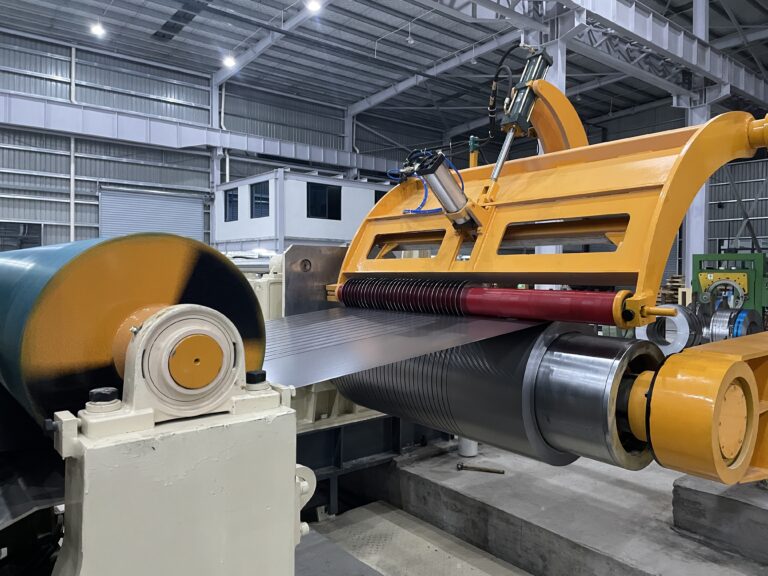
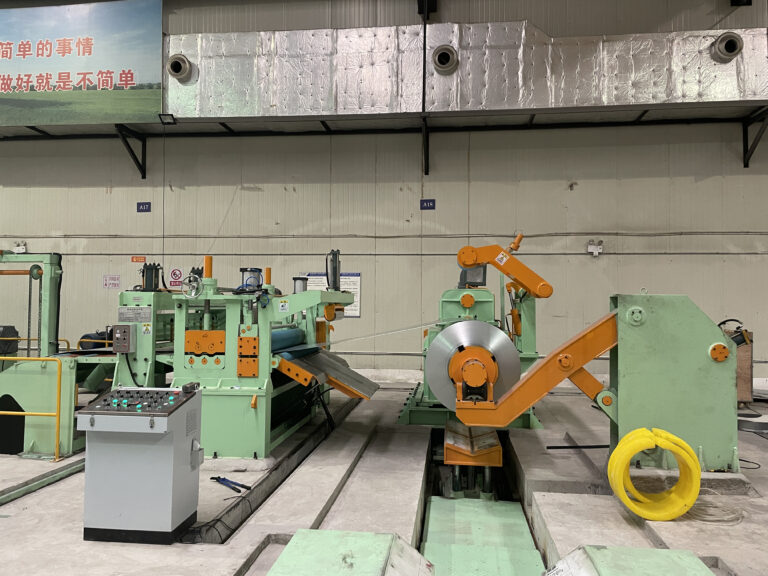
MaxDo is a coil processing equipment specialist — not a general-purpose fabrication machine builder. That distinction matters when you are evaluating suppliers for a slitting line or cut-to-length line installation. MaxDo’s entire product range, service capability, and application engineering expertise is focused on coil processing, which translates into depth of knowledge that generalist manufacturers rarely match in this specific category.
The MD Series slitting lines cover the full gauge spectrum from 0.3 mm to 25 mm across four models. The MA Series cut-to-length lines mirror that range with sheet length capability from 500 mm to 12,000 mm. All models are CE marked and manufactured under ISO 9001:2015.
MD Series Capability Matrix

Verified against MaxDo product documentation, March 2026. Confirm current specs on individual product pages before specifying.
| Model | Gauge Range (mm) | Max Width (mm) | Max Coil Weight (t) | Max Speed (m/min) | Width Tolerance |
|---|---|---|---|---|---|
| MD-850 | 0.3 – 3.0 | 850 | 10 | 120 | ±0.1 mm |
| MD-1350 | 0.5 – 6.0 | 1,350 | 20 | 100 | ±0.1 mm |
| MD-1650 | 1.0 – 12.0 | 1,650 | 35 | 80 | ±0.1 mm |
| MD-2200 | 3.0 – 25.0 | 2,200 | 60 | 60 | ±0.1 mm |
All MD Series lines feature Siemens PLC control (S7 on MD-1650 and MD-2200), AC servo drives, automatic blade gap adjustment, and closed-loop servo tension control. The MD-1650’s loop control system eliminates the strip sag and edge wave common in tension-stand designs — a measurable quality difference when processing wide-flange structural steel or AHSS above 800 MPa.
For operations requiring both precise strip widths and precise blank lengths, the two-stage approach — MD Series slitting line followed by MA Series CTL line — is common in automotive stamping plants. → See: metal slitting vs. cut-to-length lines for a full comparison of when each process applies.
Export Infrastructure:
- On-site installation and commissioning teams
- Technical training programs adapted to local operator skill levels
- Remote diagnostic support via OPC-UA connected HMI (MD-1650, MD-2200)
- Local partnership networks in Southeast Asia, Middle East, and Africa
- Spare parts inventory with international logistics coordination
Export Project Reference: Philippine Steel Service Center
Note: This project data is provided by MaxDo and has not been independently verified by a third party.
A Philippine steel service center required slitting capability to process imported carbon steel coils for local distribution, with the constraint of an unstable regional power supply (±10% voltage variation) and limited on-site technical support capacity.
MaxDo supplied a standard slitting line with integrated voltage regulation, simplified Siemens PLC controls configured for the local operator skill profile, and a spare parts package stocked with items locally sourceable in Manila. Training was conducted in Tagalog with MaxDo technicians on-site for commissioning plus a structured 30-day handover period.
Reported outcomes after 30 months: 81% equipment availability with basic preventive maintenance, local operators qualified for routine operation and first-level fault diagnosis, and throughput adequate for regional market requirements.
→ Download MaxDo E-Catalog for full technical specifications across all product lines.
→ Use the slitting line ROI calculator to model payback on coil processing investment.
Schuler Group (Germany)
Headquarters: Göppingen, Germany
Specialization: Large-scale forming systems, automotive press lines, automation
Global Presence: Operations in 40+ countries
Schuler is the reference standard for high-tonnage automotive press systems. Their export strength lies in complete turnkey press lines for automotive body and structural components — operations where forming force, precision, and 20-year reliability define the purchase decision rather than price. EV platform tooling changeovers and e-mobility structural components are primary 2026 growth drivers per Schuler’s stated strategy.
Key Export Capabilities: Automotive press systems | Aerospace forming equipment | Complete production lines | Servo-press technology | Lifecycle service contracts
Komatsu Industries (Japan)
Headquarters: Tokyo, Japan
Specialization: Precision press machinery, servo-mechanical presses
Global Presence: Strong in Asia-Pacific and Americas
Komatsu Industries (the industrial machinery division, distinct from the construction equipment group) specializes in servo-mechanical press systems with high-precision stroke control. Their export strength in Asia-Pacific leverages established distribution infrastructure and deep application expertise in electronics and precision component stamping.
Key Export Capabilities: Servo-mechanical press systems | High-precision stamping | Automation integration | Quality control systems | Technical training programs
Salvagnini Group (Italy)
Headquarters: Sarego, Italy
Specialization: Flexible manufacturing systems, panel benders, punching-laser combinators
Global Presence: Direct sales in 80+ countries
Salvagnini’s differentiation is flexible manufacturing cell architecture — systems that can change from one sheet metal part family to another with zero tooling changeover time. Their panel bender technology, which forms sheet metal flanges through a fully automated bending process without repositioning, has no direct equivalent in the market. This makes them the default evaluation for job shops and contract manufacturers processing high-mix, low-to-medium volume sheet metal.
Key Export Capabilities: Panel benders | Punching-laser combination machines | Automated storage and retrieval | Manufacturing execution software | Global technical support
TRUMPF Group (Germany)
Headquarters: Ditzingen, Germany
Specialization: Laser technology, machine tools, electronics for manufacturing
Verified Revenue: €4.3 billion total revenue FY2024/25 (TRUMPF press release, October 2025)
Global Presence: Subsidiaries in 70+ countries
TRUMPF is the global leader in industrial laser systems by revenue. Their TruLaser range sets the performance benchmark for sheet metal laser cutting — 2D cutting machines, tube cutting systems, and laser welding cells. FY2024/25 saw revenue decline 16% to €4.3 billion due to automotive sector softness in Germany, China, and the US, with management expressing cautious optimism for FY2025/26 recovery. This market context matters for buyers: TRUMPF’s current order intake environment creates negotiating opportunities on delivery schedules and pricing that did not exist in 2022–2023.
Key Export Capabilities: TruLaser cutting and welding systems | TruPunch punching machines | Automation cells | TruConnect digital manufacturing | Global service and spare parts network
Amada Holdings (Japan)
Headquarters: Kanagawa, Japan
Specialization: Sheet metal fabrication equipment — punching, laser, bending
Global Presence: Operations in 100+ countries
Amada’s breadth of market coverage (100+ countries with direct operations) makes them the most globally distributed sheet metal fabrication equipment manufacturer. Their comprehensive product range — turret punch presses, fiber laser cutting systems, press brake equipment, and factory automation — means buyers can consolidate multiple process steps with a single supplier relationship and integrated software stack. This is a significant total-cost-of-ownership advantage for multi-machine installations.
Key Export Capabilities: Turret punch presses | Fiber laser cutting | Press brakes | Automation solutions | AMNC control system integration | Technical support and training
Prima Power (Finland/Italy)
Headquarters: Seinäjoki, Finland (operations in Italy)
Specialization: Sheet metal processing — laser, punching, combination machines, night train automation
Global Presence: Direct presence in 50+ countries
Prima Power’s strength is systems integration — their Night Train FMS (Flexible Manufacturing System) connects punching, laser, and bending cells with automated material handling and sequencing software. This makes them the evaluation leader for manufacturers targeting lights-out or near-lights-out sheet metal processing capability.
Key Export Capabilities: Laser cutting systems | Punching machines | Combination punch-laser | Night Train FMS | Automation and software integration
Bystronic Group (Switzerland)
Headquarters: Niederönz, Switzerland
Specialization: Laser cutting, press brake systems, automation software
Global Presence: Operations in 30+ countries
Bystronic’s focus is precision laser cutting and bending with an emphasis on workflow software integration. Their BySoft suite connects CAD/CAM programming, nesting, and machine control in a unified environment. For buyers who weight software integration and programming efficiency as procurement factors — common in contract manufacturing and prototyping environments — Bystronic’s ecosystem approach justifies premium pricing.
Key Export Capabilities: ByStar Fiber laser cutting | Xpert Pro press brake | ByVision software suite | Automation cells | Global service network
LVD Group (Belgium)
Headquarters: Gullegem, Belgium
Specialization: Sheet metalworking — press brakes, laser cutting, punching
Global Presence: Direct sales in 45+ countries
LVD is a strong value proposition in press brake and laser cutting equipment for European and export markets. Their CADMAN software platform provides integrated CAD/CAM with adaptive bending technology (Easy-Form Laser angle measurement) that compensates for material springback in real time — a genuine technical advantage for operations processing varied steel grades or high-springback materials like AHSS.
Key Export Capabilities: Press brake systems with adaptive bending | Laser cutting | Punching machines | CADMAN software integration | Technical training programs
Mazak Corporation (Japan)
Headquarters: Nagoya, Japan (Yamazaki Mazak Corporation)
Specialization: CNC machine tools, multi-tasking manufacturing systems
Global Presence: Operations in 50+ countries
Mazak is the world’s largest privately held machine tool manufacturer by production volume. Their export strength lies in CNC turning, milling, and multi-tasking machine tools rather than coil processing or sheet metal fabrication — making them the appropriate evaluation for prismatic part manufacturers, not service center slitting or blanking operations. Their MAZATROL CNC and Smooth Technology suite address the Industry 4.0 in metal processing integration requirements of connected factory environments.
Key Export Capabilities: CNC turning and milling centers | Multi-tasking machines | MAZATROL Smooth CNC | Automation solutions | MTConnect-compatible monitoring
Equipment Selection Framework: Matching Manufacturer to Application
The ten manufacturers above cover different segments of the metal processing equipment market. Using the wrong manufacturer category is a more common mistake than selecting the wrong model within a category.
Use this decision matrix before shortlisting manufacturers.
| Your Primary Process | Equipment Category | Primary Manufacturer Candidates |
|---|---|---|
| Coil slitting (strip production) | Slitting lines | MaxDo (MD Series), specialist slitting line manufacturers |
| Coil to flat sheet (blanking) | Cut-to-length lines | MaxDo (MA Series), specialist CTL manufacturers |
| High-tonnage forming / stamping | Press systems | Schuler, Komatsu Industries, Aida |
| Laser cutting (sheet) | Laser cutting machines | TRUMPF, Amada, Bystronic, Prima Power |
| Flexible sheet fabrication | Punching / combination | Salvagnini, Amada, LVD, Bystronic |
| CNC machined components | Machine tools | Mazak, DMG Mori, Haas |
| High-mix sheet metal job shop | FMS / automation cells | Prima Power, Salvagnini, Amada |
→ See: slitting vs. blanking vs. CTL lines for a detailed process comparison if your operation involves more than one coil processing step.
Regional Export Strengths by Country of Origin
Understanding national engineering traditions helps predict where each supplier’s strengths are genuine versus marketed.
German Engineering: Precision Forming and High-Volume Automation
Germany’s export strength (approximately 18% of global precision machinery exports) is rooted in Mittelstand manufacturing culture — typically family-owned, export-dependent businesses that have spent decades refining specific product lines. Schuler’s press technology and TRUMPF’s laser systems reflect this: benchmark-level in their specific domains, premium-priced, with comprehensive lifecycle support.
German exporters typically lead on: engineering documentation quality, safety system rigor, long-term service network reliability, and applications engineering depth.
Japanese Engineering: Precision, Reliability, and Automation Integration
Japan’s machinery exporters (approximately 12% global share) prioritize ultra-high precision tolerances, long service life, and systematic quality control. Amada and Mazak reflect this through manufacturing process discipline that translates to consistent machine-to-machine specification adherence across large fleets.
Japanese exporters typically lead on: dimensional repeatability, automation integration experience, long-term parts availability, and rigorous quality documentation.
Chinese Engineering: Coil Processing, Cost-Effectiveness, and Speed to Market
China’s machinery export share has grown significantly, with the sector producing competitive equipment across multiple categories. MaxDo’s position in coil processing equipment reflects a focused approach: deep application expertise in slitting and CTL systems, competitive pricing relative to European alternatives, and export infrastructure scaled for emerging market deployments.
Pro tip: When evaluating Chinese machinery suppliers, the most reliable quality indicator is not the certificate — it is the control system brand. MaxDo’s use of Siemens PLC systems (standard across the MD and MA Series) means control system support, spare parts, and programmer training are available through Siemens’ global distribution network, independent of MaxDo’s direct support capability.
The top 10 metal processing machine suppliers guide provides additional context on supplier selection by equipment category.
2026 Market Trends Driving Equipment Procurement
The metal processing machines market was valued at $29.68 billion in 2024, projected to reach $42.29 billion by 2031 at a 5.3% CAGR (The Insight Partners, 2025). Four trends are directly affecting equipment specifications and supplier selection in 2026:
EV Structural Components and AHSS Processing
EV battery enclosures, door rings, and B-pillars increasingly use Advanced High Strength Steel (AHSS) grades above 980 MPa — materials that demand precise slitting tolerance, controlled edge condition, and minimal residual stress. Operations adding AHSS capability need slitting lines with servo tension control, carbide-tipped blade packages, and loop geometry designed for high-springback strip. → See the advanced metal slitting lines guide for AHSS-specific configuration guidance.
Manufacturing Nearshoring
Post-2020 supply chain restructuring has accelerated nearshoring — moving production closer to end markets. This drives equipment procurement in Mexico (USMCA beneficiary for North American automotive supply), Poland and Czechia (EU manufacturing expansion), Vietnam (electronics and appliance supply chain), and Morocco (European automotive and aerospace supply). Export manufacturers with established service infrastructure in these corridors have a material advantage over those without.
IIoT and Remote Diagnostics
Buyers in developed markets increasingly require OPC-UA connectivity, remote diagnostic access, and integration with MES/ERP systems as a procurement condition. Manufacturers who deliver this as standard rather than a future-roadmap item are winning competitive evaluations. The MaxDo MD-1650 and MD-2200 include SCADA-ready Siemens S7 + HMI configurations. → See: slitting line control system upgrades for retrofit options on existing lines.
Energy Sector Feedstock Demand
Solar mounting structures (aluminum and galvanized steel framing), wind turbine tower sections (heavy-gauge plate), and grid infrastructure are sustained demand drivers for coil processing equipment. Service centers supplying renewable energy manufacturers need equipment range coverage from light-gauge aluminum (0.3–2.0 mm) through heavy structural plate (8–20 mm) — a range that can require two distinct slitting or CTL lines. → The MA-1650 cut-to-length line handles wind and solar infrastructure components up to 12 mm at 25 m/min.
International Equipment Procurement: Contract and Risk Framework
Payment and Delivery Milestone Structure
International equipment contracts should tie payment milestones to verifiable progress events, not calendar dates. A typical risk-balanced structure:
| Milestone | Payment % | Verification Event |
|---|---|---|
| Contract signing | 30% | Signed contract and bank transfer |
| Manufacturing start | 20% | Factory inspection photos or video confirmation |
| Factory acceptance test | 30% | Witnessed FAT at manufacturer’s facility |
| Delivery and installation | 15% | Signed delivery receipt + installation sign-off |
| Commissioning completion | 5% | Production trial run meeting spec acceptance criteria |
Retaining 5–10% at commissioning is standard practice and protects against performance shortfalls that only manifest at full production speed.
Performance Guarantee Language
Vague performance warranties are the primary source of post-delivery disputes. Specify:
- Width tolerance at rated speed on named material grade (e.g., “±0.1 mm width tolerance at 80 m/min on DC01 cold-rolled steel, 2.0 mm gauge”)
- Flatness specification for CTL lines (e.g., “flatness ≤ 3 mm/m on S235 hot-rolled, 4.0 mm gauge after leveling”)
- Availability commitment (e.g., “≥ 90% mechanical availability in months 7–12 of operation, excluding consumable wear items”)
Spare Parts and Obsolescence Protection
For equipment with 15–20 year operational lives, spare parts availability is a critical procurement factor. Request:
- A complete bill of consumable items (blades, bearings, seals, belts) with current unit pricing
- Confirmation that PLC/HMI hardware remains supported by the control system manufacturer for minimum 10 years
- A committed spare parts holding agreement (manufacturer holds X months of critical spares for Y years post-delivery)
→ See: slitting line maintenance schedule for a full consumable lifecycle reference.
Frequently Asked Questions
Q: How do I verify that a manufacturer’s export certifications are genuine?
A: Request the actual compliance document — not a marketing claim. For CE marking, the Declaration of Conformity must list the specific EU directives applied (e.g., Machinery Directive 2006/42/EC, Low Voltage Directive 2014/35/EU), the harmonized standards referenced, and the manufacturer’s authorized representative in the EU. For ISO 9001:2015, request the current certificate with the issuing registrar’s name and certificate number, then verify directly on the registrar’s website. Certificates that cannot be independently verified through the registrar are worthless.
Q: What’s the right way to compare a German manufacturer vs. a Chinese manufacturer for a slitting line purchase?
A: Do not compare on country of origin — compare on the specific capability matrix for your application. German press manufacturers do not automatically make better slitting lines than Chinese coil processing specialists. The relevant evaluation factors are: width tolerance at rated speed on your specific material grade, control system brand and local support availability, documented climate installations similar to your facility, and reference customers you can contact directly. MaxDo’s MD Series and a European generalist’s slitting offering should be evaluated against those specific criteria, not national reputation alone.
Q: How does power quality variation affect equipment selection?
A: Power quality is a critical site condition that must be disclosed in procurement specifications. Equipment designed for ±5% voltage tolerance will suffer control system faults and potential equipment damage on grids with ±10–15% variation. Verify the supplier’s stated voltage tolerance range, then obtain a power quality report from your local utility or run a 30-day power quality meter log before specifying equipment. Solutions include integrated voltage stabilizers, servo-stabilized isolation transformers, or in severe cases, a UPS system upstream of the equipment control panel. This is a site engineering cost that should be budgeted separately from equipment cost.
Q: Should I require a Factory Acceptance Test (FAT) before shipment?
A: For any capital equipment above $150,000, a witnessed FAT is standard practice and worth the travel investment. The FAT should run the machine at rated speed on representative material (bring your own sample coils if possible), verify all safety functions, test all control modes, and generate a punch list of items to be corrected before final payment. Manufacturers who resist FAT access or offer only video-based FAT should be treated as higher risk.
Q: What is the right MD Series model for processing AHSS above 780 MPa?
A: For AHSS grades between 590 MPa and 980 MPa (DP590, DP780, DP980), the MD-1350 slitting line handles these grades up to 6 mm gauge with upgraded carbide-tipped slitting blades — specify the carbide blade package at order. For AHSS above 980 MPa (DP1180, 22MnB5 hot-stamped grades) or widths above 1,350 mm, specify the MD-1650 with the AHSS blade configuration. The selection driver is tensile strength combined with gauge — refer to the MD Series comparison for the full selection matrix.
Q: How do I structure a technology transfer agreement without compromising my supplier relationship?
A: Effective technology transfer agreements distinguish between manufacturing capability transfer (acceptable to most suppliers) and design/development capability transfer (typically protected as core IP). A practical framework: the supplier transfers process documentation, training programs, and manufacturing know-how sufficient for local maintenance and minor adaptation, while retaining design rights, software source code, and core component manufacturing. Agree upfront on what “technology transfer” specifically includes — a one-page annex defining inclusions and exclusions prevents disputes better than general contract language.
Q: What causes the most post-installation failures in international equipment deployments?
A: Based on recurring patterns in the industry, the top three failure modes are: (1) inadequate site preparation — equipment installed on foundations that do not meet flatness or load-bearing specifications, causing vibration and tolerance drift; (2) power quality mismatch — not disclosed in procurement specs, causing recurring electrical faults; and (3) training gaps — operators handed a manual rather than completing a structured commissioning period, resulting in parameter errors that damage tooling and material. All three are preventable through diligence in the procurement and commissioning process, not through equipment specification alone. → See: slitting line troubleshooting guide for a systematic fault diagnosis framework.
Ready to Specify Your Coil Processing Equipment?
- Request a custom configuration quote → Contact MaxDo’s engineering team
- Explore the full MD Series slitting line lineup → MD Series product pages
- Schedule a factory tour and witnessed FAT → MaxDo Factory Tour
Related Resources
- Ultimate guide to metal slitting lines
- Complete guide to cut-to-length lines
- Metal slitting vs. cut-to-length lines — process comparison
- Slitting vs. blanking vs. CTL: which process is right?
- Advanced metal slitting lines — AHSS and high-strength grades
- Industry 4.0 in metal processing — implementation guide
- Slitting line control system upgrades
- Slitting line maintenance schedule
- Slitting line troubleshooting guide
- How slitting lines maximize material yield and reduce scrap
- Metal production line automation ROI
- Sheet metal gauge thickness chart
- Top 10 metal processing machine suppliers
- Slitting line ROI calculator
Market size data: Fortune Business Insights, Sheet Metal Processing Equipment Market (2025); The Insight Partners, Metal Processing Machines Market (2025). TRUMPF revenue: TRUMPF Group press release, October 2025. MaxDo product specifications: MaxDo Machine official documentation, verified March 2026. All competitor data reflects publicly available information only.