

How to Eliminate Material Deformation After Slitting: Integrated Leveling and Tension Control Solutions
Discover how pre-slitting leveling and precision tension control eliminate coil camber, prevent 10-12mm curvature defects, and ensure ±0.1mm accuracy for quality metal processing.
When steel coils arrive from your supplier with accurate dimensions but visible longitudinal bending after slitting, the resulting 10-12mm centerline deviation can transform straightforward C-channel forming operations into a production nightmare. This slitting coil camber problem stems from one critical oversight: suppliers either skip the leveling step entirely or fail to calibrate their equipment correctly before slitting operations begin.
Material deformation after slitting isn’t just an aesthetic concern—it directly impacts your bottom line through increased scrap rates, inconsistent part dimensions, and frustrated production teams. Industry data shows that facilities processing improperly prepared material experience rejection rates of 8-15%, compared to under 2% for properly leveled stock. The solution lies in understanding why leveling before slitting is non-negotiable and how integrated tension control prevents defects from occurring in the first place.
Modern precision slitting systems with properly configured multi-roll levelers eliminate 85-90% of residual coil stress before cutting begins. Combined with servo-driven tension control maintaining ±0.1mm tolerance throughout processing, these integrated systems consistently deliver 96%+ material yield across diverse applications. This guide explores the engineering principles, equipment specifications, and process controls that separate quality coil processing from inadequate operations that create costly downstream problems.
Understanding Post-Slitting Material Deformation
Material deformation manifests in three distinct patterns after slitting: longitudinal camber (also called saber bend), transverse bow across the strip width, and twist along the material’s length. Each defect type traces back to unresolved residual stresses in the parent coil that release asymmetrically when the material is cut into narrower strips.
Longitudinal camber represents the most common and problematic deformation. When a straight edge is placed against the strip’s concave edge, camber is measured as the maximum distance between the material and the straight edge at the arc’s center. ASTM A568 and ISO 16162 standards specify acceptable camber tolerances, typically requiring less than 2mm deviation per meter of length for precision applications.
The root causes trace directly to the material’s processing history. During hot rolling and coiling, uneven cooling rates create differential thermal contraction across the coil width. The coiling process itself introduces bending stresses that remain “locked” in the material structure. When slitting separates wide coils into narrow strips, these internal stresses no longer balance each other, causing visible curvature as each strip seeks its natural stress-relief geometry.
Downstream impacts extend far beyond simple dimensional non-conformance. For operations like C-channel forming, material with 10-12mm centerline deviation produces inconsistent bend angles, variable leg dimensions, and parts that fail to nest properly during assembly. Production data shows scrap rates climbing to 15-20% when processing material with significant camber defects, compared to 1-2% rejection rates with properly prepared stock. Quality engineers face difficult decisions: attempt costly rework, absorb losses through scrapping, or compromise on part specifications—none representing acceptable long-term solutions.
Why Leveling Before Slitting Is Critical
The physics of coil set explains why post-slitting correction proves largely ineffective compared to pre-slitting treatment. Rolling operations work metal through multiple stands where heavy forces compress and elongate the material, creating residual stress patterns throughout the coil’s cross-section. When this material is wound onto coils, additional bending stresses layer onto existing stress distributions, creating complex internal tension patterns.
Leveling before slitting addresses these stresses while the material remains in its full-width form, where the entire cross-section can be systematically worked to redistribute internal forces. Multi-roll levelers accomplish this through progressive bending cycles that alternately compress and stretch material fibers beyond their yield point. This mechanical working reorganizes the internal grain structure, allowing uniform stress distribution that remains stable through subsequent slitting operations.
The technical superiority of pre-slitting leveling becomes clear when examining the mechanics. A 1500mm wide coil contains significantly more structural rigidity than the same material after slitting into 150mm strips. Full-width leveling applies uniform pressure across the entire cross-section, effectively “resetting” the material’s stress state. Attempting to level 150mm strips after cutting deals with material that has already released its internal tensions asymmetrically—like trying to straighten a twisted spring after it has already assumed its relaxed configuration.
Multi-roll leveler specifications directly determine stress reduction effectiveness. Professional systems utilize 5-21 roll configurations depending on material thickness and yield strength characteristics. Thinner materials with higher elastic recovery require more rolls with smaller diameters to achieve adequate plastic deformation. For example, processing 0.5mm stainless steel typically requires 13-17 working rolls, while 6mm carbon steel may need only 7-9 rolls with proportionally larger diameters.
Roll diameter, spacing, and penetration depth represent critical calibration parameters. The gap between upper and lower roll rows must be set slightly smaller than material thickness—typically 0.1-0.3mm less—to ensure adequate plastic deformation during each bending cycle. Roll spacing determines the bending radius each cycle produces, with closer spacing creating sharper bends that more effectively work-harden and stress-relieve the material. Proper configuration reduces residual stress variations by 85-90% compared to unleveled material, delivering the stable dimensional characteristics essential for quality slitting.
Precision Tension Control for Camber Prevention
Multi-zone tension management forms the operational foundation that prevents camber formation during slitting operations. Unlike single-zone systems that apply uniform tension across the entire line, advanced configurations independently control tension in the uncoiler section, through the leveler, at the slitter head, and in the recoiler zone. This granular control prevents the differential elongation patterns that manifest as edge camber in finished strips.
Servo-driven tension systems represent the current state-of-the-art, replacing pneumatic dancers and load cells with encoder-feedback systems that respond in milliseconds. MaxDo’s MD series equipment maintains ±0.1mm tolerance throughout processing by continuously monitoring material velocity, thickness variations, and real-time cutting forces. When the system detects a 0.05mm thickness change in incoming material, servo controllers instantly adjust tension parameters to maintain consistent elongation across the strip width—preventing the asymmetric stretching that creates camber.
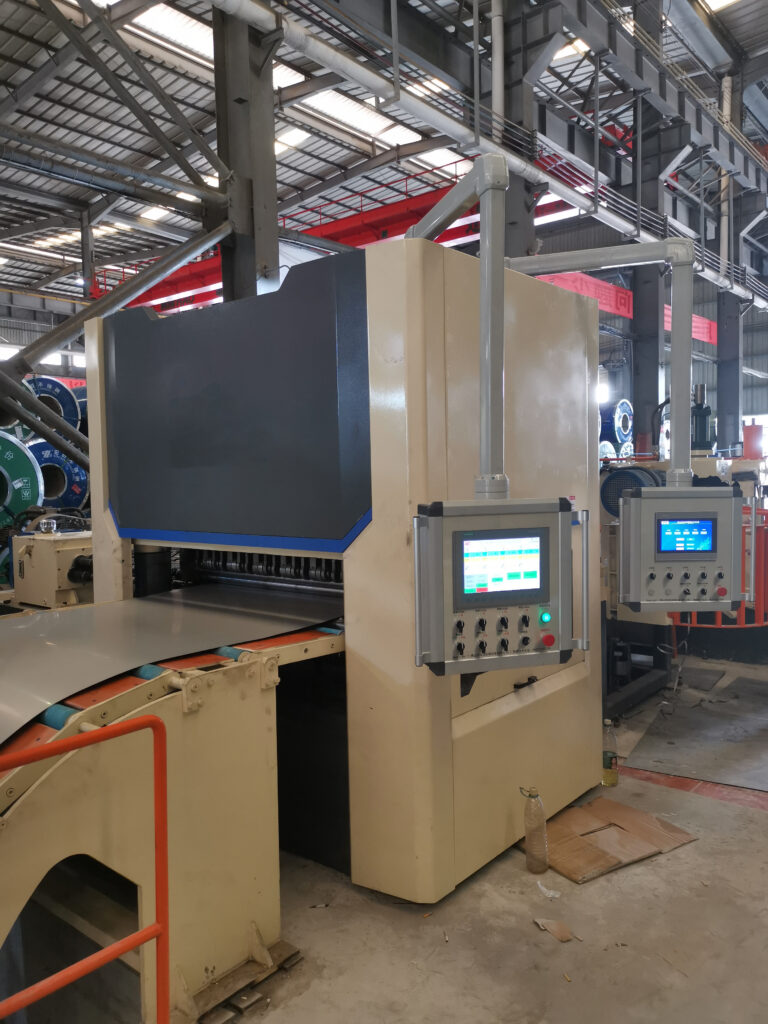
Real-time monitoring capabilities extend beyond simple tension measurement. Advanced systems track cutting force variations that indicate blade wear or material property changes, automatically adjusting tension to compensate. When processing a coil with gradually increasing hardness from outer to inner wraps—a common characteristic in cold-rolled steel—the system progressively modifies tension parameters to maintain consistent material conditioning throughout the run.
Pre-looping and post-looping configurations critically minimize strip distortion during handoffs between processing stations. A properly designed loop allows brief material accumulation between sections operating at slightly different speeds, preventing sudden tension spikes that cause permanent deformation. The loop acts as a mechanical buffer, absorbing speed variations while servo controllers synchronize station velocities to minimize loop depth variation. This prevents the “snatch and release” tension patterns that create periodic camber variations along strip length.
Material-specific tension parameters require different approaches based on metallurgical characteristics. Carbon steel typically processes at 3-8 kg/mm² tension, maintaining enough force for dimensional control without risking permanent elongation. Stainless steel’s work-hardening behavior demands reduced tension—typically 2-5 kg/mm²—to prevent building excessive stress during processing. Aluminum processing requires the lowest tension settings at 1.5-4 kg/mm² due to its lower yield strength and tendency toward permanent deformation under moderate stress. Precision servo roll feed systems enable these material-specific adjustments while maintaining consistent throughput.
Integrated Leveling-Slitting System Architecture
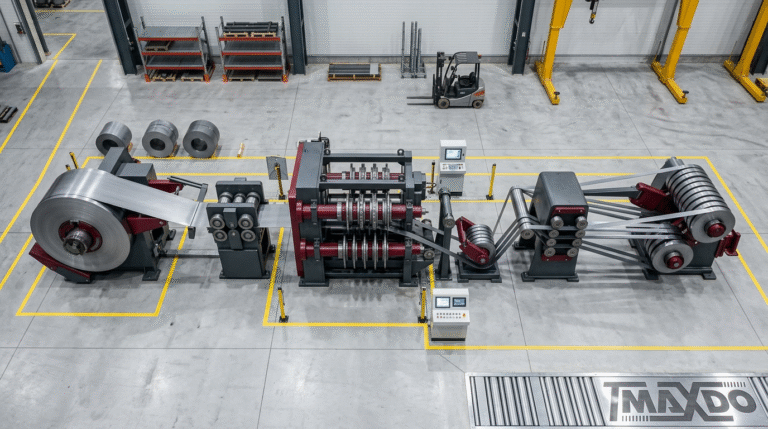
Professional coil processing systems integrate uncoiling, leveling, slitting, and recoiling functions through synchronized servo control that eliminates material handling discontinuities. The equipment sequence begins with a hydraulic mandrel expansion uncoiler capable of handling 25-ton coils, feeding material into a precision multi-roll leveler, through a servo slitter head with dynamic blade positioning, and concluding with a tension recoiler incorporating automatic strip separation.
Centralized servo control synchronizes speed matching across all stations with encoder feedback systems ensuring consistent material flow. When processing speed changes from 80 m/min to 150 m/min during acceleration, all stations receive synchronized commands that maintain constant tension and prevent loop depth variations that could induce camber. This integration proves essential when processing challenging materials where minor tension fluctuations create significant dimensional problems.
MaxDo’s MD series specifications demonstrate professional-grade capabilities across multiple production scales. The MD-850 handles materials from 300-820mm width and 0.3-12mm thickness, consuming 138.5kW total power while maintaining processing speeds up to 250 m/min. For facilities requiring expanded capacity, the MD-1350MM leveling machine processes 300-1300mm widths across four distinct thickness ranges, while the MD-1650MM extends capabilities to 1600mm working width with 422.5kW power consumption.
Key technical features distinguish professional systems from entry-level equipment. Encoder feedback systems provide positional accuracy within 0.01mm, supporting the precise blade gap control essential for consistent edge quality. Automatic gap adjustment compensates for gradual blade wear throughout extended production runs, maintaining cutting quality that might otherwise degrade after processing 50-100 tons. Real-time quality monitoring through laser-based measurement systems detects dimensional variations within ±0.01mm during production, enabling immediate process corrections before significant material loss occurs.
Power and speed considerations directly impact operational economics. The MD-850’s 138.5kW consumption represents optimized energy efficiency for light-gauge processing, while heavier systems scaling to 428.5kW support the increased cutting forces required for medium-gauge applications. Processing speed ranges from 1-250 m/min allow optimization for specific material types—stainless steel typically processes at 60-120 m/min due to higher cutting forces, while thin-gauge cold-rolled steel may run at 180-250 m/min where line speed becomes the limiting factor for throughput.
Correcting Existing Coil Saber Defects
Assessment methods determine whether correction represents an economically viable option versus material replacement. Camber magnitude measurement using precision straight edges and feeler gauges quantifies the deviation severity. For defects under 5mm per meter of length, roller leveling correction typically proves cost-effective. Deviations exceeding 10mm per meter often make material replacement more economical than attempting extensive correction that consumes production capacity and introduces secondary quality risks.
Roller leveling correction techniques employ controlled bending and unbending cycles targeting specific curvature patterns. The process works by feeding cambered material through a multi-roll leveler with asymmetric roll positioning that applies greater plastic deformation to the material’s convex side. This differential working gradually straightens the strip by inducing compensating curvature that counteracts the original camber. Success requires careful calibration—excessive correction creates reverse camber, while insufficient working leaves residual curvature.
Tension leveling addresses more severe camber through a fundamentally different mechanism. The process applies controlled tension exceeding the material’s yield strength while passing it over a series of small-diameter rolls. This combination of tension and bending permanently elongates the material, stretching out localized stress concentrations that cause camber. Tension leveling proves particularly effective for material where roller leveling alone cannot overcome severe stress distributions, though it reduces material thickness by 1-3% through plastic elongation.
Stretch leveling applications achieve the highest flatness levels for critical applications requiring maximum dimensional accuracy. The process applies pure tensile force beyond yield strength without bending components, producing uniform plastic elongation across the entire strip width and length. Aerospace and precision electronics applications frequently specify stretch-leveled material where flatness tolerances under 0.5mm per meter justify the additional processing cost. However, the thickness reduction and reduced material strength from work-hardening limit stretch leveling to applications where these trade-offs prove acceptable.
Process limitations become apparent when incoming defects exceed correction capabilities. Material with greater than 15mm deviation over coil width typically contains stress distributions too severe for mechanical correction. Attempting to force such material flat either fails to achieve acceptable results or introduces secondary problems like edge wave, center buckle, or thickness variations. In these cases, returning material to the supplier or relegating it to less-demanding applications represents the most practical solution. Understanding these limitations helps troubleshoot quality issues unique to slit products before they compromise production schedules.
Blade Setup and Cutting Parameters
Blade geometry selection fundamentally determines edge quality and the potential for induced deformation during slitting. Contemporary systems utilize circular knife configurations with optimal blade penetration ranging from 8-12% of material thickness. This penetration depth provides clean shearing action without excessive force that could induce localized stress. Shallow penetration under 5% often creates torn edges with microcracking, while excessive penetration above 15% generates high cutting forces that deflect material and cause dimensional variations.
Side clearance specifications require precision calibration to prevent edge distortion and secondary deformation. Professional practice maintains clearances at 5-8% of material thickness, balancing the need for clean separation against minimizing shear zone width. When processing 2.0mm steel, optimal clearance falls in the 0.10-0.16mm range. Insufficient clearance causes blade binding and excessive tool wear, while excessive clearance creates ragged edges with pronounced burr formation that affects downstream forming operations.
Servo-positioned blade holders maintain these precise clearances throughout extended production runs, compensating for thermal expansion, vibration, and gradual tool wear. The system continuously monitors cutting force feedback—abnormal increases indicate developing blade wear or material property changes requiring adjustment. This dynamic control prevents the gradual quality degradation common in fixed-position systems where blade-to-blade clearance slowly increases as tooling wears, eventually producing edges with excessive burr height and width variations.
Dynamic clearance adjustment automatically modifies parameters as material properties vary within individual coils. Cold-rolled steel coils frequently exhibit 5-10% hardness variation from outer to inner wraps due to differential age-hardening and work-hardening during processing. As the system detects increasing cutting force when processing harder inner wraps, it incrementally adjusts blade clearance to maintain optimal cutting geometry. This adaptability maintains consistent edge quality across entire coil lengths that might otherwise require manual mid-run adjustments in conventional systems.
Blade maintenance schedules balance tool life optimization against quality maintenance requirements. Inspection intervals typically occur every 50-100 tons processed, with detailed examination of cutting edge condition, blade mounting security, and clearance measurements. Replacement criteria consider edge quality trends rather than arbitrary time intervals—when burr height increases by 30% or width tolerance variation exceeds ±0.02mm, blade replacement prevents defect propagation that would compromise larger material quantities. Systematic maintenance records identify patterns that support predictive replacement scheduling, reducing unplanned downtime while maintaining quality consistency.
Quality Verification and Process Control
Real-time measurement systems represent the first line of defense against dimensional variations that create costly scrap. Laser-based monitoring achieves ±0.01mm accuracy during production, continuously verifying strip width, edge straightness, and thickness uniformity. The system compares measurements against programmed specifications 100 times per second, instantly flagging deviations that exceed tolerance bands. This immediate feedback enables process corrections within seconds rather than discovering problems only during post-production inspection when hundreds of meters of defective material may have already accumulated.
Statistical process control integration transforms raw measurement data into actionable quality intelligence. The system tracks camber trends, width tolerance distributions, and edge quality metrics across individual coils, production shifts, and extended timeframes. Control charts reveal gradual process drift before it produces out-of-specification material—a systematic 0.02mm increase in average width over eight hours signals developing blade wear requiring attention. This predictive approach prevents quality escapes that reactive inspection methods miss until defects become pronounced.
Incoming material inspection protocols identify coils with excessive stress or pre-existing defects before processing begins. Visual inspection reveals obvious surface problems, edge damage from handling, and dimensional irregularities suggesting processing issues at the mill. Mechanical testing through sample leveling and trial slitting exposes hidden problems—a coil that exhibits pronounced camber after trial slitting despite appearing acceptable on visual inspection indicates severe residual stress requiring specialized handling or potential rejection.
Post-slitting verification confirms that finished strips meet all dimensional and quality specifications. Flatness testing employs precision surface plates or dedicated flatness measurement systems that quantify deviation from ideal plane geometry. Camber measurement using calibrated straight edges follows ASTM A568 protocols, ensuring results correlate with customer inspection methods. Dimensional conformance checks verify width tolerance maintenance, edge quality, and thickness consistency across representative samples from each production run.
Predictive maintenance indicators monitor system parameters that signal emerging quality issues before they affect production. Hydraulic pressure variations in the uncoiler indicate developing mandrel expansion problems that could cause uneven material feeding. Cutting force trends reveal blade wear patterns, enabling scheduled replacement before edge quality deteriorates. Servo motor temperature monitoring identifies bearing problems or alignment issues that eventually cause positional errors affecting dimensional accuracy. Comprehensive facilities implement condition monitoring programs that reduce unplanned downtime by 40-60% while maintaining consistent quality through proactive intervention.
Material-Specific Processing Strategies
Carbon steel optimization focuses on standard leveling intensity while preserving coating integrity during processing. Galvanized and galvannealed coatings require blade geometry that minimizes coating damage—excessive cutting forces can disrupt zinc layers, creating bare spots that compromise corrosion resistance. Processing speeds typically range 120-180 m/min for coated carbon steel, balancing productivity against coating preservation. Temperature control proves essential—blade temperatures above 80°C from friction can alter coating adhesion properties, requiring coolant application or speed reduction during extended runs.
Stainless steel challenges stem from its work-hardening characteristics and superior strength. Cutting forces exceed carbon steel by 15-20%, necessitating more rigid blade mounting systems and enhanced vibration damping. Austenitic grades (304, 316) particularly exhibit rapid work-hardening—as the cutting edge deforms material, the affected zone strengthens significantly, accelerating tool wear. Specialized blade configurations with modified rake angles reduce work-hardening severity by 40-60%, improving tool life and edge quality. Processing speeds drop to 60-120 m/min for thick-gauge stainless, with tension parameters reduced 20-30% compared to carbon steel to prevent building excessive stress that manifests as post-slitting springback.
Aluminum processing demands fundamentally different parameters due to its tendency toward blade adhesion and galling. The material’s relatively soft structure allows microscopic welding to cutting edges at the molecular level, building up deposits that eventually cause edge damage and width variations. Specialized blade coatings—typically titanium nitride or diamond-like carbon—minimize adhesion through reduced friction and chemical compatibility. Processing tension must decrease to 1.5-4 kg/mm² to prevent permanent elongation, while leveler penetration depth reduces by 30-40% compared to steel. Blade maintenance intervals shorten significantly—inspection every 30-40 tons prevents adhesion buildup that would otherwise compromise quality.
High-strength steel (AHSS) processing for automotive applications presents unique complications from pronounced springback behavior. Material with 780 MPa tensile strength exhibits 40-60% more elastic recovery than 350 MPa grades, requiring increased roll penetration depth and extended leveling cycles to achieve comparable stress reduction. Tension control becomes even more critical—variations that produce negligible effects in mild steel create visible camber in AHSS. Modern CTL and slitting line configurations for advanced automotive materials incorporate specialized features addressing these challenges, including adaptive tension control that adjusts parameters based on real-time springback measurement.
ROI and Performance Benchmarks
Material yield improvements from integrated leveling-slitting systems directly enhance profitability through reduced waste. Facilities upgrading from conventional equipment typically see edge trim reduction from 4.2% to 1.8% of coil width by maintaining tighter dimensional control. This 2.4 percentage point improvement translates to 24mm of additional usable material from each meter of 1000mm coil width—60 additional linear meters from a typical 2500-meter coil. Camber-related rejection drops from 8% to under 2% through precision tension control, recovering 6% of production volume previously lost to dimensional defects.
Case study results from a major automotive supplier quantify these improvements with actual financial impact. The facility processed 15,000 tons annually of galvanized steel for structural components using conventional slitting equipment delivering 82% material utilization. Implementation of servo-controlled MD series slitting technology improved yield to 94%—a 12 percentage point gain representing 1,800 additional tons of usable material annually. At $850 per ton material cost, this generated $1.53 million annual savings. Combined with reduced setup time, improved order fulfillment rates, and decreased quality claims, total benefit reached $1.6 million against equipment investment of $2.4 million, delivering 18-month payback.
Quality metrics from MaxDo’s MD series installations across 500+ facilities demonstrate consistent performance across diverse applications. The systems routinely deliver 96%+ material yield with ±0.1mm width accuracy, even when processing challenging materials like AHSS and stainless steel. Edge quality consistently maintains burr height under 0.05mm and burr width under 0.15mm—specifications meeting automotive Tier 1 supplier requirements without secondary deburring operations. Processing speed capabilities from 1-250 m/min support throughput optimization, with most facilities operating at 60-75% of maximum speed to balance productivity against tool life and quality consistency.
Operational efficiency gains extend beyond direct material savings. Servo-driven blade positioning reduces setup times by 40-50% compared to manual adjustment systems—changeovers completing in 12-15 minutes versus 25-30 minutes for conventional equipment. This improved flexibility enables economical processing of smaller lot sizes, supporting just-in-time manufacturing strategies. Minimized downtime through predictive maintenance improves overall equipment effectiveness (OEE) from typical 65-70% levels to 80-85%, effectively increasing facility capacity 15-20% without capital expansion.
Long-term sustainability benefits create value beyond immediate financial returns. Precision control systems extend equipment life by preventing the wear patterns that plague less sophisticated machinery—proper blade clearance maintenance eliminates side-load conditions causing premature bearing failure. Reduced material handling through integrated processing minimizes edge damage from multiple coil unwind-rewind cycles. Energy efficiency from servo drive technology cuts power consumption 15-25% compared to hydraulic systems, reducing operating costs while supporting corporate sustainability initiatives. For comprehensive information on maximizing these benefits, explore resources on how slitting lines maximize material yield.
Conclusion
Eliminating material deformation after slitting requires understanding that camber prevention begins long before the cutting operation. Leveling before slitting addresses residual coil stresses while material maintains its full structural rigidity, reducing stress variations by 85-90% and creating the stable foundation for precision cutting. Multi-roll leveler configurations with proper diameter, spacing, and penetration parameters systematically work-harden and stress-relieve material, preventing the asymmetric stress release that manifests as visible curvature when coils are separated into narrow strips.
Integrated tension control completes the system by maintaining dimensional stability throughout processing. Servo-driven systems responding in milliseconds prevent the differential elongation patterns that create edge camber, maintaining ±0.1mm tolerance from uncoiler through recoiler. Material-specific parameters accommodate the diverse metallurgical characteristics of carbon steel, stainless steel, aluminum, and AHSS, ensuring each alloy receives appropriate treatment for optimal quality.
The performance data speaks clearly—facilities implementing comprehensive leveling and tension control achieve 96%+ material yield with under 2% camber rejection, compared to 80-85% yield with 8-15% defect rates from inadequate processing. For production managers frustrated with C-channel forming inconsistencies from supplier-processed coils showing 10-12mm centerline deviation, the solution lies in either demanding proper pre-slitting leveling or bringing processing in-house with properly configured equipment.
MaxDo’s 20+ years of R&D experience with 500+ installations across 30+ countries demonstrates proven expertise in precision metal coil processing. The MD series platforms deliver the integrated leveling-slitting capabilities that transform problematic supplier material into consistent, high-quality strips supporting demanding downstream operations. Contact MaxDo’s engineering team to discuss your specific processing challenges and explore equipment configurations optimized for your material types, production volumes, and quality requirements.
FAQ
What causes longitudinal bending (camber) in slit metal strips?
Longitudinal camber results from residual stress patterns created during the original rolling and coiling operations. Hot rolling induces uneven cooling rates across the coil width, creating differential thermal contraction. The coiling process adds bending stresses that remain “locked” in the material structure. When slitting cuts wide coils into narrow strips, these internal stresses no longer balance each other—each strip releases tension asymmetrically, seeking its natural stress-relief geometry that appears as visible curvature. Material lacking proper leveling before slitting retains these stress patterns, allowing them to manifest as the 10-12mm centerline deviations that compromise downstream forming operations.
Can you correct material camber after slitting has already occurred?
Post-slitting correction faces significant limitations compared to preventive measures. Roller leveling can address moderate camber under 5mm per meter through controlled bending cycles that apply differential plastic deformation. Tension leveling handles more severe cases by stretching material beyond yield strength while passing over small-diameter rolls. However, coil saber correction after cutting proves less effective than pre-slitting treatment because narrow strips lack the structural rigidity of full-width material. Defects exceeding 10-15mm per meter often make material replacement more economical than attempting extensive correction that consumes production capacity without guaranteed results. Prevention through proper leveling and tension control before slitting represents the most reliable and cost-effective approach.
What leveling machine specifications are needed to prevent slitting defects?
Professional multi-roll leveling systems require 5-21 working rolls depending on material thickness and yield strength characteristics. Thin-gauge applications (under 1.5mm) typically need 13-17 rolls with smaller diameters to achieve adequate plastic deformation, while thick-gauge processing (6-12mm) may utilize 7-9 larger-diameter rolls. Roll spacing and gap adjustment prove equally critical—the clearance between upper and lower rows must be set 0.1-0.3mm smaller than material thickness to ensure proper stress relief. Servo control enables automatic gap adjustment compensating for material thickness variations, while integration with tension control systems maintains dimensional stability throughout processing. The MD-1350MM leveling machine exemplifies professional specifications for mid-range applications, delivering the calibrated stress reduction essential for slitting quality control.
How does tension control prevent edge camber in slit strips?
Multi-zone tension management independently controls force across uncoiler, leveler, slitter, and recoiler sections, preventing differential elongation that creates edge camber. Servo-driven systems with encoder feedback respond in milliseconds to material property variations, maintaining ±0.1mm tolerance throughout processing. When the system detects a thickness change or hardness variation, it instantly adjusts tension parameters to ensure uniform material conditioning across the strip width. Pre-looping and post-looping configurations absorb speed variations between stations, preventing tension spikes that cause permanent deformation. Material-specific parameters accommodate different alloys—carbon steel processes at 3-8 kg/mm², stainless steel at 2-5 kg/mm², and aluminum at 1.5-4 kg/mm²—ensuring each material receives appropriate treatment. This precision prevents metal strip curvature after slitting by maintaining dimensional stability from entry to exit.
What dimensional accuracy should I expect from a properly configured slitting line?
Industry-leading slitting lines consistently maintain ±0.1mm width tolerance with camber under 2mm per meter of length. Edge quality specifications include burr height under 0.05mm and burr width under 0.15mm—meeting automotive Tier 1 supplier requirements without secondary operations. MaxDo’s MD series equipment achieves 96%+ material yield with these precision levels across 500+ installations processing diverse materials from 0.3-12mm thickness. Real-time laser measurement systems verify dimensions with ±0.01mm accuracy during production, enabling immediate corrections that maintain specifications throughout extended runs. These performance benchmarks represent the capabilities of properly integrated leveling-slitting systems with servo-driven tension control—significantly superior to conventional equipment delivering 80-85% yield with looser dimensional tolerances that create downstream processing complications.