

Automated Metal Production Line Manufacturer Evaluation Matrix
A narrow manufacturer evaluation matrix for comparing automated metal production line suppliers by integration scope, automation depth, material evidence, FAT/SAT, service, and product routing.
Automated metal production line manufacturers should be compared by integration responsibility, not by brand familiarity alone. A complete line supplier must connect material handling, processing equipment, control logic, inspection, safety, commissioning, operator training, and service support into one stable production system.
This page is a narrow manufacturer scorecard in the MaxDo automated metal processing topic network. It owns only the supplier-evaluation question: whether an automated metal production line manufacturer can own integration scope, automation depth, material evidence, FAT/SAT, commissioning, service, and product routing. It is not the main automation system map, not an Industry 4.0 architecture page, and not an automation execution plan.
For the main automation system route, use the automated metal processing main system map. For data architecture, use the Industry 4.0 architecture support page. For execution sequence, use the automation execution support page. For narrower supplier comparisons, use the export supplier delivery checklist, coil processing equipment supplier shortlist, or CTL supplier acceptance matrix.
Define the Production Line Boundary First
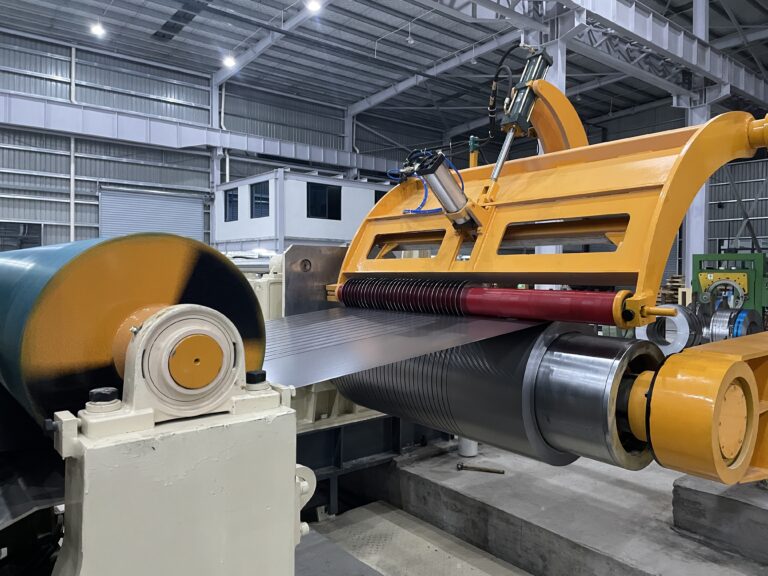
The first supplier question is scope. Does the manufacturer provide only one machine, or can it deliver the full line boundary: uncoiler, leveling, slitting or CTL, scrap handling, stacking or recoiling, electrical control, guarding, HMI, inspection interface, installation, and commissioning? For workflow mapping before supplier selection, start with the sheet metal coil processing workflow map.
Score Manufacturers by Process Fit
A strong automated-line manufacturer should match the required output state. Slitting projects need strip-width accuracy, burr control, strip separation, recoiling stability, and repeatable tension control. CTL projects need leveling, length accuracy, flatness, sheet transfer, stacking, and bundle handling. For process-path planning, compare the slitting vs blanking decision map and the slitting vs CTL order-mix guide.
| Evaluation area | What to verify | Why it matters |
|---|---|---|
| Process scope | Slitting, CTL, blanking, feeding, stacking, recoiling, or hybrid workflow | Prevents buying a machine that cannot own the full production problem. |
| Automation depth | Recipe control, servo control, HMI, inspection signals, data capture | Determines repeatability and operator dependence. |
| Material range | Grade, thickness, width, coating, surface risk, coil weight | Prevents mismatch between catalog capacity and real coil behavior. |
| Commissioning proof | FAT, SAT, acceptance samples, spare parts, training plan | Turns a purchase order into a working production line. |
Separate Control Vendors From Line OEMs
PLC, drive, robot, and sensor brands are important, but they are not the same as a production line manufacturer. The line OEM is responsible for mechanical design, process logic, integration, safety, site commissioning, and acceptance output. If automation architecture is the main issue, use the Industry 4.0 metal processing architecture guide and the metal production line automation execution plan.
Ask for Material and Acceptance Evidence
Manufacturer comparison should be tied to real coil data. Ask each supplier to respond to material grade, thickness range, width range, coil weight, surface sensitivity, strip or sheet tolerance, inspection method, and output package. For material intake, use the MD series material compatibility checklist. For quality acceptance, use the slit vs blanked product acceptance guide.
Use a 10-Point Shortlist Scorecard
- Can the manufacturer own the complete line boundary, not only one machine?
- Does the proposed process match the required output state: strip coil, flat sheet, blank, or mixed workflow?
- Does the supplier request real material data before recommending capacity?
- Are automation functions tied to repeatability, inspection, safety, and operator workflow?
- Can the supplier document acceptance criteria before shipment?
- Is commissioning split into FAT, shipment, installation, SAT, training, and spare parts?
- Does the layout fit site space, crane access, coil logistics, and downstream movement?
- Can the line be serviced in the buyer’s region?
- Does the supplier explain ROI through yield, changeover, labor, and defect reduction rather than vague speed claims?
- Does the final proposal include risks, assumptions, exclusions, and required buyer-side preparation?
Route the Shortlist to the Right Supplier Page
If the decision is mainly about export readiness, compare the export-oriented equipment manufacturer checklist. If the decision is coil-processing specific, compare the coil processing equipment supplier shortlist. If the project is CTL-specific, compare the cut-to-length line supplier evaluation page.
For MaxDo equipment paths, start with the metal slitting machine category or the metal cut-to-length line category. Common RFQ anchors include the MA-1350 slitting machine and the CT-1350 cut-to-length line. To request a manufacturer evaluation discussion, send the line boundary, material data, output state, automation target, and acceptance requirements through the contact form.